







Question: DQ 2 Post: Big Data - Potential Big Revenue for GM? 1st Step: Read the case Big Data - Potential Big Revenue for GM? available
DQ 2 Post: Big Data - Potential Big Revenue for GM?
1st Step: Read the case "Big Data - Potential Big Revenue for GM?" available in your textbook at the end of chapter 5, p. 141.
2nd Step: Answer the following question
Gas and food are obvious choices for the GM Marketplace. What are other types of retailers or brands that could be logically added to the service? What data that cars collect now or could collect would be helpful in targeting customers for a real time offer?
your answer should be about 100 to 200 words
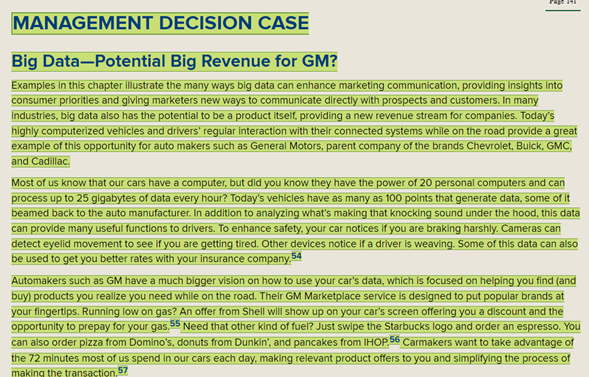
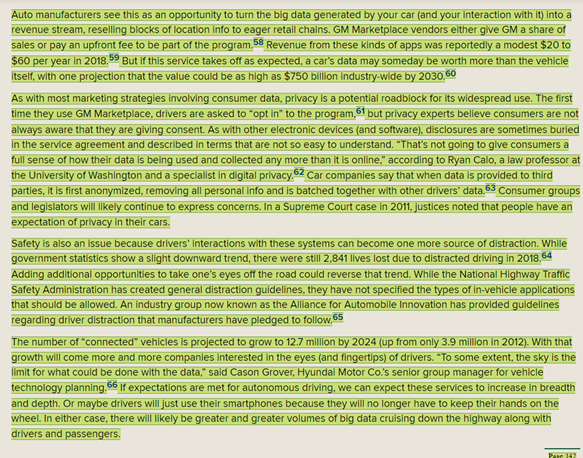
Big Data-Potential Big Revenue for GM? Examples in this chapter illustrate the many ways big data can enhance marketing communication, providing insights into consumer priorities and glving marketers new ways to communicate directly with prospects and customers. In many industries, big data also has the potential to be a product itself, providing a new revenue stream for companies. Today's highly computerized vehicles and drivers' regular interaction with their connected systems while on the road provide a great example of this opportunity for auto makers such as General Motors, parent company of the brands Chevrolet, Buick, GMC, and Cadillac. Most of us know that our cars have a computer, but did you know they have the power of 20 personal computers and can process up to 25 gigabytes of data every hour? Today's vehicles have as many as 100 points that generate data, some of it beamed back to the auto manufacturer. In addition to analyzing what's making that knocking sound under the hood, this data can provide many useful functions to drivers. To enhance safety. your car notices if you are braking harshly. Cameras can detect eyelid movement to see if you are getting tired. Other devices notice if a driver is weaving. Some of this data can also be used to get you better rates with your insurance company. 54 Automakers such as GM have a much bigger vision on how to use your car's data, which is focused on helping you find (and buy) products you realize you need while on the road. Their GM Marketplace service is designed to put popular brands at your fingertips. Running low on gas? An offer from Shell will show up on your car's screen offering you a discount and the opportunity to prepay for your gas. 55 Need that other kind of fuel? Just swipe the Starbucks logo and order an espresso. You can also order pizza from Domino's, donuts from Dunkin', and pancakes from IHOP. 56 Carmakers want to take advantage of the 72 minutes most of us spend in our cars each day, making relevant product offers to you and simplifying the process of making the transaction, 57 Auto manufacturers see this as an opportunity to turn the big data generated by your car (and your interaction with it) into a revenue stream, reselling blocks of location info to eager retail chains. GM Marketplace vendors either give GM a share of sales or pay an upfront fee to be part of the program. 58 Revenue from these kinds of apps was reportedly a modest $20 to $60 per year in 2018..59 But if this service takes off as expected, a car's data may someday be worth more than the vehicle itself, with one projection that the value could be as high as $750 billion industry-wide by 2030.60 As with most marketing strategies involving consumer data, privacy is a potential roadblock for its widespread use. The first time they use GM Marketplace, drivers are asked to "opt in" to the program, 61 but privacy experts believe consumers are not always aware that they are giving consent. As with other electronic devices (and software), disclosures are sometimes buried in the service agreement and described in terms that are not so easy to understand. "That's not going to give consumers a full sense of how their data is being used and collected any more than it is online," according to Ryan Calo, a law professor at the University of Washington and a specialist in digital privacy. 62 Car companies say that when data is provided to third parties, it is first anonymized, removing all personal info and is batched together with other drivers' data. 63 Consumer groups and legislators will likely continue to express concerns. In a Supreme Court case in 2011, justices noted that people have an expectation of privacy in their cars. Safety is also an issue because drivers' interactions with these systems can become one more source of distraction. While government statistics show a slight downward trend, there were still 2,841 lives lost due to distracted driving in 2018.64 Adding additional opportunities to take one's eyes off the road could reverse that trend. While the National Highway Traffic Safety Administration has created general distraction guidelines, they have not specified the types of in-vehicle applications that should be allowed. An industry group now known as the Alliance for Automobile Innovation has provided guidelines regarding driver distraction that manufacturers have pledged to follow. 65 The number of "connected" vehicles is projected to grow to 12.7 million by 2024 (up from only 3.9 million in 2012). With that growth will come more and more companies interested in the eyes (and fingertips) of drivers. "To some extent, the sky is the limit for what could be done with the data," said Cason Grover, Hyundal Motor Co.'s senior group manager for vehicle technology planning. 66 If expectations are met for autonomous driving, we can expect these services to increase in breadth and depth. Or maybe drivers will just use their smartphones because they will no longer have to keep their hands on the wheel. In either case, there will likely be greater and greater volumes of big data cruising down the highway along with drivers and passengers
Step by Step Solution
There are 3 Steps involved in it

Get step-by-step solutions from verified subject matter experts
 Study Help