





Question: Dr. Aliyah Washington needs guidance on evaluating an algorithm which categorizes individuals as Obese or Not Obese. Obesity is generally determined by BMI. Body mass
Dr. Aliyah Washington needs guidance on
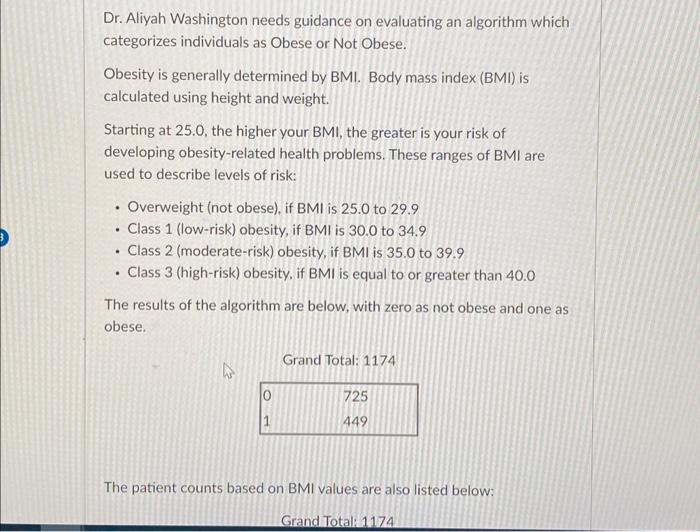
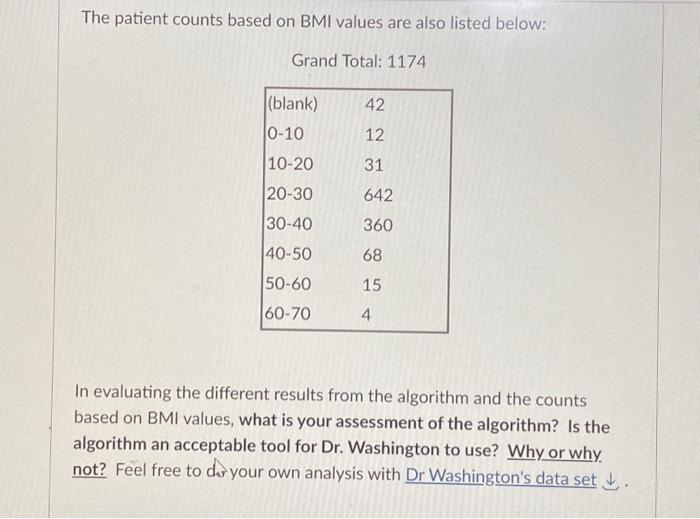
Dr. Aliyah Washington needs guidance on evaluating an algorithm which categorizes individuals as Obese or Not Obese. Obesity is generally determined by BMI. Body mass index (BMI) is calculated using height and weight. Starting at 25.0, the higher your BMI, the greater is your risk of developing obesity-related health problems. These ranges of BMI are used to describe levels of risk: - Overweight (not obese), if BMI is 25.0 to 29.9 - Class 1 (low-risk) obesity, if BMI is 30.0 to 34.9 - Class 2 (moderate-risk) obesity, if BMI is 35.0 to 39.9 - Class 3 (high-risk) obesity, if BMI is equal to or greater than 40.0 The results of the algorithm are below, with zero as not obese and one as obese. Grand Total: 1174 The patient counts based on BMI values are also listed below: The patient counts based on BMI values are also listed below: Grand Total: 1174 In evaluating the different results from the algorithm and the counts based on BMI values, what is your assessment of the algorithm? Is the algorithm an acceptable tool for Dr. Washington to use? Why or why. not? Feel free to dor your own analysis with Dr Washington's data set . Dr. Aliyah Washington needs guidance on evaluating an algorithm which categorizes individuals as Obese or Not Obese. Obesity is generally determined by BMI. Body mass index (BMI) is calculated using height and weight. Starting at 25.0, the higher your BMI, the greater is your risk of developing obesity-related health problems. These ranges of BMI are used to describe levels of risk: - Overweight (not obese), if BMI is 25.0 to 29.9 - Class 1 (low-risk) obesity, if BMI is 30.0 to 34.9 - Class 2 (moderate-risk) obesity, if BMI is 35.0 to 39.9 - Class 3 (high-risk) obesity, if BMI is equal to or greater than 40.0 The results of the algorithm are below, with zero as not obese and one as obese. Grand Total: 1174 The patient counts based on BMI values are also listed below: The patient counts based on BMI values are also listed below: Grand Total: 1174 In evaluating the different results from the algorithm and the counts based on BMI values, what is your assessment of the algorithm? Is the algorithm an acceptable tool for Dr. Washington to use? Why or why. not? Feel free to dor your own analysis with Dr Washington's data set

Step by Step Solution

There are 3 Steps involved in it

1 Expert Approved Answer
Step: 1 Unlock blur-text-image

Question Has Been Solved by an Expert!

Get step-by-step solutions from verified subject matter experts

Step: 2 Unlock
Step: 3 Unlock

Students Have Also Explored These Related General Management Questions!