







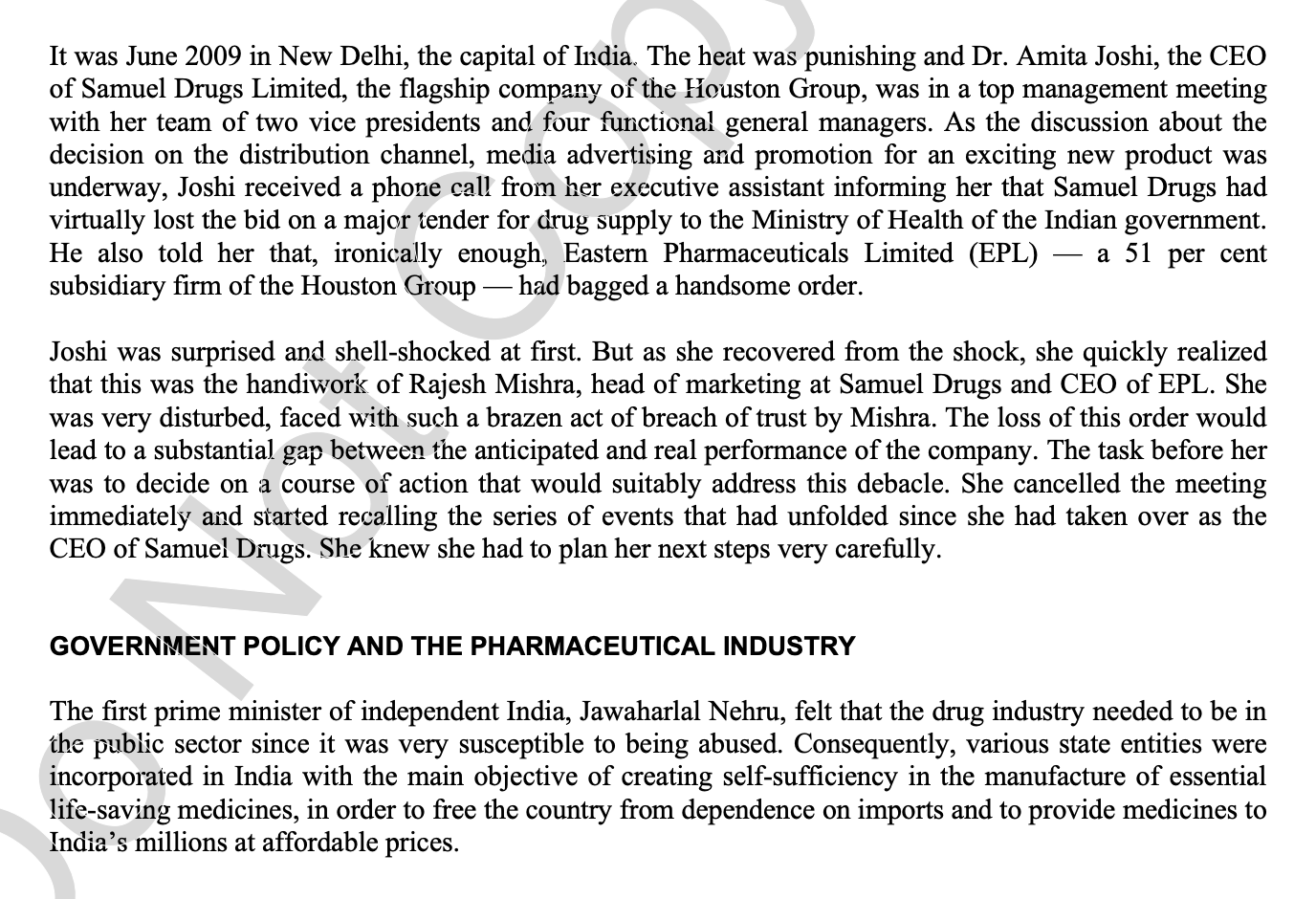
Question: dr amit shahi case It was June 2 0 0 9 in New Delhi, the capital of India. The heat was punishing and Dr .
dr amit shahi case It was June in New Delhi, the capital of India. The heat was punishing and Dr Amita Joshi, the CEO
of Samuel Drugs Limited, the flagship company of the Houston Group, was in a top management meeting
with her team of two vice presidents and four functional general managers. As the discussion about the
decision on the distribution channel, media advertising and promotion for an exciting new product was
underway, Joshi received a phone call from her executive assistant informing her that Samuel Drugs had
virtually lost the bid on a major tender for drug supply to the Ministry of Health of the Indian government.
He also told her that, ironically enough, Eastern Pharmaceuticals Limited EPL a per cent
subsidiary firm of the Houston Group had bagged a handsome order.
Joshi was surprised and shellshocked at first. But as she recovered from the shock, she quickly realized
that this was the handiwork of Rajesh Mishra, head of marketing at Samuel Drugs and CEO of EPL. She
was very disturbed, faced with such a brazen act of breach of trust by Mishra. The loss of this order would
lead to a substantial gap between the anticipated and real performance of the company. The task before her
was to decide on a course of action that would suitably address this debacle. She cancelled the meeting
immediately and started recalling the series of events that had unfolded since she had taken over as the
CEO of Samuel Drugs. She knew she had to plan her next steps very carefully.
GOVERNMENT POLICY AND THE PHARMACEUTICAL INDUSTRY
The first prime minister of independent India, Jawaharlal Nehru, felt that the drug industry needed to be in
the public sector since it was very susceptible to being abused. Consequently, various state entities were
incorporated in India with the main objective of creating selfsufficiency in the manufacture of essential
lifesaving medicines, in order to free the country from dependence on imports and to provide medicines to
India's millions at affordable prices. SAMUEL DRUGS: A HISTORY
Samuel Drugs was founded by Samuel Houston, an exemployee of a large stateowned drug
manufacturing organization. Houston was a youthful man when he joined the stateowned corporation in
and he climbed the career ladder very fast. He had an amazing grasp of the manufacturing process of
drugs and he introduced various innovative practices. A former colleague who was now a competitor once
mentioned in an award ceremony, "Samuel is a visionary leader. He has the potential to rise very fast in the
organization. One shouldn't be surprised to find him at the helm of the industry soon. He has some brilliant
ideas that the drug industry and the entire nation can benefit from."
In when private entrepreneurship in the drug industry was introduced, the government of Gujarat a
state in western India also decided to sell some of the nonfunctional units of state drug corporations.
More than half a dozen nonfunctional manufacturing facilities near the state capital, Ahmedabad, were put
up for auction. Houston had recently come into a large sum of money from the sale of some ancestral
property and he was evaluating the investment options for it The auction notice struck him as a golden
opportunity. He discovered that the outdated machinery would also come with the manufacturing facilities
and he was confident of his capacity to turn the units around. He discussed the matter with his likeminded
colleagues and friends, who were apprehensive at first but soon recognized the potential in the investment.
Houston convinced them to invest in a new organization, which he was going to found and lead.
Samuel Drugs Ltd started its operations on August Samuel Houston, who owned per cent of
the equity, assumed the position of chief executive officer, and many of his previous colleagues and
subordinates joined him in the new venture. He created an organizational culture that facilitated
professional autonomy. The division of responsibility was based on the competencies of people, and the
personalities of executives were matched with appropriate job content. However, the company's legacy as
a bureaucratic government organization also impacted the organizational culture. There was a high degree
of formalization and the decisionmaking process was unduly long.
Under the leadership of its founder and CEO, Samuel Drugs grew to be the biggest player amongst the
MSMEs in The company played a major role in strategic national health programs, such as Family
Welfare and Population Control providing MalaD & MalaN in the fight against malaria providing
chloroquine and in the prevention of dehydration providing oral rehydration salts
Step by Step Solution
There are 3 Steps involved in it
1 Expert Approved Answer
Step: 1 Unlock

Question Has Been Solved by an Expert!
Get step-by-step solutions from verified subject matter experts
Step: 2 Unlock
Step: 3 Unlock
 Study Help