







Question: Dr. Chebat is mostly explaining about intangible environmental factors, such as ambient scents, music, colors and effect of all these factors on shoppers. Referring to
Dr. Chebat is mostly explaining about intangible environmental factors, such as ambient scents, music, colors and effect of all these factors on shoppers. Referring to that study, answer the following 2 questions
a) What is store image? (Do not use direct quotations, paraphrase them). How do you think store image affect consumers, as they shop?(Hint: Appealing to utilitarian or hedonic needs)
b) Do you think stores have personalities just like we do? Explain. Do you think consumers would look for a match between their personalities and store personalities?
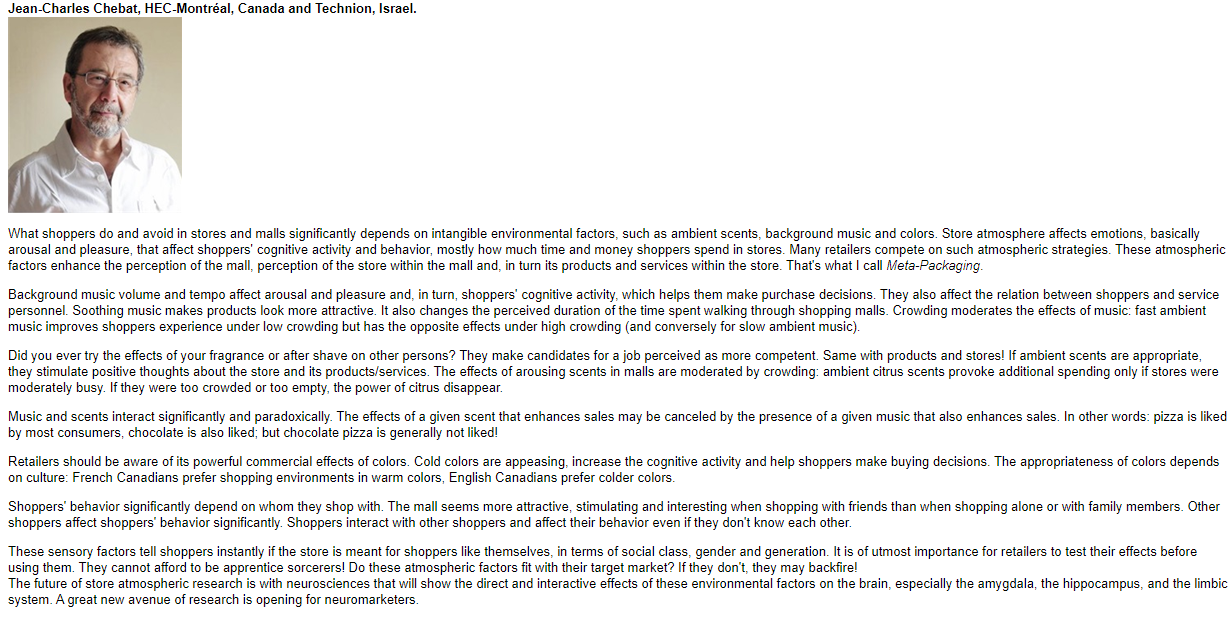
If you can't read the picture, you can find it below:
Jean-Charles Chebat, HEC-Montral, Canada and Technion, Israel.
What shoppers do and avoid in stores and malls significantly depends on intangible environmental factors, such as ambient scents, background music and colors. Store atmosphere affects emotions, basically arousal and pleasure, that affect shoppers' cognitive activity and behavior, mostly how much time and money shoppers spend in stores. Many retailers compete on such atmospheric strategies. These atmospheric factors enhance the perception of the mall, perception of the store within the mall and, in turn its products and services within the store. That's what I call Meta-Packaging.
Background music volume and tempo affect arousal and pleasure and, in turn, shoppers' cognitive activity, which helps them make purchase decisions. They also affect the relation between shoppers and service personnel. Soothing music makes products look more attractive. It also changes the perceived duration of the time spent walking through shopping malls. Crowding moderates the effects of music: fast ambient music improves shoppers experience under low crowding but has the opposite effects under high crowding (and conversely for slow ambient music).
Did you ever try the effects of your fragrance or after shave on other persons? They make candidates for a job perceived as more competent. Same with products and stores! If ambient scents are appropriate, they stimulate positive thoughts about the store and its products/services. The effects of arousing scents in malls are moderated by crowding: ambient citrus scents provoke additional spending only if stores were moderately busy. If they were too crowded or too empty, the power of citrus disappear.
Music and scents interact significantly and paradoxically. The effects of a given scent that enhances sales may be canceled by the presence of a given music that also enhances sales. In other words: pizza is liked by most consumers, chocolate is also liked; but chocolate pizza is generally not liked!
Retailers should be aware of its powerful commercial effects of colors. Cold colors are appeasing, increase the cognitive activity and help shoppers make buying decisions. The appropriateness of colors depends on culture: French Canadians prefer shopping environments in warm colors, English Canadians prefer colder colors.
Shoppers' behavior significantly depend on whom they shop with. The mall seems more attractive, stimulating and interesting when shopping with friends than when shopping alone or with family members. Other shoppers affect shoppers' behavior significantly. Shoppers interact with other shoppers and affect their behavior even if they don't know each other.
These sensory factors tell shoppers instantly if the store is meant for shoppers like themselves, in terms of social class, gender and generation. It is of utmost importance for retailers to test their effects before using them. They cannot afford to be apprentice sorcerers! Do these atmospheric factors fit with their target market? If they don't, they may backfire!
The future of store atmospheric research is with neurosciences that will show the direct and interactive effects of these environmental factors on the brain, especially the amygdala, the hippocampus, and the limbic system. A great new avenue of research is opening for neuromarketers.
Jean-Charles Chebat, HEC-Montral, Canada and Technion, Israel. What shoppers do and avoid in stores and malls significantly depends on intangible environmental factors, such as ambient scents, background music and colors. Store atmosphere affects emotions, basically arousal and pleasure, that affect shoppers' cognitive activity and behavior, mostly how much time and money shoppers spend in stores. Many retailers compete on such atmospheric strategies. These atmospheric factors enhance the perception of the mall, perception of the store within the mall and, in turn its products and services within the store. That's what I call Meta-Packaging. Background music volume and tempo affect arousal and pleasure and, in turn, shoppers' cognitive activity, which helps them make purchase decisions. They also affect the relation between shoppers and service personnel. Soothing music makes products look more attractive. It also changes the perceived duration of the time spent walking through shopping malls. Crowding moderates the effects of music: fast ambient music improves shoppers experience under low crowding but has the opposite effects under high crowding and conversely for slow ambient music). Did you ever try the effects of your fragrance or after shave on other persons? They make candidates for a job perceived as more competent. Same with products and stores! If ambient scents are appropriate, they stimulate positive thoughts about the store and its products/services. The effects of arousing scents in malls are moderated by crowding: ambient citrus scents provoke additional spending only if stores were moderately busy. If they were too crowded or too empty, the power of citrus disappear. Music and scents interact significantly and paradoxically. The effects of a given scent that enhances sales may be canceled by the presence of a given music that also enhances sales. In other words: pizza is liked by most consumers, chocolate is also liked, but chocolate pizza is generally not liked! Retailers should be aware of its powerful commercial effects of colors. Cold colors are appeasing, increase the cognitive activity and help shoppers make buying decisions. The appropriateness of colors depends on culture: French Canadians prefer shopping environments in warm colors, English Canadians prefer colder colors. Shoppers' behavior significantly depend on whom they shop with. The mall seems more attractive, stimulating and interesting when shopping with friends than when shopping alone or with family members. Other shoppers affect shoppers' behavior significantly. Shoppers interact with other shoppers and affect their behavior even if they don't know each other. These sensory factors tell shoppers instantly if the store is meant for shoppers like themselves in terms of social class, gender and generation. It is of utmost importance for retailers to test their effects before using them. They cannot afford to be apprentice sorcerers! Do these atmospheric factors fit with their target market? If they don't, they may backfire! The future of store atmospheric research is with neurosciences that will show the direct and interactive effects of these environmental factors on the brain, especially the amygdala, the hippocampus, and the limbic system. A great new avenue of research is opening for neuromarketers
Step by Step Solution
There are 3 Steps involved in it

Get step-by-step solutions from verified subject matter experts
 Study Help