







Question: Dr. Smith conducted a statistical test on the data from his research to examine his hypothesis that men and women have different scores on an
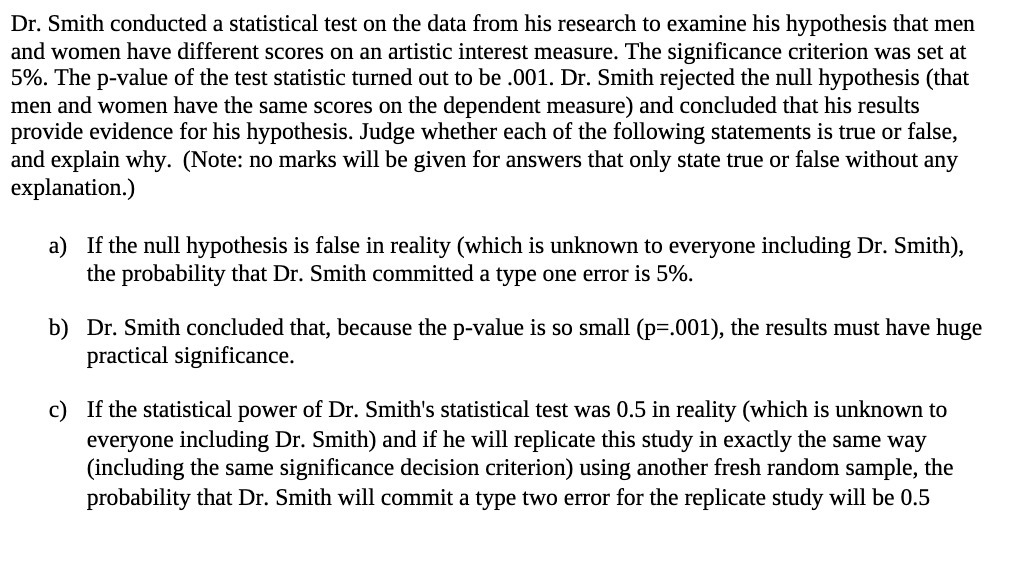
Dr. Smith conducted a statistical test on the data from his research to examine his hypothesis that men and women have different scores on an artistic interest measure. The significance criterion was set at 5%. The p-value of the test statistic turned out to be .001. Dr. Smith rejected the null hypothesis (that men and women have the same scores on the dependent measure) and concluded that his results provide evidence for his hypothesis. Judge whether each of the following statements is true or false, and explain why. (Note: no marks will be given for answers that only state true or false without any explanation.) a) If the null hypothesis is false in reality (which is unknown to everyone including Dr. Smith), the probability that Dr. Smith committed a type one error is 5%. b) Dr. Smith concluded that, because the p-value is so small (p:.001), the results must have huge practical significance. c) If the statistical power of Dr. Smith's statistical test was 0.5 in reality (which is unknown to everyone including Dr. Smith) and if he will replicate this study in exactly the same way (including the same significance decision criterion) using another fresh random sample, the probability that Dr. Smith will commit a type two error for the replicate study will be 0.5
Step by Step Solution
There are 3 Steps involved in it

Get step-by-step solutions from verified subject matter experts
 Study Help