







Question: Draft a case brief....professional to maintain The key to understanding these obligations and their applicability is the definition of knowing. Where is the line to
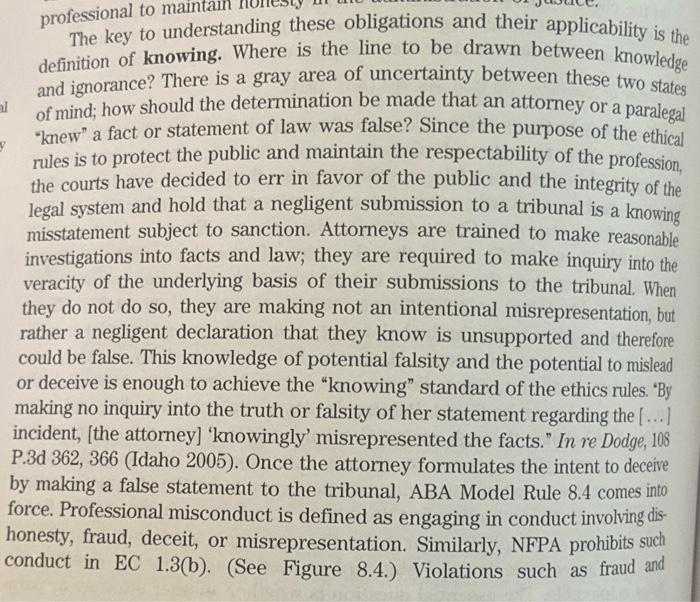
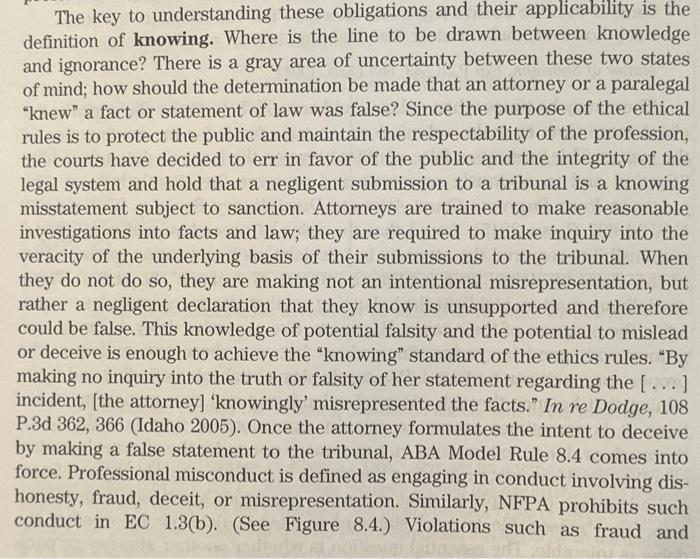
The key to understanding these obligations and their applicability is the definition of knowing. Where is the line to be drawn between knowledge and ignorance? There is a gray area of uncertainty between these two states of mind; how should the determination be made that an attorney or a paralegal "knew" a fact or statement of law was false? Since the purpose of the ethical rules is to protect the public and maintain the respectability of the profession, the courts have decided to err in favor of the public and the integrity of the legal system and hold that a negligent submission to a tribunal is a knowing misstatement subject to sanction. Attorneys are trained to make reasonable investigations into facts and law; they are required to make inquiry into the veracity of the underlying basis of their submissions to the tribunal. When they do not do so, they are making not an intentional misrepresentation, but rather a negligent declaration that they know is unsupported and therefore could be false. This knowledge of potential falsity and the potential to mislead or deceive is enough to achieve the "knowing" standard of the ethics rules. "By making no inquiry into the truth or falsity of her statement regarding the [] incident, [the attorney] 'knowingly' misrepresented the facts." In re Dodge, 108 P.3d 362, 366 (Idaho 2005). Once the attorney formulates the intent to deceive by making a false statement to the tribunal, ABA Model Rule 8.4 comes into force. Professional misconduct is defined as engaging in conduct involving dishonesty, fraud, deceit, or misrepresentation. Similarly, NFPA prohibits such conduct in EC 1.3(b). (See Figure 8.4.) Violations such as fraud and The key to understanding these obligations and their applicability is the definition of knowing. Where is the line to be drawn between knowledge and ignorance? There is a gray area of uncertainty between these two states of mind; how should the determination be made that an attorney or a paralegal "knew" a fact or statement of law was false? Since the purpose of the ethical rules is to protect the public and maintain the respectability of the profession, the courts have decided to err in favor of the public and the integrity of the legal system and hold that a negligent submission to a tribunal is a knowing misstatement subject to sanction. Attorneys are trained to make reasonable investigations into facts and law; they are required to make inquiry into the veracity of the underlying basis of their submissions to the tribunal. When they do not do so, they are making not an intentional misrepresentation, but rather a negligent declaration that they know is unsupported and therefore could be false. This knowledge of potential falsity and the potential to mislead or deceive is enough to achieve the "knowing" standard of the ethics rules. "By making no inquiry into the truth or falsity of her statement regarding the [] incident, [the attorney] 'knowingly' misrepresented the facts." In re Dodge, 108 P.3d 362, 366 (Idaho 2005). Once the attorney formulates the intent to deceive by making a false statement to the tribunal, ABA Model Rule 8.4 comes into force. Professional misconduct is defined as engaging in conduct involving dishonesty, fraud, deceit, or misrepresentation. Similarly, NFPA prohibits such conduct in EC 1.3(b). (See Figure 8.4.) Violations such as fraud and
Step by Step Solution
There are 3 Steps involved in it

Get step-by-step solutions from verified subject matter experts
 Study Help