



Question: draw a systems diagram and use it to derive odes for changes in the concentrations of A,B,C,Ca,Cb,Cc and solve them ABC In particular we are
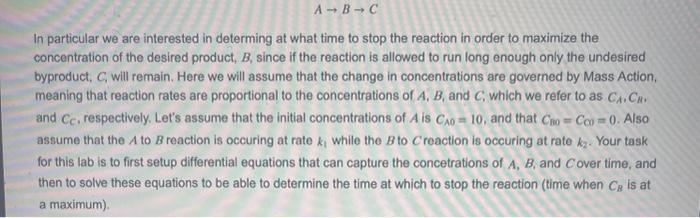
ABC In particular we are interested in determing at what time to stop the reaction in order to maximize the concentration of the desired product, B, since if the reaction is allowed to run long enough only the undesired byproduct, C, will remain. Here we will assume that the change in concentrations are governed by Mass Action, meaning that reaction rates are proportional to the concentrations of A,B, and C, which we refer to as CA,CB. and CC, respectively. Let's assume that the initial concentrations of A is CA0=10, and that CB0=CC0=0. Also assume that the A to B reaction is occuring at rate k1 while the B to C reaction is occuring at rate k2. Your task for this lab is to first setup differential equations that can capture the concetrations of A,B, and C over time, and then to solve these equations to be able to determine the time at which to stop the reaction (time when CB is at a maximum)
Step by Step Solution
There are 3 Steps involved in it

Get step-by-step solutions from verified subject matter experts