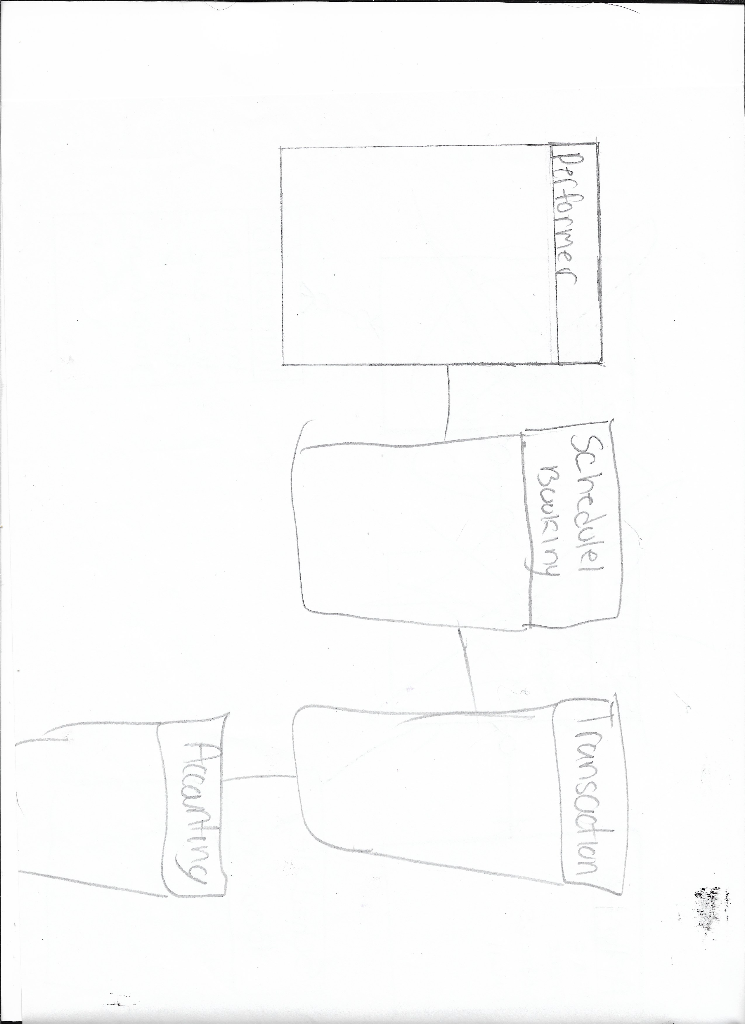
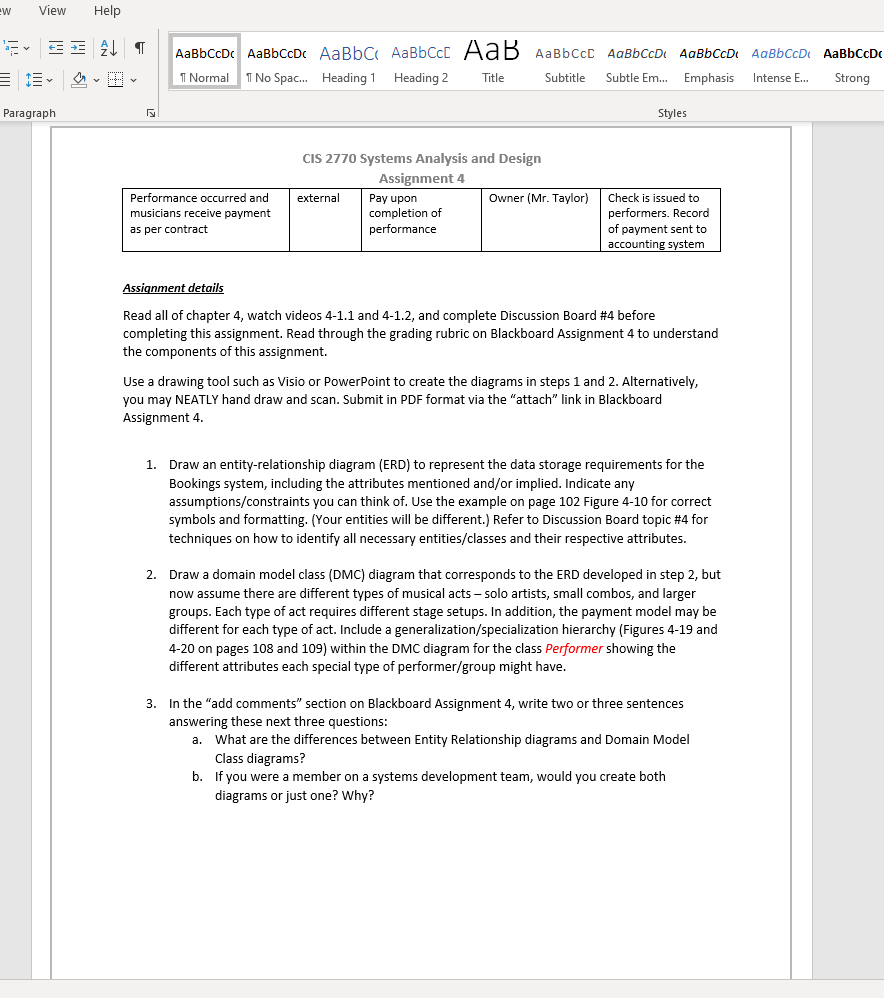
Question: Draw an entity-relationship diagram (ERD) to represent the data storage requirements for the Bookings system, including the attributes mentioned and/or implied. Indicate any assumptions/constraints you
- Draw an entity-relationship diagram (ERD) to represent the data storage requirements for the Bookings system, including the attributes mentioned and/or implied. Indicate any assumptions/constraints you can think of. Use the example on page 102 Figure 4-10 for correct symbols and formatting. (Your entities will be different.) Refer to Discussion Board topic #4 for techniques on how to identify all necessary entities/classes and their respective attributes.
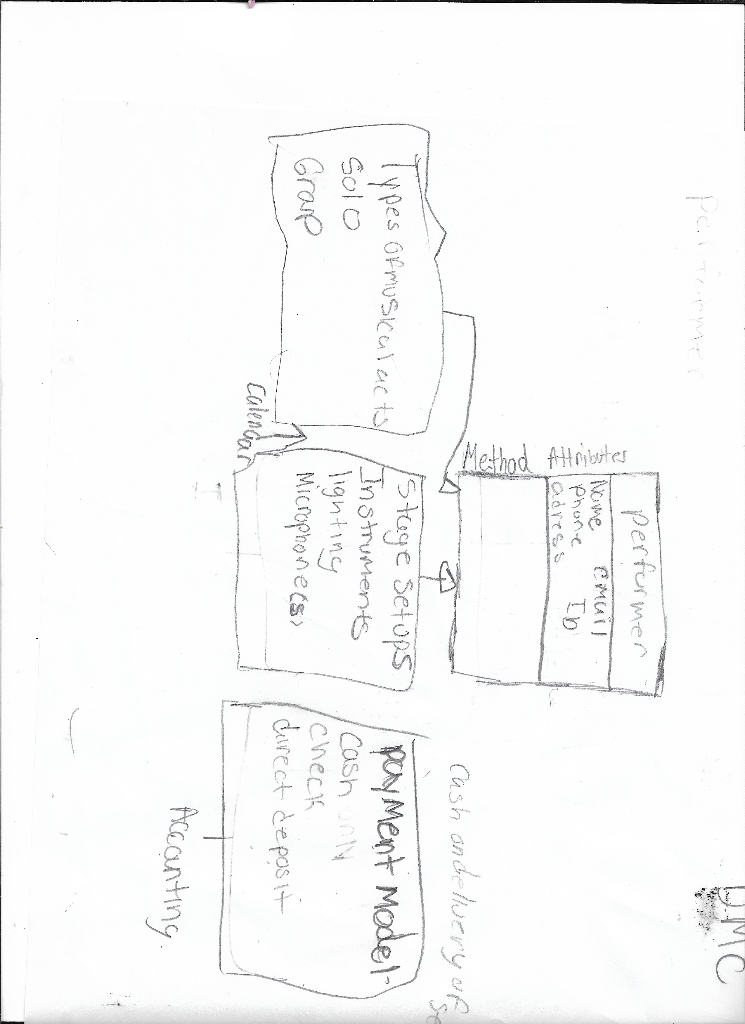
- Draw a domain model class (DMC) diagram that corresponds to the ERD developed in step 2, but now assume there are different types of musical acts solo artists, small combos, and larger groups. Each type of act requires different stage setups. In addition, the payment model may be different for each type of act. Include a generalization/specialization hierarchy (Figures 4-19 and 4-20 on pages 108 and 109) within the DMC diagram for the class Performer showing the different attributes each special type of performer/group might have.
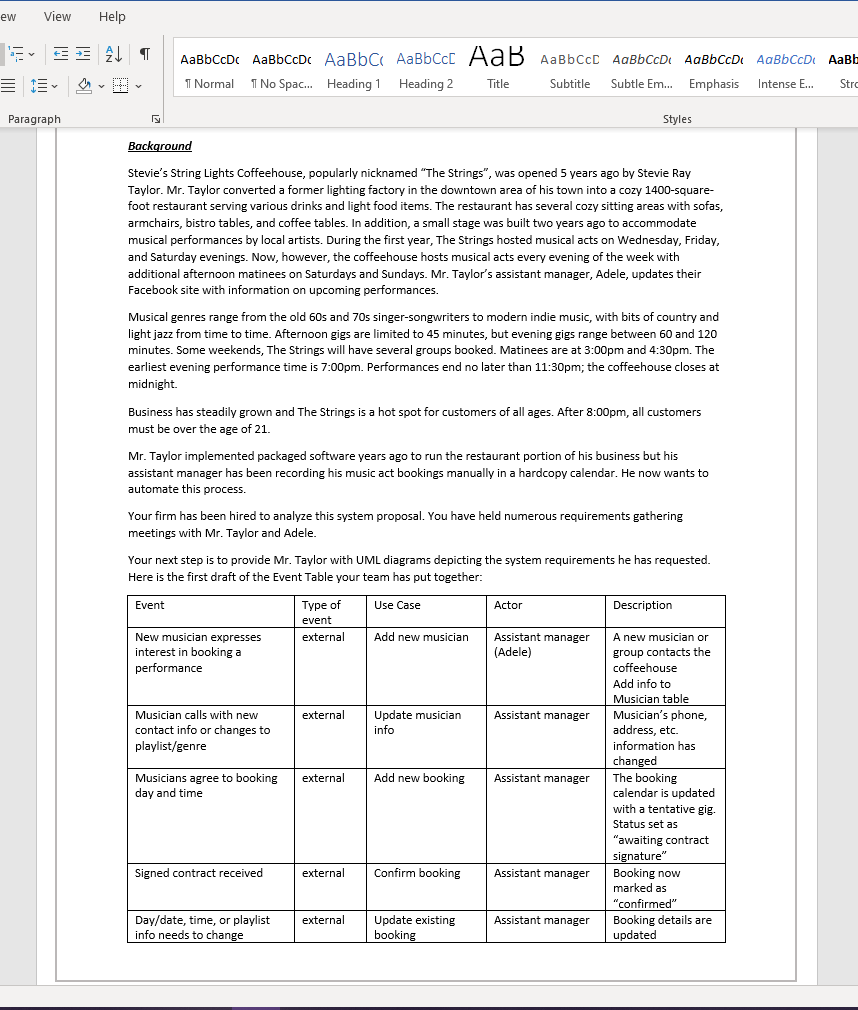
I have to make 2 diagrams an ERD and a DMC. I am having trouble understanding what are the right entities for the diagrams and why they would be those. I attached the diagrams I was working on not sure if I was headed in the right direction. I am just confused on how to do ERD and DMC diagrams. The other to images attached have the questions in greater detail I only need help with steps 1 and 2.
Schedulel Booking Transaction Performer 1 Accounting al performer 3 Nome cmuil El phone Ib Mesthad Attributes Cash andellery of Types of musical acto solo Group stage setups Instruments I lighting Microphones) payment Model I Cash only I check I direct deposit W Accounting. ew View Help -~ EE = 20 1 Normal 1 No Spac... Heading 1 Heading 2 Title Subtitle Subtle Em... Emphasis Intense E... Stro Paragraph Styles Background Stevie's String Lights Coffeehouse, popularly nicknamed "The Strings", was opened 5 years ago by Stevie Ray Taylor. Mr. Taylor converted a former lighting factory in the downtown area of his town into a cozy 1400-square- foot restaurant serving various drinks and light food items. The restaurant has several cozy sitting areas with sofas, armchairs, bistro tables, and coffee tables. In addition, a small stage was built two years ago to accommodate musical performances by local artists. During the first year, The Strings hosted musical acts on Wednesday, Friday, and Saturday evenings. Now, however, the coffeehouse hosts musical acts every evening of the week with additional afternoon matinees on Saturdays and Sundays. Mr. Taylor's assistant manager, Adele, updates their Facebook site with information on upcoming performances. Musical genres range from the old 60s and 70s singer-songwriters to modern indie music, with bits of country and light jazz from time to time. Afternoon gigs are limited to 45 minutes, but evening gigs range between 60 and 120 minutes. Some weekends, The Strings will have several groups booked. Matinees are at 3:00pm and 4:30pm. The earliest evening performance time is 7:00pm. Performances end no later than 11:30pm; the coffeehouse closes at midnight. Business has steadily grown and The Strings is a hot spot for customers of all ages. After 8:00pm, all customers must be over the age of 21. Mr. Taylor implemented packaged software years ago to run the restaurant portion of his business but his assistant manager has been recording his music act bookings manually in a hardcopy calendar. He now wants to automate this process. Your firm has been hired to analyze this system proposal. You have held numerous requirements gathering meetings with Mr. Taylor and Adele. Your next step is to provide Mr. Taylor with UML diagrams depicting the system requirements he has requested. Here is the first draft of the Event Table your team has put together: Event Use Case Actor Description Type of event external Add new musician New musician expresses interest in booking a performance Assistant manager (Adele) external Musician calls with new contact info or changes to playlist/genre Update musician info Assistant manager Musicians agree to booking day and time external Add new booking Assistant manager A new musician or group contacts the coffeehouse Add info to Musician table Musician's phone, address, etc. information has changed The booking calendar is updated with a tentative gig. Status set as "awaiting contract signature" Booking now marked as "confirmed" Booking details are updated Signed contract received external Confirm booking Assistant manager external Day/date, time, or playlist info needs to change Update existing booking Assistant manager W View Help Er Ata AaBbCcDc AabbCcDc AaBb C AaBbcc AaB AaBbcc AaBbCcDi AaBbCcDi AaBbCcDi AaBbCcDo 1 Normal 1 No Spac... Heading 1 Heading 2 Title Subtitle Subtle Em... Emphasis Intense E... Strong Paragraph Styles Performance occurred and musicians receive payment as per contract CIS 2770 Systems Analysis and Design Assignment 4 external Pay upon Owner (Mr. Taylor) completion of performance Check is issued to performers. Record of payment sent to accounting system Assignment details Read all of chapter 4, watch videos 4-1.1 and 4-1.2, and complete Discussion Board #4 before completing this assignment. Read through the grading rubric on Blackboard Assignment 4 to understand the components of this assignment. Use a drawing tool such as Visio or PowerPoint to create the diagrams in steps 1 and 2. Alternatively, you may NEATLY hand draw and scan. Submit in PDF format via the "attach" link in Blackboard Assignment 4. 1. Draw an entity-relationship diagram (ERD) to represent the data storage requirements for the Bookings system, including the attributes mentioned and/or implied. Indicate any assumptions/constraints you can think of. Use the example on page 102 Figure 4-10 for correct symbols and formatting. (Your entities will be different.) Refer to Discussion Board topic #4 for techniques on how to identify all necessary entities/classes and their respective attributes. 2. Draw a domain model class (DMC) diagram that corresponds to the ERD developed in step 2, but now assume there are different types of musical acts - solo artists, small combos, and larger groups. Each type of act requires different stage setups. In addition, the payment model may be different for each type of act. Include a generalization/specialization hierarchy (Figures 4-19 and 4-20 on pages 108 and 109) within the DMC diagram for the class Performer showing the different attributes each special type of performer/group might have. 3. In the "add comments" section on Blackboard Assignment 4, write two or three sentences answering these next three questions: a. What are the differences between Entity Relationship diagrams and Domain Model Class diagrams? b. If you were a member on a systems development team, would you create both diagrams or just one? Why? Schedulel Booking Transaction Performer 1 Accounting al performer 3 Nome cmuil El phone Ib Mesthad Attributes Cash andellery of Types of musical acto solo Group stage setups Instruments I lighting Microphones) payment Model I Cash only I check I direct deposit W Accounting. ew View Help -~ EE = 20 1 Normal 1 No Spac... Heading 1 Heading 2 Title Subtitle Subtle Em... Emphasis Intense E... Stro Paragraph Styles Background Stevie's String Lights Coffeehouse, popularly nicknamed "The Strings", was opened 5 years ago by Stevie Ray Taylor. Mr. Taylor converted a former lighting factory in the downtown area of his town into a cozy 1400-square- foot restaurant serving various drinks and light food items. The restaurant has several cozy sitting areas with sofas, armchairs, bistro tables, and coffee tables. In addition, a small stage was built two years ago to accommodate musical performances by local artists. During the first year, The Strings hosted musical acts on Wednesday, Friday, and Saturday evenings. Now, however, the coffeehouse hosts musical acts every evening of the week with additional afternoon matinees on Saturdays and Sundays. Mr. Taylor's assistant manager, Adele, updates their Facebook site with information on upcoming performances. Musical genres range from the old 60s and 70s singer-songwriters to modern indie music, with bits of country and light jazz from time to time. Afternoon gigs are limited to 45 minutes, but evening gigs range between 60 and 120 minutes. Some weekends, The Strings will have several groups booked. Matinees are at 3:00pm and 4:30pm. The earliest evening performance time is 7:00pm. Performances end no later than 11:30pm; the coffeehouse closes at midnight. Business has steadily grown and The Strings is a hot spot for customers of all ages. After 8:00pm, all customers must be over the age of 21. Mr. Taylor implemented packaged software years ago to run the restaurant portion of his business but his assistant manager has been recording his music act bookings manually in a hardcopy calendar. He now wants to automate this process. Your firm has been hired to analyze this system proposal. You have held numerous requirements gathering meetings with Mr. Taylor and Adele. Your next step is to provide Mr. Taylor with UML diagrams depicting the system requirements he has requested. Here is the first draft of the Event Table your team has put together: Event Use Case Actor Description Type of event external Add new musician New musician expresses interest in booking a performance Assistant manager (Adele) external Musician calls with new contact info or changes to playlist/genre Update musician info Assistant manager Musicians agree to booking day and time external Add new booking Assistant manager A new musician or group contacts the coffeehouse Add info to Musician table Musician's phone, address, etc. information has changed The booking calendar is updated with a tentative gig. Status set as "awaiting contract signature" Booking now marked as "confirmed" Booking details are updated Signed contract received external Confirm booking Assistant manager external Day/date, time, or playlist info needs to change Update existing booking Assistant manager W View Help Er Ata AaBbCcDc AabbCcDc AaBb C AaBbcc AaB AaBbcc AaBbCcDi AaBbCcDi AaBbCcDi AaBbCcDo 1 Normal 1 No Spac... Heading 1 Heading 2 Title Subtitle Subtle Em... Emphasis Intense E... Strong Paragraph Styles Performance occurred and musicians receive payment as per contract CIS 2770 Systems Analysis and Design Assignment 4 external Pay upon Owner (Mr. Taylor) completion of performance Check is issued to performers. Record of payment sent to accounting system Assignment details Read all of chapter 4, watch videos 4-1.1 and 4-1.2, and complete Discussion Board #4 before completing this assignment. Read through the grading rubric on Blackboard Assignment 4 to understand the components of this assignment. Use a drawing tool such as Visio or PowerPoint to create the diagrams in steps 1 and 2. Alternatively, you may NEATLY hand draw and scan. Submit in PDF format via the "attach" link in Blackboard Assignment 4. 1. Draw an entity-relationship diagram (ERD) to represent the data storage requirements for the Bookings system, including the attributes mentioned and/or implied. Indicate any assumptions/constraints you can think of. Use the example on page 102 Figure 4-10 for correct symbols and formatting. (Your entities will be different.) Refer to Discussion Board topic #4 for techniques on how to identify all necessary entities/classes and their respective attributes. 2. Draw a domain model class (DMC) diagram that corresponds to the ERD developed in step 2, but now assume there are different types of musical acts - solo artists, small combos, and larger groups. Each type of act requires different stage setups. In addition, the payment model may be different for each type of act. Include a generalization/specialization hierarchy (Figures 4-19 and 4-20 on pages 108 and 109) within the DMC diagram for the class Performer showing the different attributes each special type of performer/group might have. 3. In the "add comments" section on Blackboard Assignment 4, write two or three sentences answering these next three questions: a. What are the differences between Entity Relationship diagrams and Domain Model Class diagrams? b. If you were a member on a systems development team, would you create both diagrams or just one? Why









 Study Help