



Question: draw an E-R diagram to represent this database. Where and if a relationship needs to be an association entity, show correctly on diagram. Show all
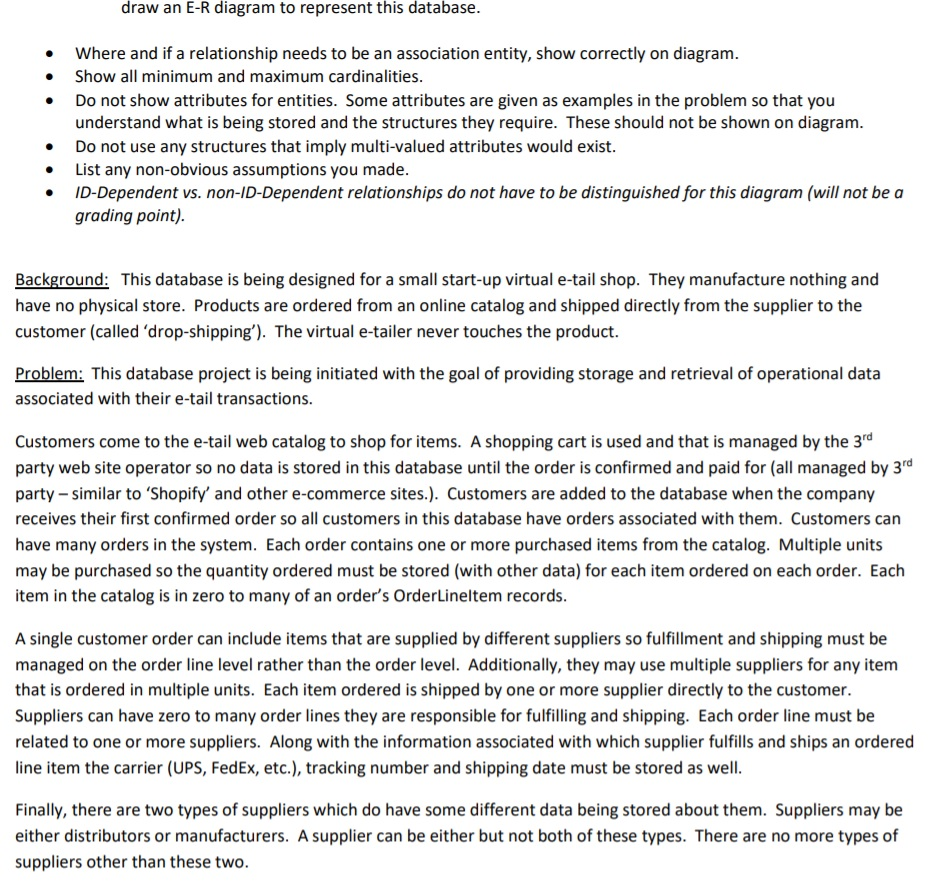
draw an E-R diagram to represent this database. Where and if a relationship needs to be an association entity, show correctly on diagram. Show all minimum and maximum cardinalities. Do not show attributes for entities. Some attributes are given as examples in the problem so that you understand what is being stored and the structures they require. These should not be shown on diagram. Do not use any structures that imply multi-valued attributes would exist. List any non-obvious assumptions you made. ID-Dependent vs. non-ID-Dependent relationships do not have to be distinguished for this diagram (will not be a grading point). Background: This database is being designed for a small start-up virtual e-tail shop. They manufacture nothing and have no physical store. Products are ordered from an online catalog and shipped directly from the supplier to the customer (called 'drop-shipping'). The virtual e-tailer never touches the product. Problem: This database project is being initiated with the goal of providing storage and retrieval of operational data associated with their e-tail transactions. Customers come to the e-tail web catalog to shop for items. A shopping cart is used and that is managed by the 3rd party web site operator so no data is stored in this database until the order is confirmed and paid for (all managed by 3rd party - similar to 'Shopify' and other e-commerce sites.). Customers are added to the database when the company receives their first confirmed order so all customers in this database have orders associated with them. Customers can have many orders in the system. Each order contains one or more purchased items from the catalog. Multiple units may be purchased so the quantity ordered must be stored (with other data) for each item ordered on each order. Each item in the catalog is in zero to many of an order's OrderLineltem records. A single customer order can include items that are supplied by different suppliers so fulfillment and shipping must be managed on the order line level rather than the order level. Additionally, they may use multiple suppliers for any item that is ordered in multiple units. Each item ordered is shipped by one or more supplier directly to the customer. Suppliers can have zero to many order lines they are responsible for fulfilling and shipping. Each order line must be related to one or more suppliers. Along with the information associated with which supplier fulfills and ships an ordered line item the carrier (UPS, FedEx, etc.), tracking number and shipping date must be stored as well. Finally, there are two types of suppliers which do have some different data being stored about them. Suppliers may be either distributors or manufacturers. A supplier can be either but not both of these types. There are no more types of suppliers other than these two. draw an E-R diagram to represent this database. Where and if a relationship needs to be an association entity, show correctly on diagram. Show all minimum and maximum cardinalities. Do not show attributes for entities. Some attributes are given as examples in the problem so that you understand what is being stored and the structures they require. These should not be shown on diagram. Do not use any structures that imply multi-valued attributes would exist. List any non-obvious assumptions you made. ID-Dependent vs. non-ID-Dependent relationships do not have to be distinguished for this diagram (will not be a grading point). Background: This database is being designed for a small start-up virtual e-tail shop. They manufacture nothing and have no physical store. Products are ordered from an online catalog and shipped directly from the supplier to the customer (called 'drop-shipping'). The virtual e-tailer never touches the product. Problem: This database project is being initiated with the goal of providing storage and retrieval of operational data associated with their e-tail transactions. Customers come to the e-tail web catalog to shop for items. A shopping cart is used and that is managed by the 3rd party web site operator so no data is stored in this database until the order is confirmed and paid for (all managed by 3rd party - similar to 'Shopify' and other e-commerce sites.). Customers are added to the database when the company receives their first confirmed order so all customers in this database have orders associated with them. Customers can have many orders in the system. Each order contains one or more purchased items from the catalog. Multiple units may be purchased so the quantity ordered must be stored (with other data) for each item ordered on each order. Each item in the catalog is in zero to many of an order's OrderLineltem records. A single customer order can include items that are supplied by different suppliers so fulfillment and shipping must be managed on the order line level rather than the order level. Additionally, they may use multiple suppliers for any item that is ordered in multiple units. Each item ordered is shipped by one or more supplier directly to the customer. Suppliers can have zero to many order lines they are responsible for fulfilling and shipping. Each order line must be related to one or more suppliers. Along with the information associated with which supplier fulfills and ships an ordered line item the carrier (UPS, FedEx, etc.), tracking number and shipping date must be stored as well. Finally, there are two types of suppliers which do have some different data being stored about them. Suppliers may be either distributors or manufacturers. A supplier can be either but not both of these types. There are no more types of suppliers other than these two
Step by Step Solution
There are 3 Steps involved in it

Get step-by-step solutions from verified subject matter experts