







Question: Draw ER model for the below case. Attach the ER MODEL picture with details of relationships,entities and attributes In Allegheny County, where Duquesne U. is
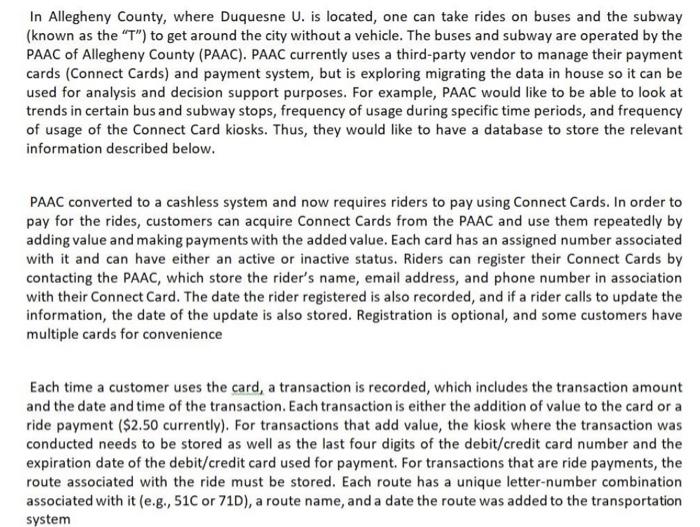
In Allegheny County, where Duquesne U. is located, one can take rides on buses and the subway (known as the "T") to get around the city without a vehicle. The buses and subway are operated by the PAAC of Allegheny County (PAAC). PAAC currently uses a third-party vendor to manage their payment cards (Connect Cards) and payment system, but is exploring migrating the data in house so it can be used for analysis and decision support purposes. For example, PAAC would like to be able to look at trends in certain bus and subway stops, frequency of usage during specific time periods, and frequency of usage of the Connect Card kiosks. Thus, they would like to have a database to store the relevant information described below.
PAAC converted to a cashless system and now requires riders to pay using Connect Cards. In order to pay for the rides, customers can acquire Connect Cards from the PAAC and use them repeatedly by adding value and making payments with the added value. Each card has an assigned number associated with it and can have either an active or inactive status. Riders can register their Connect Cards by contacting the PAAC, which store the rider's name, email address, and phone number in association with their Connect Card. The date the rider registered is also recorded, and if a rider calls to update the information, the date of the update is also stored. Registration is optional, and some customers have multiple cards for convenience
Each time a customer uses the card, a transaction is recorded, which includes the transaction amount and the date and time of the transaction. Each transaction is either the addition of value to the card or a ride payment ($2.50 currently). For transactions that add value, the kiosk where the transaction was conducted needs to be stored as well as the last four digits of the debit/credit card number and the expiration date of the debit/credit card used for payment. For transactions that are ride payments, the route associated with the ride must be stored. Each route has a unique letter-number combination associated with it (e.g., 51C or 71D), a route name, and a date the route was added to the transportation system
(known as the " T ") to get around the city without a vehicle. The buses and subway are operated by the PAAC of Allegheny County (PAAC). PAAC currently uses a third-party vendor to manage their payment cards (Connect Cards) and payment system, but is exploring migrating the data in house so it can be used for analysis and decision support purposes. For example, PAAC would like to be able to look at trends in certain bus and subway stops, frequency of usage during specific time periods, and frequency of usage of the Connect Card kiosks. Thus, they would like to have a database to store the relevant information described below. PAAC converted to a cashless system and now requires riders to pay using Connect Cards. In order to pay for the rides, customers can acquire Connect Cards from the PAAC and use them repeatedly by adding value and making payments with the added value. Each card has an assigned number associated with it and can have either an active or inactive status. Riders can register their Connect Cards by contacting the PAAC, which store the rider's name, email address, and phone number in association with their Connect Card. The date the rider registered is also recorded, and if a rider calls to update the information, the date of the update is also stored. Registration is optional, and some customers have multiple cards for convenience Each time a customer uses the card, a transaction is recorded, which includes the transaction amount and the date and time of the transaction. Each transaction is either the addition of value to the card or a ride payment ( $2.50 currently). For transactions that add value, the kiosk where the transaction was conducted needs to be stored as well as the last four digits of the debit/credit card number and the expiration date of the debit/credit card used for payment. For transactions that are ride payments, the route associated with the ride must be stored. Each route has a unique letter-number combination associated with it (e.g., 51C or 71D), a route name, and a date the route was added to the transportation system
Step by Step Solution
There are 3 Steps involved in it

Get step-by-step solutions from verified subject matter experts
 Study Help