







Question: Draw Model the below case study as-is processes in Business Process Model and Notation (BPMN) using tool Case Study: MegahBina Construction Company. MegahBina is a
Draw Model the below case study as-is processes in Business Process Model and Notation (BPMN) using tool
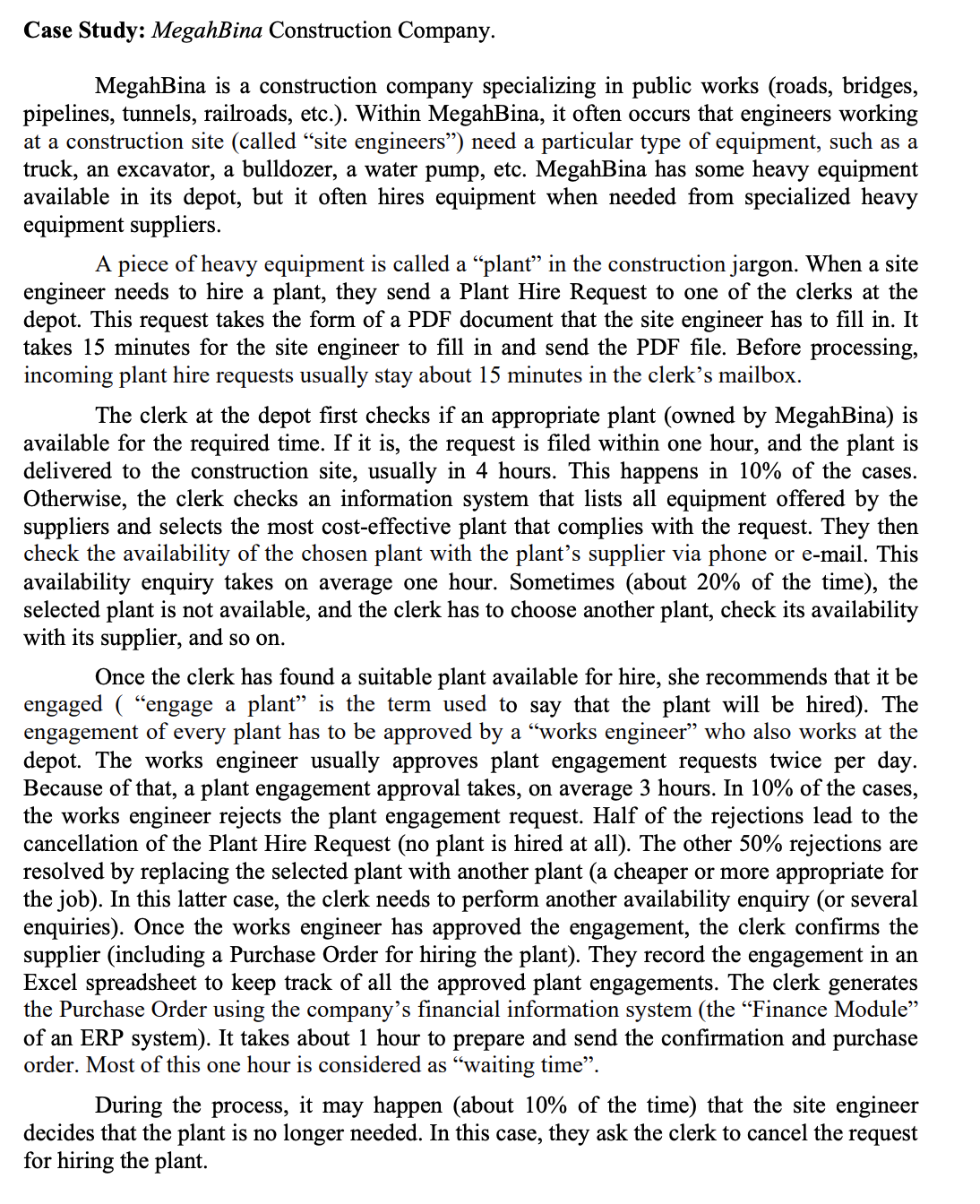
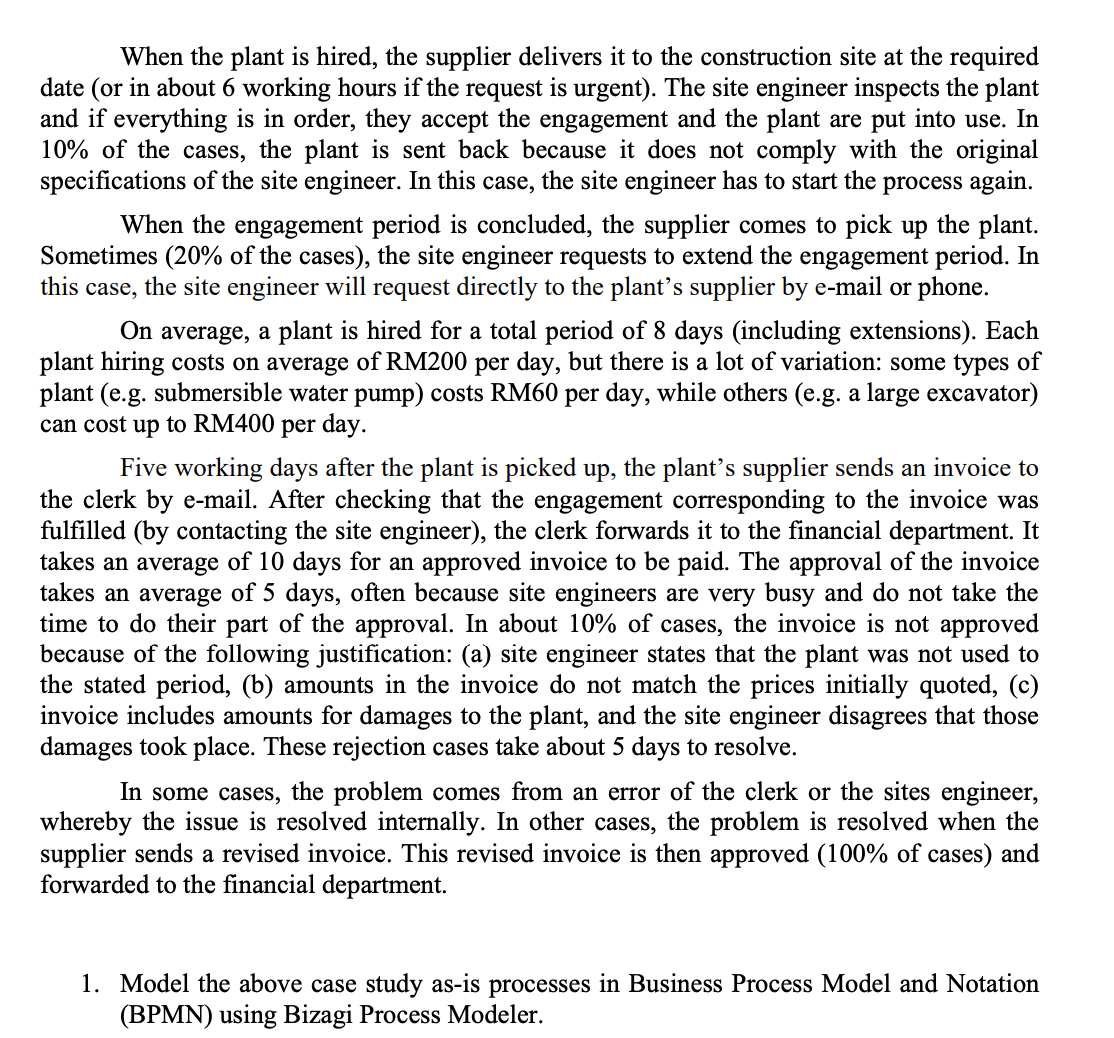
Case Study: MegahBina Construction Company. MegahBina is a construction company specializing in public works (roads, bridges, pipelines, tunnels, railroads, etc.). Within MegahBina, it often occurs that engineers working at a construction site (called "site engineers") need a particular type of equipment, such as a truck, an excavator, a bulldozer, a water pump, etc. MegahBina has some heavy equipment available in its depot, but it often hires equipment when needed from specialized heavy equipment suppliers. A piece of heavy equipment is called a "plant" in the construction jargon. When a site engineer needs to hire a plant, they send a Plant Hire Request to one of the clerks at the depot. This request takes the form of a PDF document that the site engineer has to fill in. It takes 15 minutes for the site engineer to fill in and send the PDF file. Before processing, incoming plant hire requests usually stay about 15 minutes in the clerk's mailbox. The clerk at the depot first checks if an appropriate plant (owned by MegahBina) is available for the required time. If it is, the request is filed within one hour, and the plant is delivered to the construction site, usually in 4 hours. This happens in 10% of the cases. Otherwise, the clerk checks an information system that lists all equipment offered by the suppliers and selects the most cost-effective plant that complies with the request. They then check the availability of the chosen plant with the plant's supplier via phone or e-mail. This availability enquiry takes on average one hour. Sometimes (about 20% of the time), the selected plant is not available, and the clerk has to choose another plant, check its availability with its supplier, and so on. Once the clerk has found a suitable plant available for hire, she recommends that it be engaged ( "engage a plant" is the term used to say that the plant will be hired). The engagement of every plant has to be approved by a "works engineer" who also works at the depot. The works engineer usually approves plant engagement requests twice per day. Because of that, a plant engagement approval takes, on average 3 hours. In 10% of the cases, the works engineer rejects the plant engagement request. Half of the rejections lead to the cancellation of the Plant Hire Request (no plant is hired at all). The other 50% rejections are resolved by replacing the selected plant with another plant (a cheaper or more appropriate for the job). In this latter case, the clerk needs to perform another availability enquiry (or several enquiries). Once the works engineer has approved the engagement, the clerk confirms the supplier (including a Purchase Order for hiring the plant). They record the engagement in an Excel spreadsheet to keep track of all the approved plant engagements. The clerk generates the Purchase Order using the company's financial information system (the "Finance Module" of an ERP system). It takes about 1 hour to prepare and send the confirmation and purchase order. Most of this one hour is considered as "waiting time". During the process, it may happen (about 10% of the time) that the site engineer decides that the plant is no longer needed. In this case, they ask the clerk to cancel the request for hiring the plant. When the plant is hired, the supplier delivers it to the construction site at the required date (or in about 6 working hours if the request is urgent). The site engineer inspects the plant and if everything is in order, they accept the engagement and the plant are put into use. In 10% of the cases, the plant is sent back because it does not comply with the original specifications of the site engineer. In this case, the site engineer has to start the process again. When the engagement period is concluded, the supplier comes to pick up the plant. Sometimes ( 20% of the cases), the site engineer requests to extend the engagement period. In this case, the site engineer will request directly to the plant's supplier by e-mail or phone. On average, a plant is hired for a total period of 8 days (including extensions). Each plant hiring costs on average of RM200 per day, but there is a lot of variation: some types of plant (e.g. submersible water pump) costs RM60 per day, while others (e.g. a large excavator) can cost up to RM400 per day. Five working days after the plant is picked up, the plant's supplier sends an invoice to the clerk by e-mail. After checking that the engagement corresponding to the invoice was fulfilled (by contacting the site engineer), the clerk forwards it to the financial department. It takes an average of 10 days for an approved invoice to be paid. The approval of the invoice takes an average of 5 days, often because site engineers are very busy and do not take the time to do their part of the approval. In about 10% of cases, the invoice is not approved because of the following justification: (a) site engineer states that the plant was not used to the stated period, (b) amounts in the invoice do not match the prices initially quoted, (c) invoice includes amounts for damages to the plant, and the site engineer disagrees that those damages took place. These rejection cases take about 5 days to resolve. In some cases, the problem comes from an error of the clerk or the sites engineer, whereby the issue is resolved internally. In other cases, the problem is resolved when the supplier sends a revised invoice. This revised invoice is then approved (100\% of cases) and forwarded to the financial department. 1. Model the above case study as-is processes in Business Process Model and Notation (BPMN) using Bizagi Process Modeler
Step by Step Solution
There are 3 Steps involved in it

Get step-by-step solutions from verified subject matter experts
 Study Help