







Question: Draw the HASHTABLES! THERE IS NO CODE FOR THIS QUESTION PLEASE DO NOT ANSWER IN JAVA, C, C++. Its just explaining it and drawing it
Draw the HASHTABLES! THERE IS NO CODE FOR THIS QUESTION PLEASE DO NOT ANSWER IN JAVA, C, C++.
Its just explaining it and drawing it out in a hashtable.
Thank You!
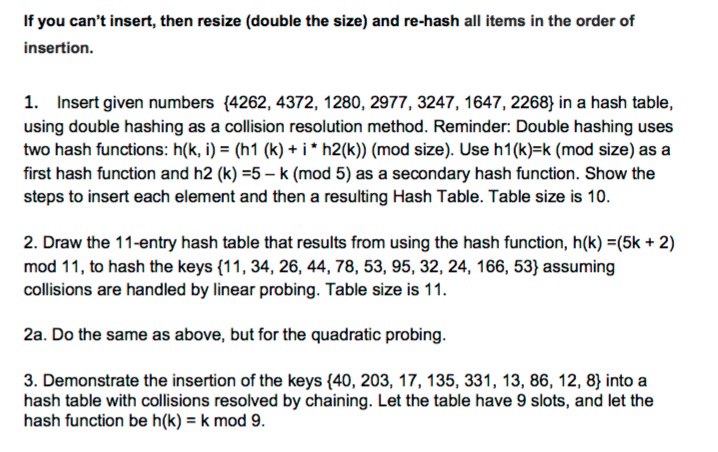
If you can't insert, then resize (double the size) and re-hash all items in the order of insertion. 1. Insert given numbers (4262, 4372, 1280, 2977, 3247, 1647, 2268) in a hash table, using double hashing as a collision resolution method. Reminder: Double hashing uses two hash functions: h(k, i) (h1 (k) i h2(k)) (mod size). Use h1(k) k (mod size) as a first hash function and h2 (k) -5-k (mod 5) as a secondary hash function. Show the steps to insert each element and then a resulting Hash Table. Table size is 10 2. Draw the 11-entry hash table that results from using the hash function, h(k) E(5k 2) mod 11, to hash the keys (11, 34, 26, 44, 78, 53, 95, 32, 24, 166, 53) assuming collisions are handled by linear probing. Table size is 11. 2a. Do the same as above, but for the quadratic probing 3. Demonstrate the insertion of the keys (40, 203, 17, 135, 331, 13, 86, 12, 8 into a hash table with collisions resolved by chaining. Let the table have 9 slots, and let the hash function be h(k) J k mod 9
Step by Step Solution
There are 3 Steps involved in it

Get step-by-step solutions from verified subject matter experts
 Study Help