







Question: Draw the recursion tree when n = 12, where n represents the length of the array, for the following recursive method: int sumSquares(int[] array, int
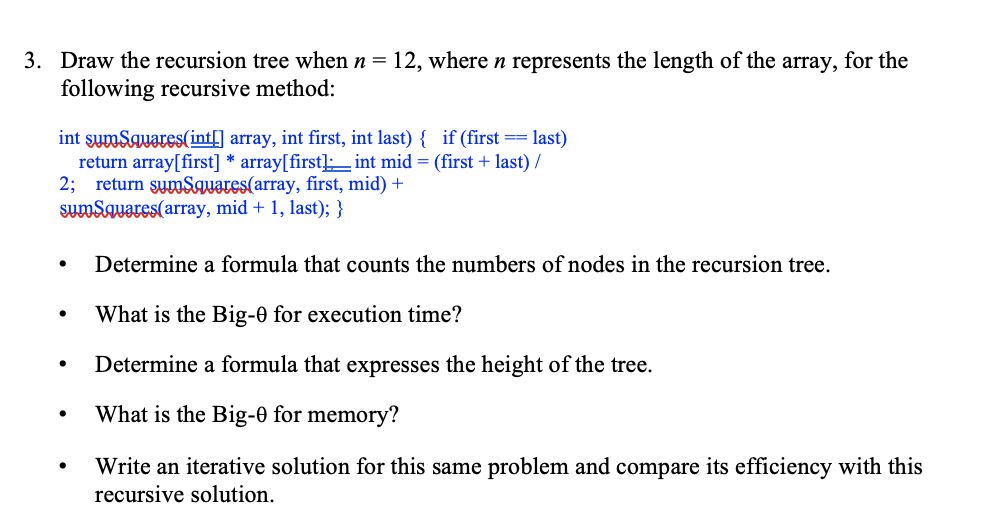
Draw the recursion tree when n = 12, where n represents the length of the array, for the following recursive method:
int sumSquares(int[] array, int first, int last) { if (first == last) return array[first] * array[first]; int mid = (first + last) / 2; return sumSquares(array, first, mid) + sumSquares(array, mid + 1, last); }
Determine a formula that counts the numbers of nodes in the recursion tree.
What is the Big-q for execution time?
Determine a formula that expresses the height of the tree.
What is the Big-q for memory?
Write an iterative solution for this same problem and compare its efficiency with this recursive solution.
3. Draw the recursion tree when n=12, where n represents the length of the array, for the following recursive method: int sumSquares(int[] array, int first, int last) { if (first == last) return array[first] * array[first]:- int mid =( first + last )/ 2 ; return sumSquares(array, first, mid) + sumSquares(array, mid +1, last); } - Determine a formula that counts the numbers of nodes in the recursion tree. - What is the Big- for execution time? - Determine a formula that expresses the height of the tree. - What is the Big- for memory? - Write an iterative solution for this same problem and compare its efficiency with this recursive solution
Step by Step Solution
There are 3 Steps involved in it

Get step-by-step solutions from verified subject matter experts
 Study Help