







Question: Draw the required FBD ( s ) for the stoplights and submit your work to Gradescope. ? According to What Things Weigh, the standard American
Draw the required FBDs for the stoplights and submit your work to Gradescope.
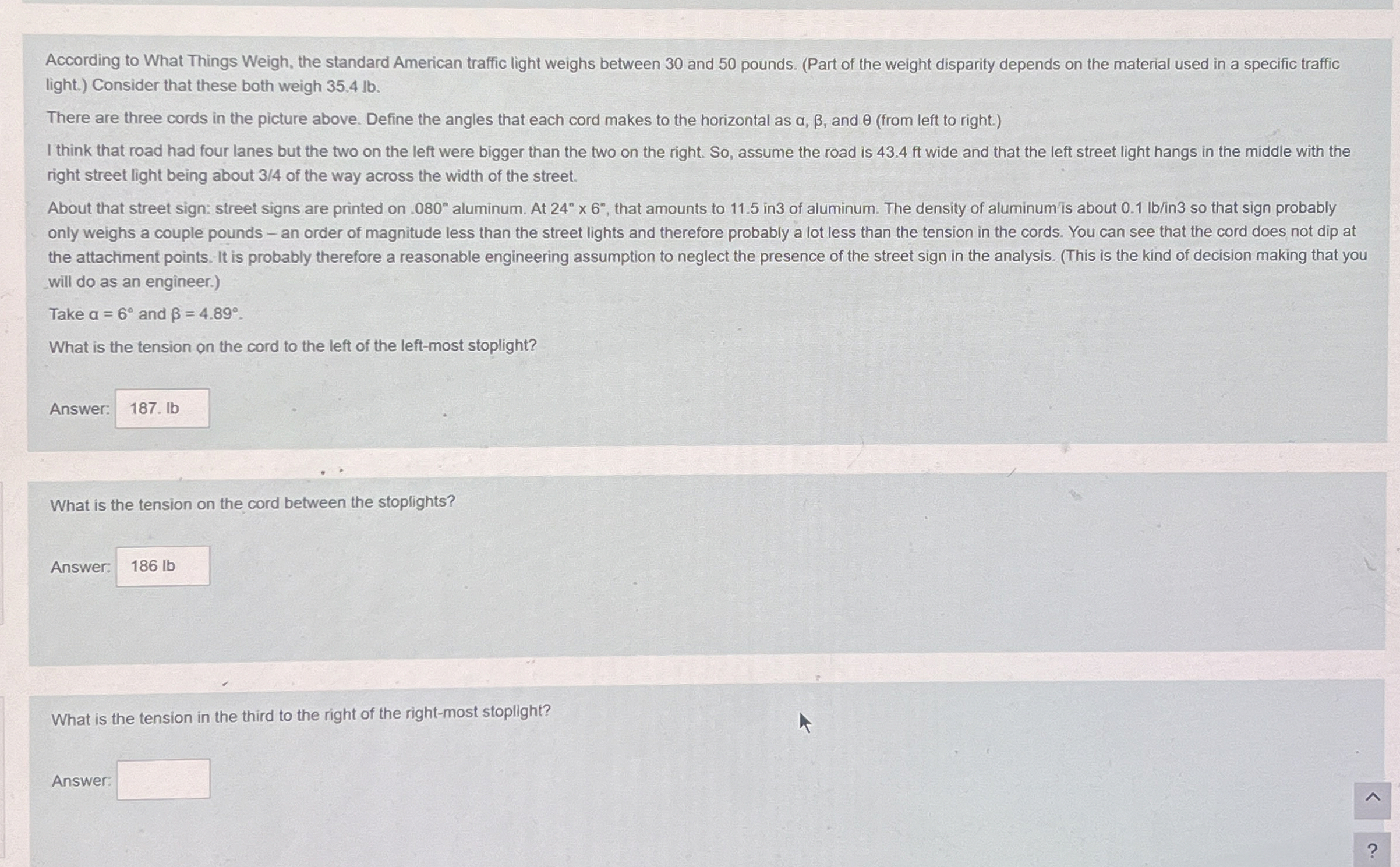
According to What Things Weigh, the standard American traffic light weighs between and pounds. Part of the weight disparity depends on the material used in a specific traffic light. Consider that these both weigh lb
There are three cords in the picture above. Define the angles that each cord makes to the horizontal as and from left to right.
I think that road had four lanes but the two on the left were bigger than the two on the right. So assume the road is ft wide and that the left street light hangs in the middle with the right street light being about of the way across the width of the street.
About that street sign: street signs are printed on aluminum. At that amounts to in of aluminum. The density of aluminum is about lbin so that sign probably only weighs a couple pounds an order of magnitude less than the street lights and therefore probably a lot less than the tension in the cords. You can see that the cord does not dip at the attachment points. It is probably therefore a reasonable engineering assumption to neglect the presence of the street sign in the analysis. This is the kind of decision making that you will do as an engineer.
Take and
What is the tension on the cord to the left of the leftmost stoplight?
Answer:
What is the tension on the cord between the stoplights?
Answer: lb
What is the tension in the third to the right of the rightmost stoplight?
Answer:
Step by Step Solution
There are 3 Steps involved in it
1 Expert Approved Answer
Step: 1 Unlock

Question Has Been Solved by an Expert!
Get step-by-step solutions from verified subject matter experts
Step: 2 Unlock
Step: 3 Unlock
 Study Help