







Question: Draw the steroid molecules using chair conformations - NOT the planar cyclohexane structures with dashes/wedges. Title of Experiment: Preparation of 5,6-Dibromocholestanol Objective - To synthesize
Draw the steroid molecules using chair conformations - NOT the planar cyclohexane structures with dashes/wedges.
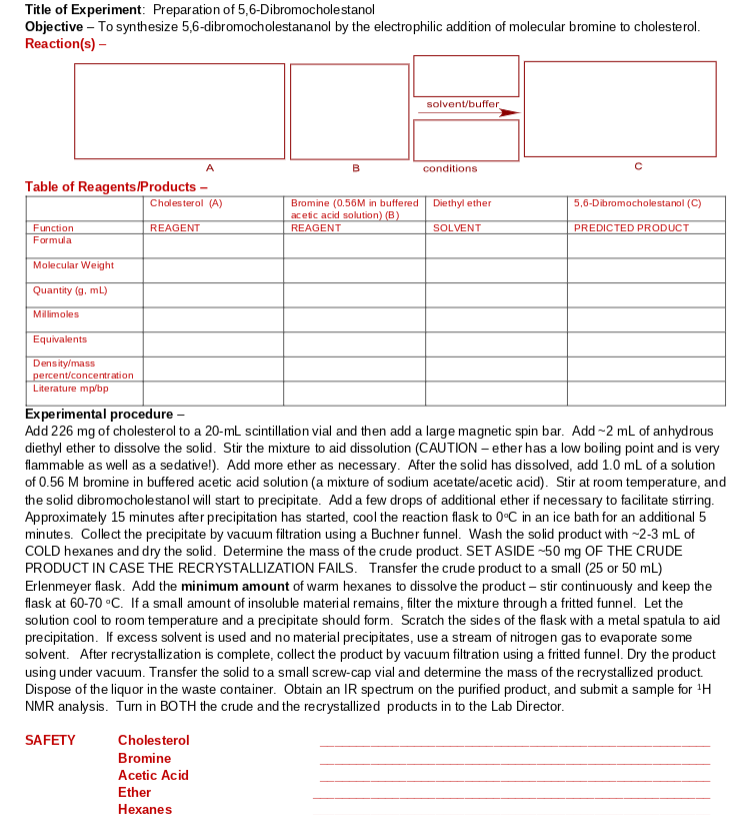
Title of Experiment: Preparation of 5,6-Dibromocholestanol Objective - To synthesize 5,6-dibromocholestananol by the electrophilic addition of molecular bromine to cholesterol. Reaction(s) - Tahle of RearienteIProdirte - Expermental proceaure - Add 226mg of cholesterol to a 20-mL scintillation vial and then add a large magnetic spin bar. Add 2mL of anhydrous diethyl ether to dissolve the solid. Stir the mixture to aid dissolution (CAUTION - ether has a low boiling point and is very flammable as well as a sedativel). Add more ether as necessary. After the solid has dissolved, add 1.0 mL of a solution of 0.56M bromine in buffered acetic acid solution (a mixture of sodium acetate/acetic acid). Stir at room temperature, and the solid dibromocholestanol will start to precipitate. Add a few drops of additional ether if necessary to facilitate stirring. Approximately 15 minutes after precipitation has started, cool the reaction flask to 0C in an ice bath for an additional 5 minutes. Collect the precipitate by vacuum filtration using a Buchner funnel. Wash the solid product with 23mL of COLD hexanes and dry the solid. Determine the mass of the crude product. SET ASIDE 50mg OF THE CRUDE PRODUCTIN CASE THE RECRYSTALLIZATION FAILS. Transfer the crude product to a small (25m or 50mL) Erlenmeyer flask. Add the minimum amount of warm hexanes to dissolve the product - stir continuously and keep the flask at 60-70 C. If a small amount of insoluble material remains, filter the mixture through a fritted funnel. Let the solution cool to room temperature and a precipitate should form. Scratch the sides of the flask with a metal spatula to aid precipitation. If excess solvent is used and no material precipitates, use a stream of nitrogen gas to evaporate some solvent. After recrystallization is complete, collect the product by vacuum filtration using a fritted funnel. Dry the product using under vacuum. Transfer the solid to a small screw-cap vial and determine the mass of the recrystallized product. Dispose of the liquor in the waste container. Obtain an IR spectrum on the purified product, and submit a sample for 1H NMR analysis. Turn in BOTH the crude and the recrystallized products in to the Lab Director
Step by Step Solution
There are 3 Steps involved in it

Get step-by-step solutions from verified subject matter experts
 Study Help