


Question: Drilling for oil and gas involves making high capital expenditures with a considerable amount of uncertainty regarding the outcome as a result of the hit
Drilling for oil and gas involves making high
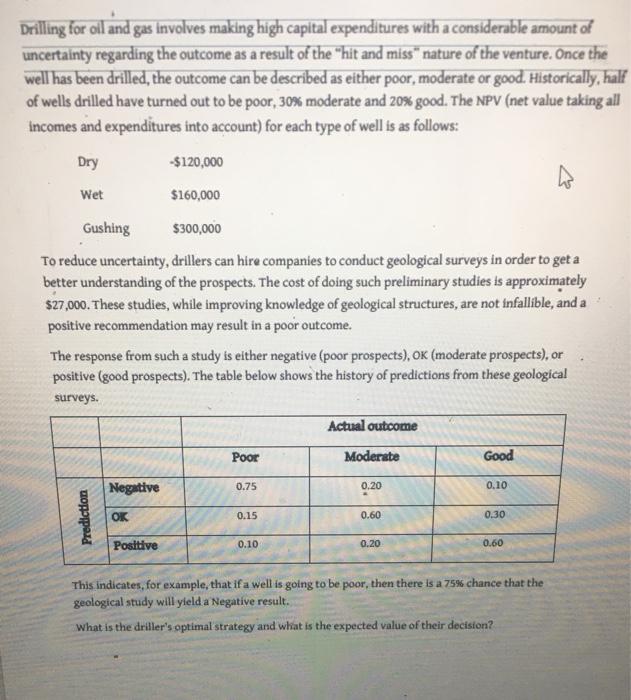
Drilling for oil and gas involves making high capital expenditures with a considerable amount of uncertainty regarding the outcome as a result of the "hit and miss" nature of the venture. Once the well has been drilled, the outcome can be described as either poor, moderate or good. Historically, half of wells drilled have turned out to be poor, 30% moderate and 20% good. The NPV (net value taking all incomes and expenditures into account) for each type of well is as follows: Dry -$120,000 Wet $160,000 Gushing $300,000 To reduce uncertainty, drillers can hire companies to conduct geological surveys in order to get a better understanding of the prospects. The cost of doing such preliminary studies is approximately $27,000. These studies, while improving knowledge of geological structures, are not infallible, and a positive recommendation may result in a poor outcome. The response from such a study is either negative (poor prospects), OK (moderate prospects), or positive (good prospects). The table below shows the history of predictions from these geological surveys. Actual outcome Poor Moderate Good Negative 0.75 0.20 0.10 Prediction OK 0.15 0.60 0.30 Positive 0.10 0.20 0.60 This indicates, for example, that if a well is going to be poor, then there is a 75% chance that the geological study will yield a Negative result. What is the driller's optimal strategy and what is the expected value of their decision

Step by Step Solution

There are 3 Steps involved in it

1 Expert Approved Answer
Step: 1 Unlock blur-text-image

Question Has Been Solved by an Expert!

Get step-by-step solutions from verified subject matter experts

Step: 2 Unlock
Step: 3 Unlock

Students Have Also Explored These Related General Management Questions!