







Question: drop down menu options are four/five/three Discounted payback period. Becker, Inc. uses the discounted payback period for projects costing lesss than $25,000 and has a
 drop down menu options are four/five/three
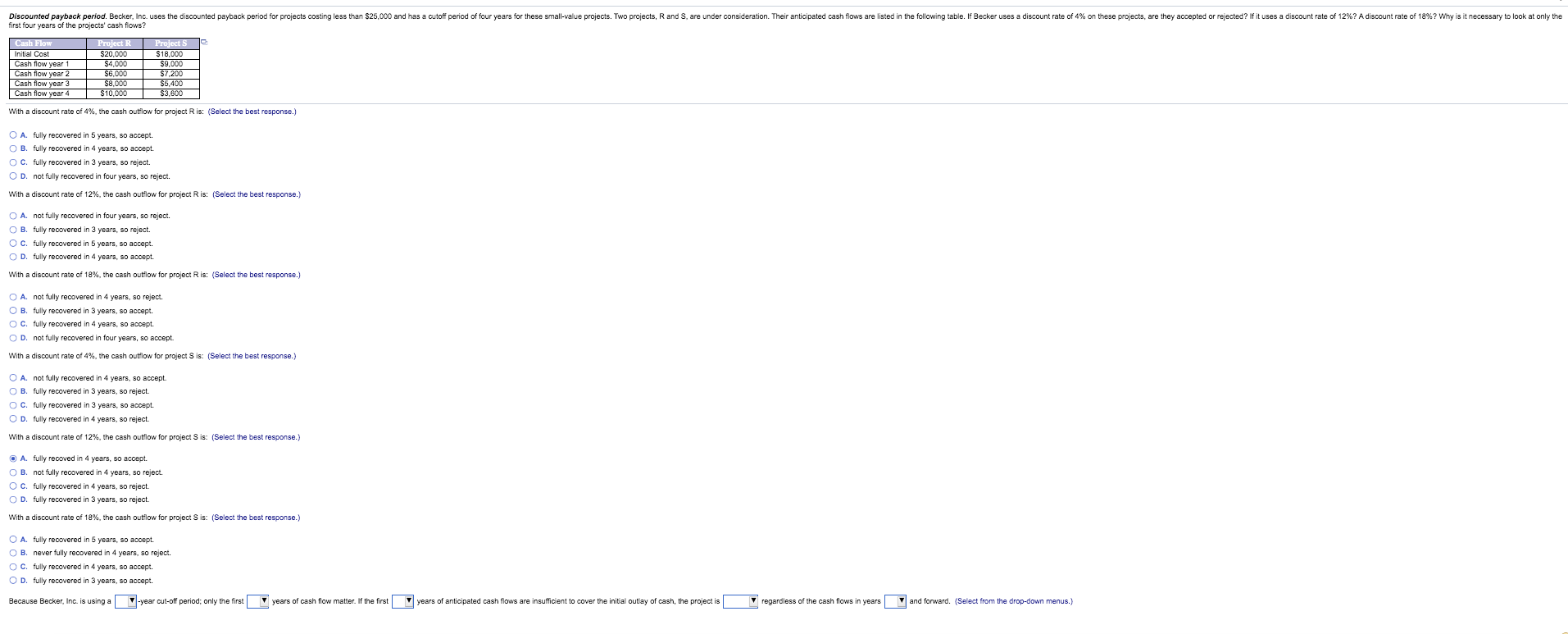
Discounted payback period. Becker, Inc. uses the discounted payback period for projects costing lesss than $25,000 and has a cutoff period of four years for these small-value projects. Two projects, R and S, are under consideration. Their anticipated cash flows are listed in the following table. If Becker uses a discount rate of 4 % on these projects, are they accepted or rejected? If it uses a discount rate of 12 % ? A discount rate of 18%? Why is it necessary to look at only the first four years of the projects' cash flows? Project R $20,000 $4,000 $6.000 S8.000 $10.000 Project S $18,000 $9,00 $7,200 $5,400 $3,600 Cash flow year 3 With a discount rate of 4 %, the cash outflow for project R is: (Select the best response.) O A. fully recovered in 5 years, so accept. O B. fully recovered in 4 years, so accept O C. fully recovered in 3 years, so reject. O D. not fully recovered in four years, so reject. With a discount rate of 12% , the cash outflow for project R is: (Select the best response.) O A. not fully recovered in four years, so reject. O B. fully recovered in 3 years, so reject. O C. fully recovered in 5 years, so accept. O D. fully recovered in 4 years, so accept. With a discount rate of 18% , the cash outflow for project R is: (Select the best response.) O A. not fully recovered in 4 years, so reject O B. fully recovered in 3 years, so accept. O C. fully recovered in 4 years, so accept O D. not fully recovered in four years, so accept With a discount rate of 4 %, the cash outflow for project S is: (Select the best response.) O A. not fully recovered in 4 years, so accept. O B. fully recovered in 3 years, so reject O C. fully recovered in 3 years, so accept O D. fully recovered in 4 years, so reject With a discount rate of 12 % , the cash outflow for project S is: (Select the best response.) A. fully recoved in 4 years, so accept. O B. not fully recovered in 4 years, so reject O C. fully recovered in 4 years, so reject O D. fully recovered in 3 years, so reject With a discount rate of 18% , the cash outflow for project S is: (Select the best response.) O A. fully recovered in 5 years, so accept O B. never fully recovered in 4 years, so reject O C. fully recovered in 4 years, so accept. O D. fully recovered in 3 years, so accept. -year cut-off period; only the first and forward. (Select from the drop-down menus.) years of anticipated cash flows are insufficient to cover the initial outlay cash, the project is regardless of the cash flows in years Because Becker, Inc. is using a Discounted payback period. Becker, Inc. uses the discounted payback period for projects costing lesss than $25,000 and has a cutoff period of four years for these small-value projects. Two projects, R and S, are under consideration. Their anticipated cash flows are listed in the following table. If Becker uses a discount rate of 4 % on these projects, are they accepted or rejected? If it uses a discount rate of 12 % ? A discount rate of 18%? Why is it necessary to look at only the first four years of the projects' cash flows? Project R $20,000 $4,000 $6.000 S8.000 $10.000 Project S $18,000 $9,00 $7,200 $5,400 $3,600 Cash flow year 3 With a discount rate of 4 %, the cash outflow for project R is: (Select the best response.) O A. fully recovered in 5 years, so accept. O B. fully recovered in 4 years, so accept O C. fully recovered in 3 years, so reject. O D. not fully recovered in four years, so reject. With a discount rate of 12% , the cash outflow for project R is: (Select the best response.) O A. not fully recovered in four years, so reject. O B. fully recovered in 3 years, so reject. O C. fully recovered in 5 years, so accept. O D. fully recovered in 4 years, so accept. With a discount rate of 18% , the cash outflow for project R is: (Select the best response.) O A. not fully recovered in 4 years, so reject O B. fully recovered in 3 years, so accept. O C. fully recovered in 4 years, so accept O D. not fully recovered in four years, so accept With a discount rate of 4 %, the cash outflow for project S is: (Select the best response.) O A. not fully recovered in 4 years, so accept. O B. fully recovered in 3 years, so reject O C. fully recovered in 3 years, so accept O D. fully recovered in 4 years, so reject With a discount rate of 12 % , the cash outflow for project S is: (Select the best response.) A. fully recoved in 4 years, so accept. O B. not fully recovered in 4 years, so reject O C. fully recovered in 4 years, so reject O D. fully recovered in 3 years, so reject With a discount rate of 18% , the cash outflow for project S is: (Select the best response.) O A. fully recovered in 5 years, so accept O B. never fully recovered in 4 years, so reject O C. fully recovered in 4 years, so accept. O D. fully recovered in 3 years, so accept. -year cut-off period; only the first and forward. (Select from the drop-down menus.) years of anticipated cash flows are insufficient to cover the initial outlay cash, the project is regardless of the cash flows in years Because Becker, Inc. is using a
Step by Step Solution
There are 3 Steps involved in it

Get step-by-step solutions from verified subject matter experts
 Study Help