







Question: drop down options: 1-equals, is less than, is more than 2,3- in equilibrium, overvalued, undervalued please show the graph too 10. The Capital Asset Pricing
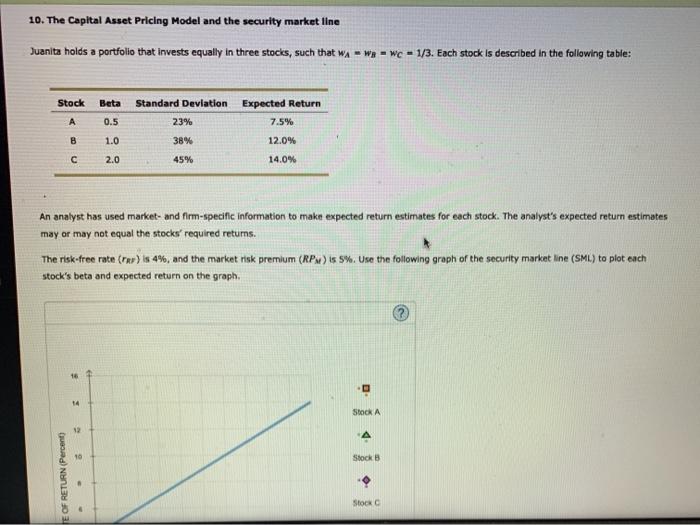
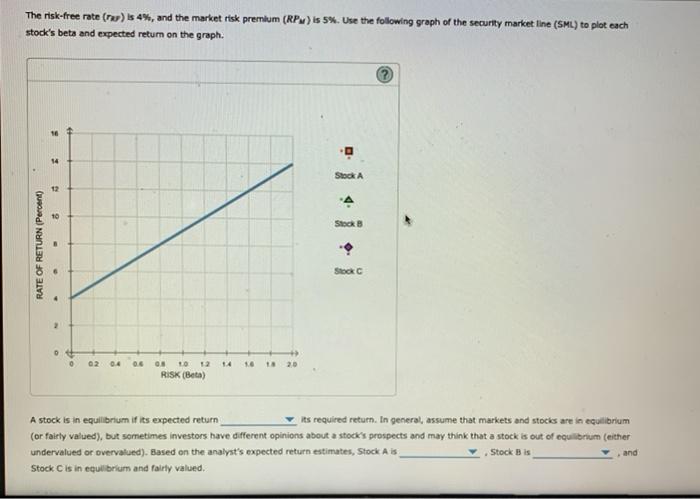
10. The Capital Asset Pricing Model and the security market line Juanita holds a portfolio that invests equally in three stocks, such that wa = wa - Wc = 1/3. Each stock is described in the following table: Stock Beta Standard Deviation 23% 0.5 Expected Return 7.5% 12.0% B 1.0 38% 2.0 45% 14.0% An analyst has used market- and firm-specific information to make expected return estimates for each stock. The analyst's expected return estimates may or may not equal the stocks' required retums. The risk-free rate (rap) is 4%, and the market risk premium (RPM) is 5%. Use the following graph of the security market line (SML.) to plot each stock's beta and expected return on the graph, 16 14 STOCKA 2 Stock E OF RETURN(Percent) Stock The risk-free rate (T) is 4%, and the market risk premium (RPM) is 5%. Use the following graph of the security market line (SML) te plot each stock's bets and expected return on the graph. 16 14 Stock A 12 A 10 St B RATE OF RETURN (Percent) . Stock 2 0 0204 14 18 20 0.6 0.8 10 RISK (Beta) A stock is in equilibrium if its expected return its required return. In general, assume that markets and stocks are in equilibrium (or fairly valued), but sometimes investors have different opinions about a stock's prospects and may think that a stock is out of equilibrium (either undervalued or overvalued). Based on the analyst's expected return estimates, Stock Ais . Stock B is Stock C is in equilibrium and fairly valued. and
Step by Step Solution
There are 3 Steps involved in it

Get step-by-step solutions from verified subject matter experts
 Study Help