



Question: Drop Down options Time Period Dividends Expected Present Value Dividends Expected Present Value Now 20.0000 1.0000 10.0000 0.0000 End of Year 10 1.1425 1.2710 1.3053
Drop Down options
Time PeriodDividends Expected Present ValueDividends Expected Present ValueNow
20.0000
1.0000
10.0000
0.0000
End of Year 10
1.1425
1.2710
1.3053
1.2050
0.6851
0.5827
0.7633
0.6150
End of Year 20
1.5729
1.7038
1.7498
1.6590
0.3992
0.3583
0.3395
0.3216
End of Year 50
3.6894
3.8913
4.1042
3.7890
0.0571
0.0672
0.0636
0.0709
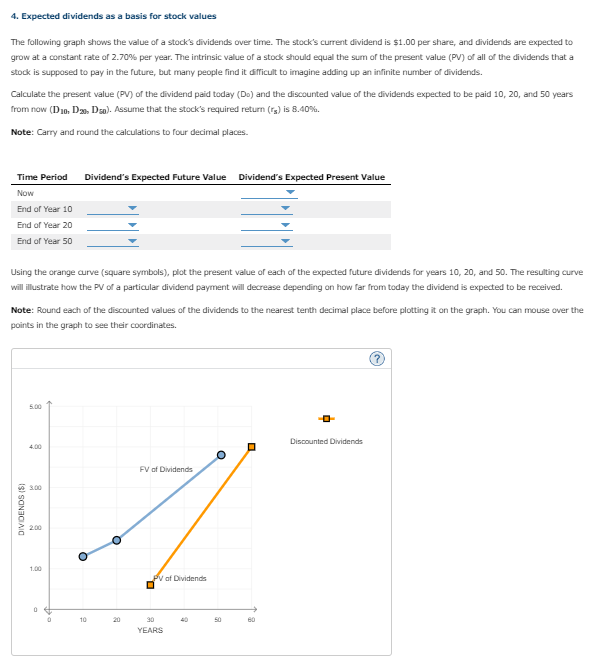
4. Expected dividends as a basis for stock values The following graph shows the value of a stock's dividends over time. The stock's current dividend is $1.00 per share, and dividends are expected to grow at a constant rate of 2.70% per year. The intrinsic value of a stock should equal the sum of the present value (PV) of all of the dividends that a stock is supposed to pay in the future, but many people find it difficult to imagine adding up an infinite number of dividends. Calculate the present value (PV) of the dividend paid today (Do) and the discounted value of the dividends expected to be paid 10 , 20 , and 50 years from now (D10,D20,D50 ). Assume that the stock's required return (rs) is 8.40%. Note: Carry and round the calculations to four decimal places. Using the orange curve (square symbols), plot the present value of each of the expected future dividends for years 10, 20, and 50. The resulting curve will illustrate how the PV of a particular dividend payment will decrease depending on how far from today the dividend is expected to be received. Note: Round each of the discounted values of the dividends to the nearest tenth decimal place before plotting it on the graph. You can mouse over the points in the graph to see their coordinates
Step by Step Solution
There are 3 Steps involved in it

Get step-by-step solutions from verified subject matter experts