



Question: Dry air is blown (20 m/s) across the flat surface of a strip of water of L = 20 cm, while at room temperature and
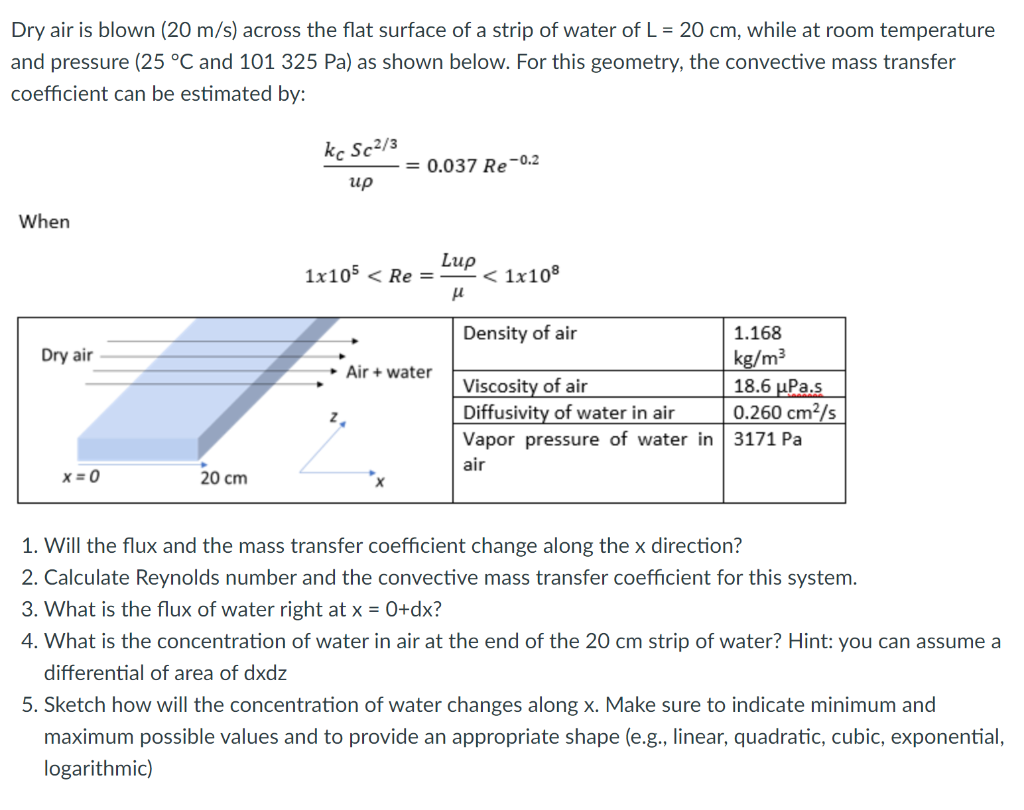 Dry air is blown (20 m/s) across the flat surface of a strip of water of L = 20 cm, while at room temperature and pressure (25 C and 101 325 Pa) as shown below. For this geometry, the convective mass transfer coefficient can be estimated by: water strip.PNG Will the flux and the mass transfer coefficient change along the x direction? Calculate Reynolds number and the convective mass transfer coefficient for this system. What is the flux of water right at x = 0+dx? What is the concentration of water in air at the end of the 20 cm strip of water? Hint: you can assume a differential of area of dxdz Sketch how will the concentration of water changes along x. Make sure to indicate minimum and maximum possible values and to provide an appropriate shape (e.g., linear, quadratic, cubic, exponential, logarithmic)
Dry air is blown (20m/s ) across the flat surface of a strip of water of L=20cm, while at room temperature and pressure (25C and 101325Pa) as shown below. For this geometry, the convective mass transfer coefficient can be estimated by: ukcSc2/3=0.037Re0.2 When 1. Will the flux and the mass transfer coefficient change along the x direction? 2. Calculate Reynolds number and the convective mass transfer coefficient for this system. 3. What is the flux of water right at x=0+dx ? 4. What is the concentration of water in air at the end of the 20cm strip of water? Hint: you can assume a differential of area of dxdz 5. Sketch how will the concentration of water changes along x. Make sure to indicate minimum and maximum possible values and to provide an appropriate shape (e.g., linear, quadratic, cubic, exponential, logarithmic)
Step by Step Solution
There are 3 Steps involved in it

Get step-by-step solutions from verified subject matter experts