







Question: Due 2 9 / 0 3 , Friday, 2 3 : 5 9 , Late submissions will not be accepted under any clrctumstance. To be
Due Friday, : Late submissions will not be accepted under any clrctumstance.
To be stibmitted in digital form, via odtuclass.
CE Spring' Soll Mechanics Homework
State all assumptions clearly. For all questions, take
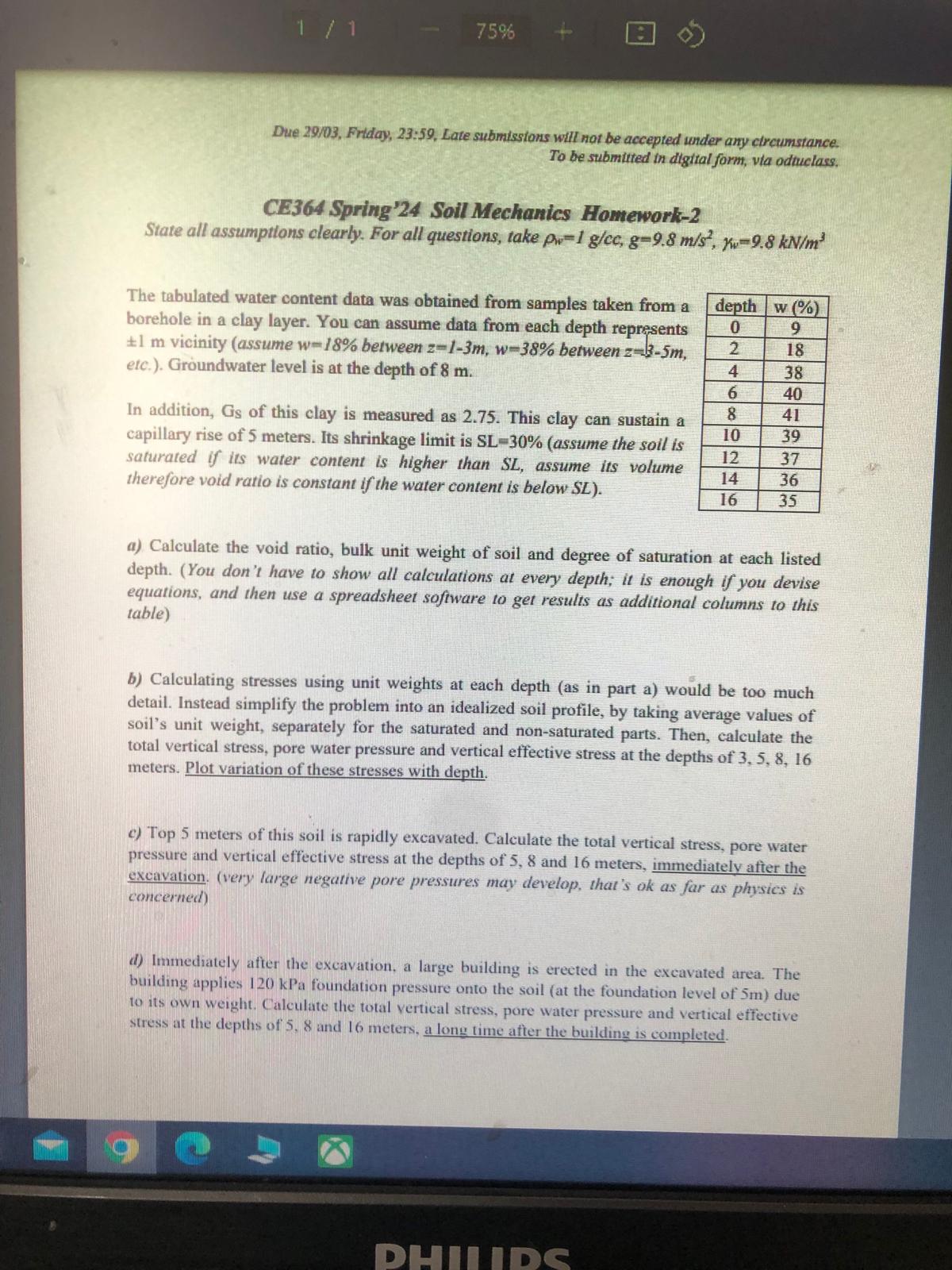
The tabulated water content data was obtained from samples taken from a
borehole in a clay layer. You can assume data from each depth represents
vicinity assume between between
etc. Groundwater level is at the depth of
In addition, Gs of this clay is measured as This clay can sustain a
capillary rise of meters. Its shrinkage limit is assume the soil is
saturated if its water content is higher than SL assume its volume
therefore void ratio is constant if the water content is below SL
a Calculate the void ratio, bulk unit weight of soil and degree of saturation at each listed
depth. You don't have to show all calculations at every depth; it is enough if you devise
equations, and then use a spreadsheet software to get results as additional columns to this
table
b Calculating stresses using unit weights at each depth as in part a would be too much
detail. Instead simplify the problem into an idealized soil profile, by taking average values of
soil's unit weight, separately for the saturated and nonsaturated parts. Then, calculate the
total vertical stress, pore water pressure and vertical effective stress at the depths of
meters. Plot variation of these stresses with depth.
c Top meters of this soil is rapidly excavated. Calculate the total vertical stress, pore water
pressure and vertical effective stress at the depths of and meters, immediately after the
excavation. very large negative pore pressures may develop, that's of as far as physics is
concerned
d Immediately after the excavation, a large building is erected in the excavated area. The
building applies kPa foundation pressure onto the soil at the foundation level of due
to its own weight. Calculate the total vertical stress, pore water pressure and vertical effective
stress at the depths of and meters, a long time after the building is completed.
Step by Step Solution
There are 3 Steps involved in it
1 Expert Approved Answer
Step: 1 Unlock

Question Has Been Solved by an Expert!
Get step-by-step solutions from verified subject matter experts
Step: 2 Unlock
Step: 3 Unlock
 Study Help