







Question: Due: Two weeks from the above date (ILOS: A1, A2, B1, B3, C1, C2, D1, D4) You have been appointed as a consultant to the
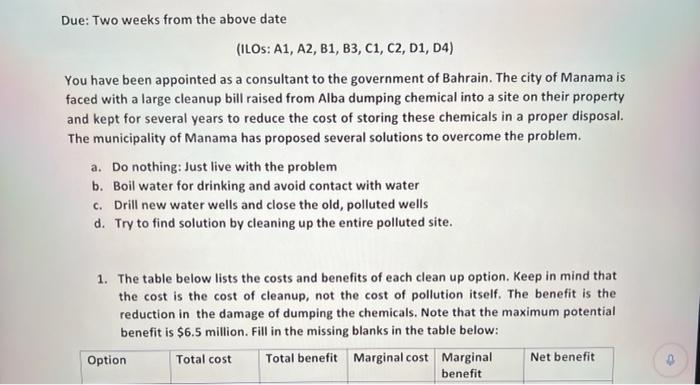
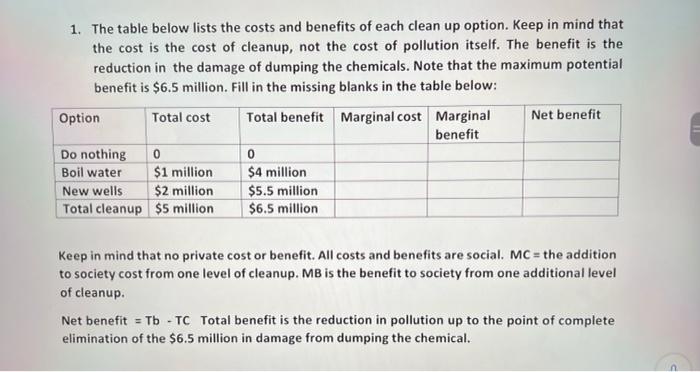
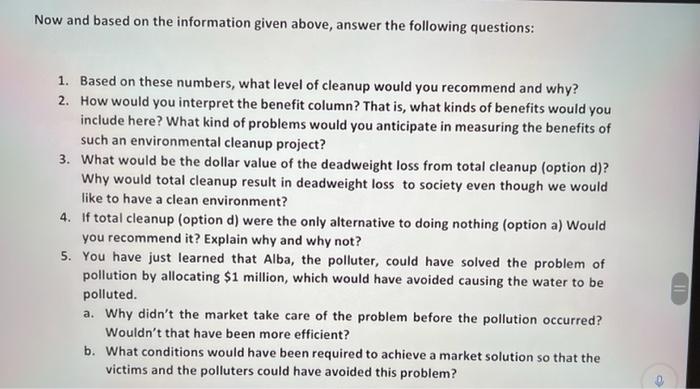
Due: Two weeks from the above date (ILOS: A1, A2, B1, B3, C1, C2, D1, D4) You have been appointed as a consultant to the government of Bahrain. The city of Manama is faced with a large cleanup bill raised from Alba dumping chemical into a site on their property and kept for several years to reduce the cost of storing these chemicals in a proper disposal. a The municipality of Manama has proposed several solutions to overcome the problem. a. Do nothing: Just live with the problem b. Boil water for drinking and avoid contact with water c. Drill new water wells and close the old, polluted wells d. Try to find solution by cleaning up the entire polluted site. 1. The table below lists the costs and benefits of each clean up option. Keep in mind that the cost is the cost of cleanup, not the cost of pollution itself. The benefit is the reduction in the damage of dumping the chemicals. Note that the maximum potential benefit is $6.5 million. Fill in the missing blanks in the table below: Option Total cost Net benefit Total benefit Marginal cost Marginal benefit 1. The table below lists the costs and benefits of each clean up option. Keep in mind that the cost is the cost of cleanup, not the cost of pollution itself. The benefit is the reduction in the damage of dumping the chemicals. Note that the maximum potential benefit is $6.5 million. Fill in the missing blanks in the table below: Option Total cost Total benefit Marginal cost Marginal Net benefit benefit Do nothing 0 0 Boil water $1 million $4 million New wells $2 million $5.5 million Total cleanup $5 million $6.5 million Il Keep in mind that no private cost or benefit. All costs and benefits are social. MC = the addition to society cost from one level of cleanup. MB is the benefit to society from one additional level of cleanup. Net benefit = Tb - TC Total benefit is the reduction in pollution up to the point of complete elimination of the $6.5 million in damage from dumping the chemical. Now and based on the information given above, answer the following questions: w 1. Based on these numbers, what level of cleanup would you recommend and why? 2. How would you interpret the benefit column? That is what kinds of benefits would you include here? What kind of problems would you anticipate in measuring the benefits of such an environmental cleanup project? 3. What would be the dollar value of the deadweight loss from total cleanup (option d)? Why would total cleanup result in deadweight loss to society even though we would like to have a clean environment? 4. If total cleanup (option d) were the only alternative to doing nothing (option a) Would you recommend it? Explain why and why not? 5. You have just learned that Alba, the polluter, could have solved the problem of pollution by allocating $1 million, which would have avoided causing the water to be polluted. a. Why didn't the market take care of the problem before the pollution occurred? Wouldn't that have been more efficient? b. What conditions would have been required to achieve a market solution so that the victims and the polluters could have avoided this problem? Due: Two weeks from the above date (ILOS: A1, A2, B1, B3, C1, C2, D1, D4) You have been appointed as a consultant to the government of Bahrain. The city of Manama is faced with a large cleanup bill raised from Alba dumping chemical into a site on their property and kept for several years to reduce the cost of storing these chemicals in a proper disposal. a The municipality of Manama has proposed several solutions to overcome the problem. a. Do nothing: Just live with the problem b. Boil water for drinking and avoid contact with water c. Drill new water wells and close the old, polluted wells d. Try to find solution by cleaning up the entire polluted site. 1. The table below lists the costs and benefits of each clean up option. Keep in mind that the cost is the cost of cleanup, not the cost of pollution itself. The benefit is the reduction in the damage of dumping the chemicals. Note that the maximum potential benefit is $6.5 million. Fill in the missing blanks in the table below: Option Total cost Net benefit Total benefit Marginal cost Marginal benefit 1. The table below lists the costs and benefits of each clean up option. Keep in mind that the cost is the cost of cleanup, not the cost of pollution itself. The benefit is the reduction in the damage of dumping the chemicals. Note that the maximum potential benefit is $6.5 million. Fill in the missing blanks in the table below: Option Total cost Total benefit Marginal cost Marginal Net benefit benefit Do nothing 0 0 Boil water $1 million $4 million New wells $2 million $5.5 million Total cleanup $5 million $6.5 million Il Keep in mind that no private cost or benefit. All costs and benefits are social. MC = the addition to society cost from one level of cleanup. MB is the benefit to society from one additional level of cleanup. Net benefit = Tb - TC Total benefit is the reduction in pollution up to the point of complete elimination of the $6.5 million in damage from dumping the chemical. Now and based on the information given above, answer the following questions: w 1. Based on these numbers, what level of cleanup would you recommend and why? 2. How would you interpret the benefit column? That is what kinds of benefits would you include here? What kind of problems would you anticipate in measuring the benefits of such an environmental cleanup project? 3. What would be the dollar value of the deadweight loss from total cleanup (option d)? Why would total cleanup result in deadweight loss to society even though we would like to have a clean environment? 4. If total cleanup (option d) were the only alternative to doing nothing (option a) Would you recommend it? Explain why and why not? 5. You have just learned that Alba, the polluter, could have solved the problem of pollution by allocating $1 million, which would have avoided causing the water to be polluted. a. Why didn't the market take care of the problem before the pollution occurred? Wouldn't that have been more efficient? b. What conditions would have been required to achieve a market solution so that the victims and the polluters could have avoided this
Step by Step Solution
There are 3 Steps involved in it

Get step-by-step solutions from verified subject matter experts
 Study Help