







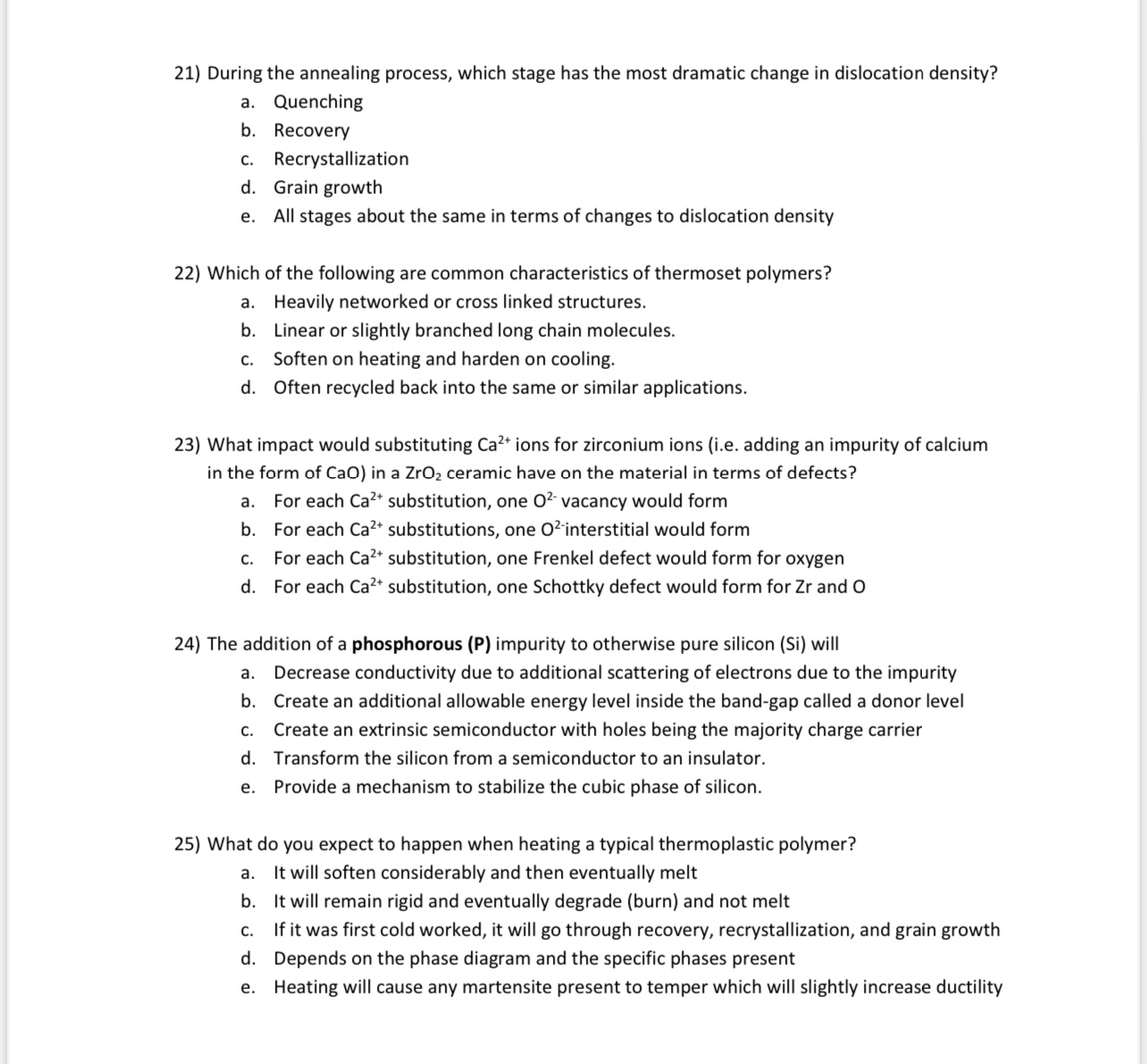
Question: During the annealing process, which stage has the most dramatic change in dislocation density? a . Quenching b . Recovery c . Recrystallization d .
During the annealing process, which stage has the most dramatic change in dislocation density?
a Quenching
b Recovery
c Recrystallization
d Grain growth
e All stages about the same in terms of changes to dislocation density
Which of the following are common characteristics of thermoset polymers?
a Heavily networked or cross linked structures.
b Linear or slightly branched long chain molecules.
c Soften on heating and harden on cooling.
d Often recycled back into the same or similar applications.
What impact would substituting ions for zirconium ions ie adding an impurity of calcium in the form of CaO in a ceramic have on the material in terms of defects?
a For each substitution, one vacancy would form
b For each substitutions, one
c For each substitution, one Frenkel defect would form for oxygen
d For each substitution, one Schottky defect would form for and
The addition of a phosphorous P impurity to otherwise pure silicon Si will
a Decrease conductivity due to additional scattering of electrons due to the impurity
b Create an additional allowable energy level inside the bandgap called a donor level
c Create an extrinsic semiconductor with holes being the majority charge carrier
d Transform the silicon from a semiconductor to an insulator.
e Provide a mechanism to stabilize the cubic phase of silicon.
What do you expect to happen when heating a typical thermoplastic polymer?
a It will soften considerably and then eventually melt
b It will remain rigid and eventually degrade burn and not melt
c If it was first cold worked, it will go through recovery, recrystallization, and grain growth
d Depends on the phase diagram and the specific phases present
e Heating will cause any martensite present to temper which will slightly increase ductility
Step by Step Solution
There are 3 Steps involved in it
1 Expert Approved Answer
Step: 1 Unlock

Question Has Been Solved by an Expert!
Get step-by-step solutions from verified subject matter experts
Step: 2 Unlock
Step: 3 Unlock
 Study Help