







Question: During the candidate itemset generation in the Apriori method from L to Ck+1, we use a rule to judge when we can merge two
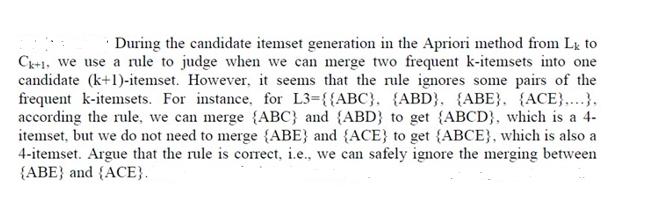
During the candidate itemset generation in the Apriori method from L to Ck+1, we use a rule to judge when we can merge two frequent k-itemsets into one candidate (k+1)-itemset. However, it seems that the rule ignores some pairs of the frequent k-itemsets. For instance, for L3={{ABC). (ABD). (ABE). {ACE)....). according the rule, we can merge (ABC) and (ABD) to get (ABCD), which is a 4- itemset, but we do not need to merge (ABE) and (ACE) to get {ABCE), which is also a 4-itemset. Argue that the rule is correct, i.e., we can safely ignore the merging between (ABE) and {ACE}.
Step by Step Solution
There are 3 Steps involved in it

Get step-by-step solutions from verified subject matter experts
 Study Help