



Question: dx Solve the equation f(x) = 0 to find the critical points of the given autonomous differential equation @ =f(x). Analyze the sign of f(x)
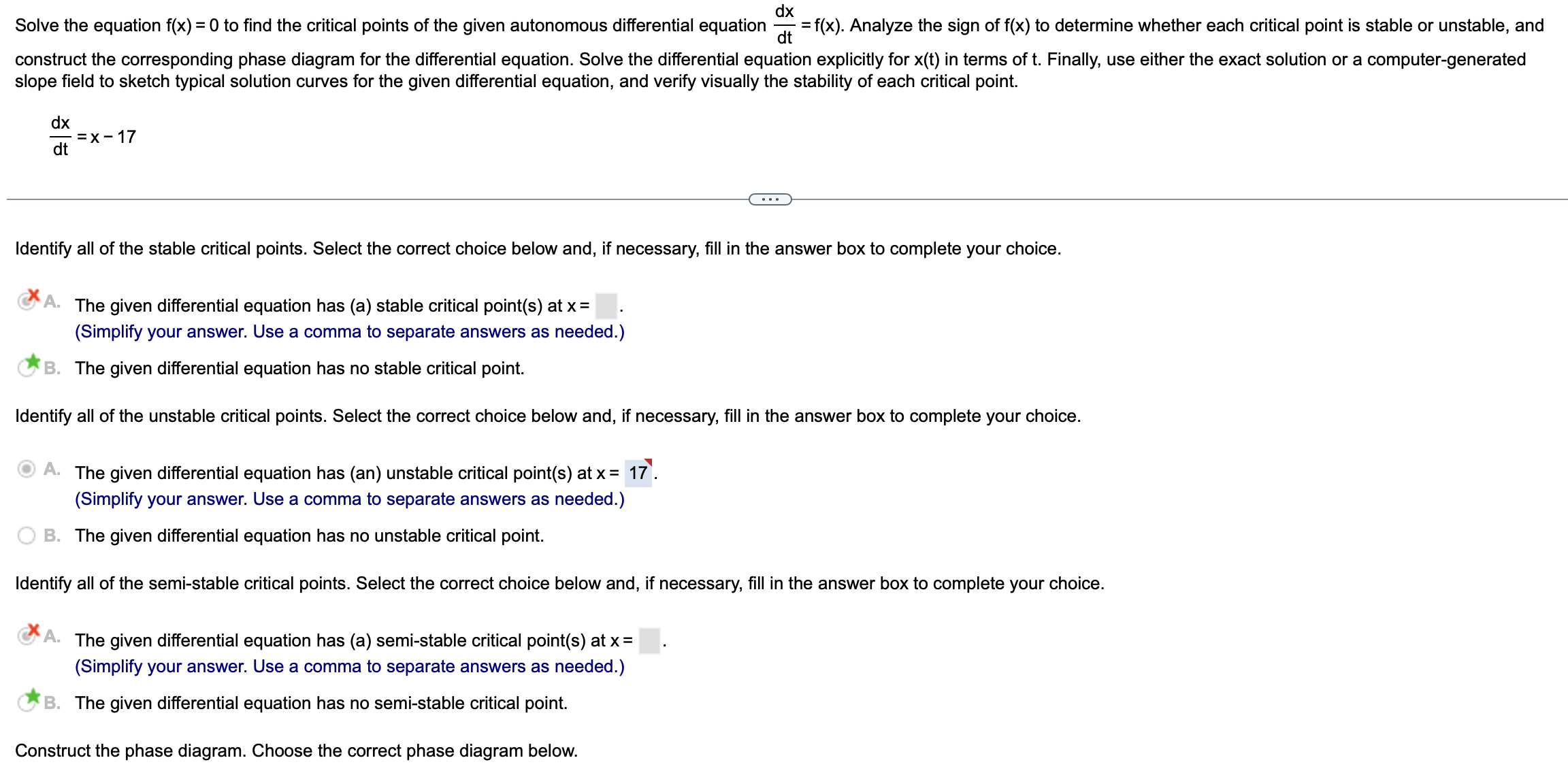
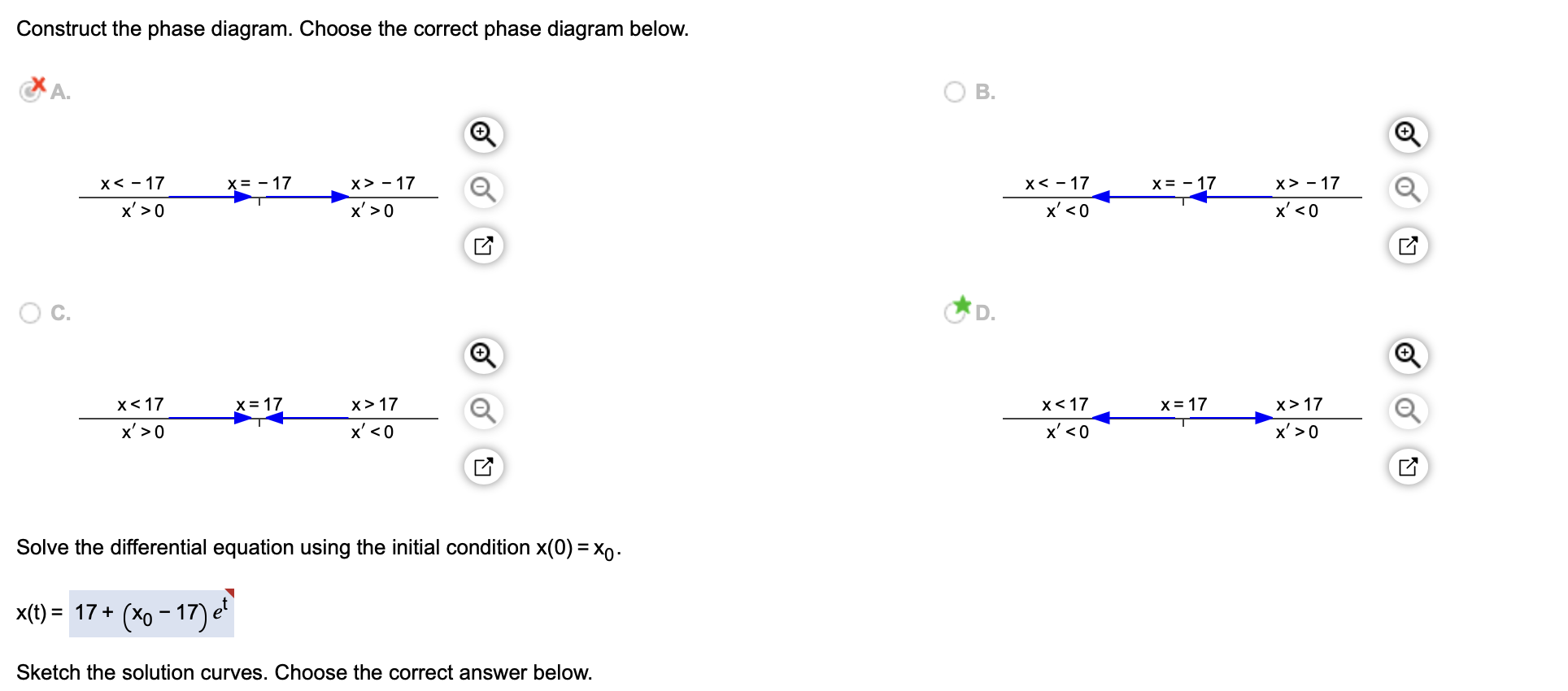
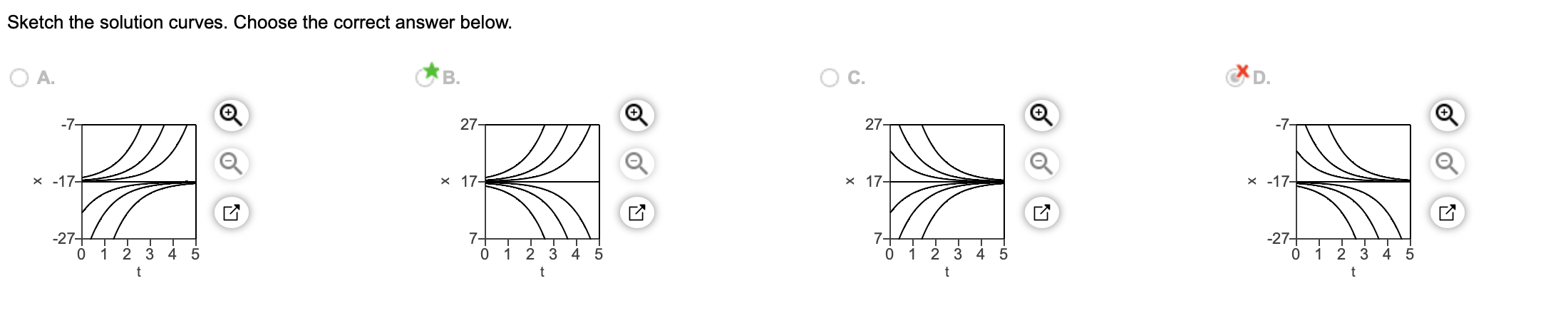
dx Solve the equation f(x) = 0 to find the critical points of the given autonomous differential equation @ =f(x). Analyze the sign of f(x) to determine whether each critical point is stable or unstable, and construct the corresponding phase diagram for the differential equation. Solve the differential equation explicitly for x(t) in terms of t. Finally, use either the exact solution or a computer-generated slope field to sketch typical solution curves for the given differential equation, and verify visually the stability of each critical point. E=X17 - Identify all of the stable critical points. Select the correct choice below and, if necessary, fill in the answer box to complete your choice. The given differential equation has (a) stable critical point(s) at x = (Simplify your answer. Use a comma to separate answers as needed.) The given differential equation has no stable critical point. Identify all of the unstable critical points. Select the correct choice below and, if necessary, fill in the answer box to complete your choice. The given differential equation has (an) unstable critical point(s) at x = 17", (Simplify your answer. Use a comma to separate answers as needed.) The given differential equation has no unstable critical point. Identify all of the semi-stable critical points. Select the correct choice below and, if necessary, fill in the answer box to complete your choice. The given differential equation has (a) semi-stable critical point(s) at x= (Simplify your answer. Use a comma to separate answers as needed.) The given differential equation has no semi-stable critical point. Construct the phase diagram. Choose the correct phase diagram below. Construct the phase diagram. Choose the correct phase diagram below. X A. O B. X - 17 X - 17 x' > 0 x' > 0 x' 17 X 17 x'> 0 X' 0 Solve the differential equation using the initial condition x(0) = XO. x(t) = 17 + (xo -17) et Sketch the solution curves. Choose the correct answer below.Sketch the solution curves. Choose the correct answer below. B. O c. XD. O A. 27- 27 x 17- x -17- x -17 x 17- 7- - 27+ -27- 1 2 3 4 5 0 1 2 3 4 5 0 2 3
Step by Step Solution
There are 3 Steps involved in it

Get step-by-step solutions from verified subject matter experts