


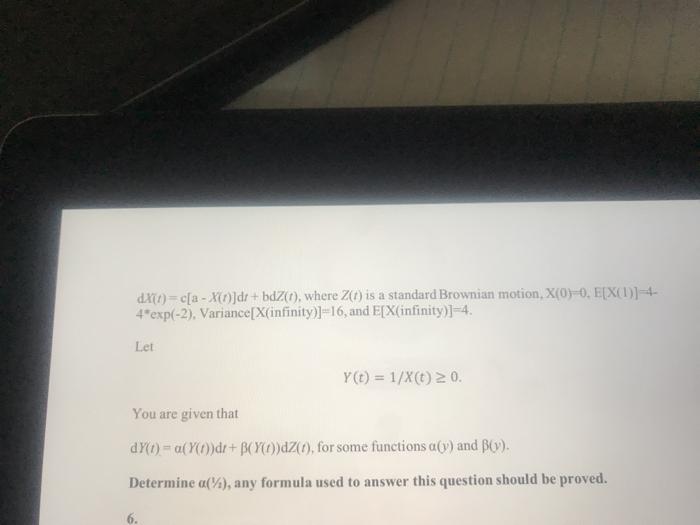
Question: dXD) - C[a - XO}dr + bdzo, where Z() is a standard Brownian motion, X(0)-0. E[X(1)]-4- 4*exp(-2), Variance[X(infinity)]-16, and E[X(infinity)]=4. Let Y(t) = 1/X(t) 20.
dXD) - C[a - XO}dr + bdzo, where Z() is a
dXD) - C[a - XO}dr + bdzo, where Z() is a standard Brownian motion, X(0)-0. E[X(1)]-4- 4*exp(-2), Variance[X(infinity)]-16, and E[X(infinity)]=4. Let Y(t) = 1/X(t) 20. You are given that dy(t) = a(Y()dr+B(YO)(), for some functions a() and B). Determine a(V), any formula used to answer this question should be proved. dXD) - C[a - XO}dr + bdzo, where Z() is a standard Brownian motion, X(0)-0. E[X(1)]-4- 4*exp(-2), Variance[X(infinity)]-16, and E[X(infinity)]=4. Let Y(t) = 1/X(t) 20. You are given that dy(t) = a(Y()dr+B(YO)(), for some functions a() and B). Determine a(V), any formula used to answer this question should be proved

Step by Step Solution

There are 3 Steps involved in it

1 Expert Approved Answer
Step: 1 Unlock blur-text-image

Question Has Been Solved by an Expert!

Get step-by-step solutions from verified subject matter experts

Step: 2 Unlock
Step: 3 Unlock

Students Have Also Explored These Related General Management Questions!