







Question: e) (10 points) In regression analysis, a loss function f takes as input a predicted value ? and an observed value y, and it returns
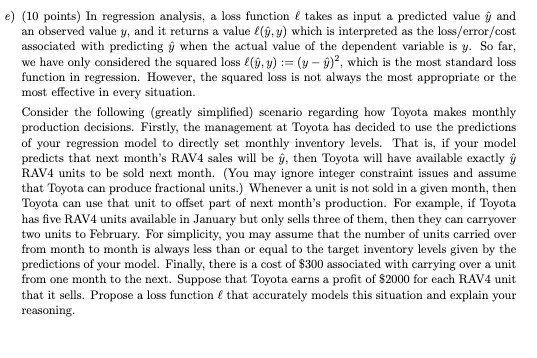
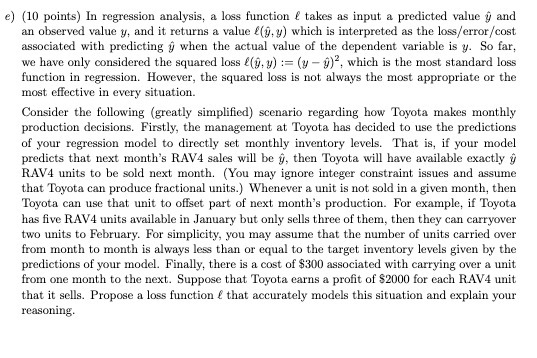
e) (10 points) In regression analysis, a loss function f takes as input a predicted value ? and an observed value y, and it returns a value f(7, () which is interpreted as the loss/error/cost associated with predicting # when the actual value of the dependent variable is y. So far, we have only considered the squared loss ((7, #) := (y -#)", which is the most standard loss function in regression. However, the squared loss is not always the most appropriate or the most effective in every situation. Consider the following (greatly simplified) scenario regarding how Toyota makes monthly production decisions. Firstly, the management at Toyota has decided to use the predictions of your regression model to directly set monthly inventory levels. That is, if your model predicts that next month's RAV4 sales will be y, then Toyota will have available exactly ? RAV4 units to be sold next month. (You may ignore integer constraint issues and assume that Toyota can produce fractional units.) Whenever a unit is not sold in a given month, then Toyota can use that unit to offset part of next month's production. For example, if Toyota has five RAV4 units available in January but only sells three of them, then they can carryover two units to February. For simplicity, you may assume that the number of units carried over from month to month is always less than or equal to the target inventory levels given by the predictions of your model. Finally, there is a cost of $300 associated with carrying over a unit from one month to the next. Suppose that Toyota earns a profit of $2000 for each RAV4 unit that it sells. Propose a loss function / that accurately models this situation and explain your reasoning
Step by Step Solution
There are 3 Steps involved in it

Get step-by-step solutions from verified subject matter experts
 Study Help