



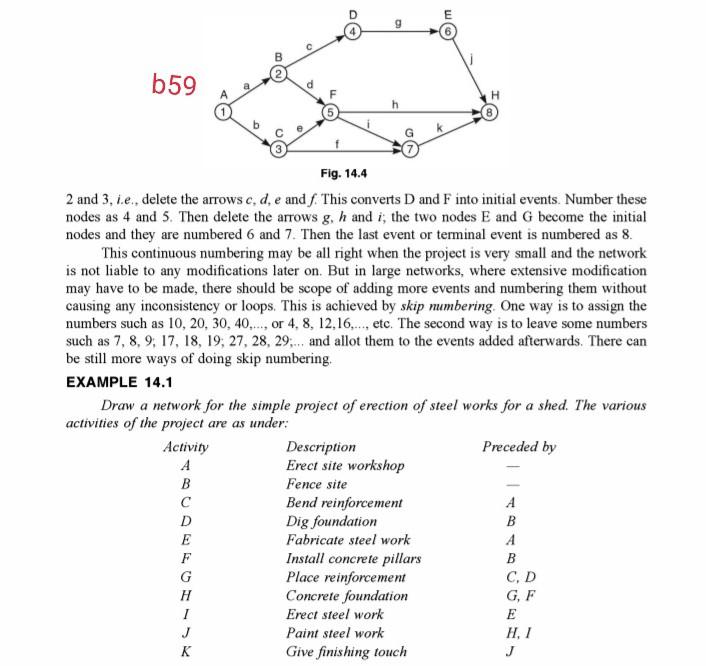
Question: . E 2 b59 d F h Fig. 14.4 2 and 3, i.e., delete the arrows c, d, e and f. This converts D and
.
E 2 b59 d F h Fig. 14.4 2 and 3, i.e., delete the arrows c, d, e and f. This converts D and F into initial events. Number these nodes as 4 and 5. Then delete the arrows g, h and i, the two nodes E and G become the initial nodes and they are numbered 6 and 7. Then the last event or terminal event is numbered as 8. This continuous numbering may be all right when the project is very small and the network is not liable to any modifications later on. But in large networks, where extensive modification may have to be made, there should be scope of adding more events and numbering them without causing any inconsistency or loops. This is achieved by skip numbering. One way is to assign the numbers such as 10, 20, 30, 40,.., or 4, 8, 12,16..., etc. The second way is to leave some numbers such as 7,8,9; 17, 18, 19, 27, 28, 29... and allot them to the events added afterwards. There can be still more ways of doing skip numbering, EXAMPLE 14.1 Draw a network for the simple project of erection of steel works for a shed. The various activities of the project are as under: Activity Description Preceded by Erect site workshop B Fence site Bend reinforcement D Dig foundation B E Fabricate steel work A F Install concrete pillars B G Place reinforcement C D H Concrete foundation GF 1 Erect steel work E J Paint steel work HT K Give finishing touch JStep by Step Solution
There are 3 Steps involved in it
1 Expert Approved Answer
Step: 1 Unlock

Question Has Been Solved by an Expert!
Get step-by-step solutions from verified subject matter experts
Step: 2 Unlock
Step: 3 Unlock