







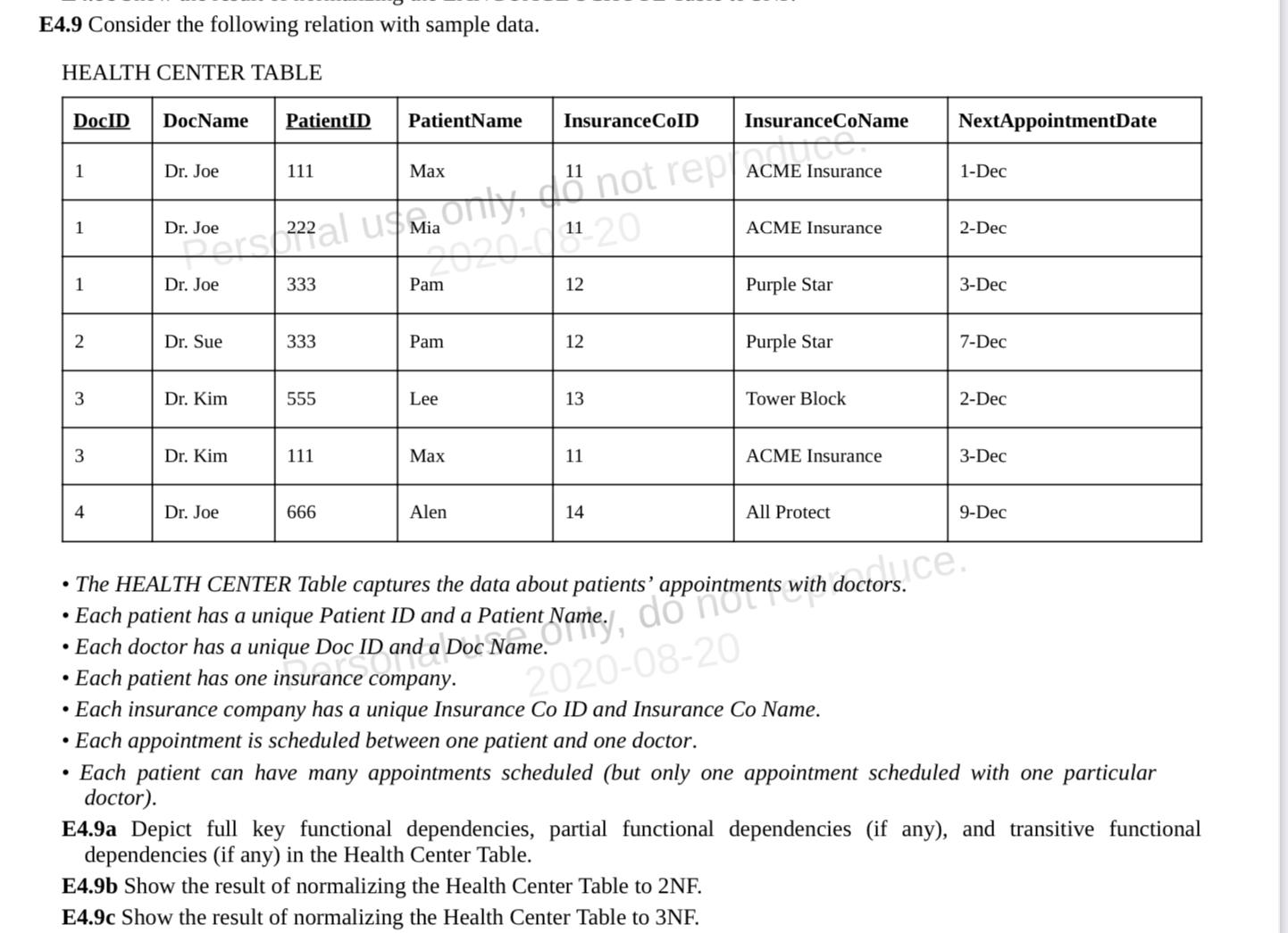
Question: E 4 . 9 Consider the following relation with sample data. HEALTH CENTER TABLE table [ [ DocID ? ( ) , DocName, PatientID
E Consider the following relation with sample data.
HEALTH CENTER TABLE
table DocID DocName, PatientID PatientName,InsuranceCoID,InsuranceCoName,NextAppointmentDateDr Joe,Max,ACME Insurance,DecDr Joe, UMia,ACME Insurance,DecDr Joe,Pam,Purple Star,DecDr Sue,Pam,Purple Star,DecDr Kim,Lee,Tower Block,DecDr Kim,Max,ACME Insurance,DecDr Joe,Alen,All Protect,Dec
The HEALTH CENTER Table captures the data about patients' appointments with doctors.
Each patient has a unique Patient ID and a Patient Name.
Each doctor has a unique Doc ID and a Doc Name.
Each patient has one insurance company.
Each insurance company has a unique Insurance Co ID and Insurance Co Name.
Each appointment is scheduled between one patient and one doctor.
Each patient can have many appointments scheduled but only one appointment scheduled with one particular doctor
Ea Depict full key functional dependencies, partial functional dependencies if any and transitive functional dependencies if any in the Health Center Table.
Eb Show the result of normalizing the Health Center Table to NF
Ec Show the result of normalizing the Health Center Table to NF
Step by Step Solution
There are 3 Steps involved in it
1 Expert Approved Answer
Step: 1 Unlock

Question Has Been Solved by an Expert!
Get step-by-step solutions from verified subject matter experts
Step: 2 Unlock
Step: 3 Unlock
 Study Help