Question: E CASE STUDY 62 . - Protecting workers, businesses and society during times of crisis through flexible working At the time of writing Worl 2020,
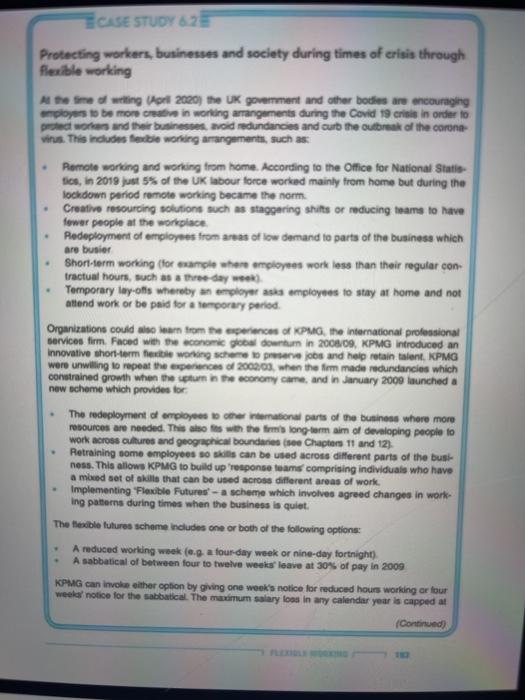
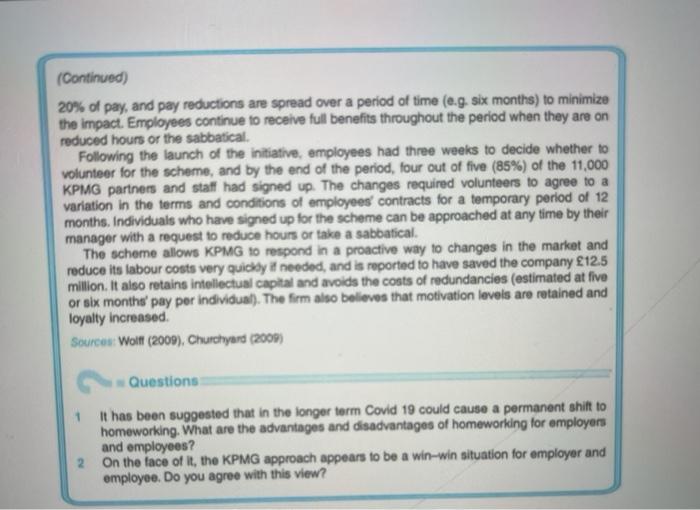
E CASE STUDY 62 . - Protecting workers, businesses and society during times of crisis through flexible working At the time of writing Worl 2020, the UK government and other bodies are encouraging ployers to be more creative in working arrangements during the Covid 19 crisis in order to protect worlans and their businesses avoid redundances and curb the outbreak of the corona Wirus. This includes feble woning arrangements, such as Remote worting and working from home. According to the Office for National Statie tics, in 2019 Just 5% of the UK labour force worked mainly from home but during the lockdown period remote working became the norm. Creative resourcing solutions such as staggering shifts or reducing teams to have fewer people at the workplace. Redeployment of employees from areas of low demand to parts of the business which are busier Short-term working (for example where employees work less than their regular con tractual hours, such as a three-day w Temporary lay-offs whereby an employer asks employees to stay at home and not attend work or be paid for a temporary period. Organizations could also learn from the experiences of KPMG, the international professional services firm. Faced with the economic gol dowrum in 2008/09, KPMG Introduced an Innovative short-term exible working scheme to preserve jobs and help retain talent, KPMG were unwilling to repeat the experiences of 2009/03, when the firm made redundancies which constrained growth when the upturn in the economy come, and in January 2009 launched a new scheme which provides for The redeployment of employees to reational parts of the business where more resources are needed. This also with the long term aim of developing people to work across cultures and geographical boundaries Chapter 11 and 12) Retraining some employees so skills can be used across different parts of the busi ness. This allows KPMG to build up response teams comprising individuals who have a mixed set of skills that can be used across different areas of work. Implementing Flexible Futures -a scheme which involves agreed changes in work ing patterns during times when the business is quiet The thesible futures scheme includes one or both of the following options A reduced working week (e. a four-day week or nine-day fortnight) A sabbatical of between four to twelve weeks leave at 30% of pay in 2009 KPMG can invokeelther option by giving one week's notice for reduced hours working or four wel notice for the sabbatical. The maimum salary loos in any calendar year is capped at (Continued (Continued) 20% of pay, and pay reductions are spread over a period of time (0.g. six months) to minimize the impact. Employees continue to receive full benefits throughout the period when they are on reduced hours or the sabbatical Following the launch of the initiative, employees had three weeks to decide whether to volunteer for the scheme, and by the end of the period, four out of five (85%) of the 11,000 KPMG partners and staff had signed up. The changes required volunteers to agree to a variation in the terms and conditions of employees contracts for a temporary period of 12 months. Individuals who have signed up for the scheme can be approached at any time by their manager with a request to reduce hours or take a sabbatical. The scheme allows KPMG to respond in a proactive way to changes in the market and reduce its labour costs very quichy i needed, and is reported to have saved the company 12.5 million. It also retains intellectual capital and avoids the costs of redundancies (estimated at five or six months' pay per individual). The firm also believes that motivation levels are retained and loyalty Increased Sources: Wolf (2009), Churchyard (2009) Questions It has been suggested that in the longer term Covid 19 could cause a permanent shift to homeworking. What are the advantages and disadvantages of homeworking for employers and employees? On the face of it, the KPMG approach appears to be a win-win situation for employer and employee. Do you agree with this view? 2









 Study Help