



Question: (e) Determine the eigenpairs (i.e. (21, VI ) and (12, v2)) for this system. Note that this matrix is a special case of the matrix
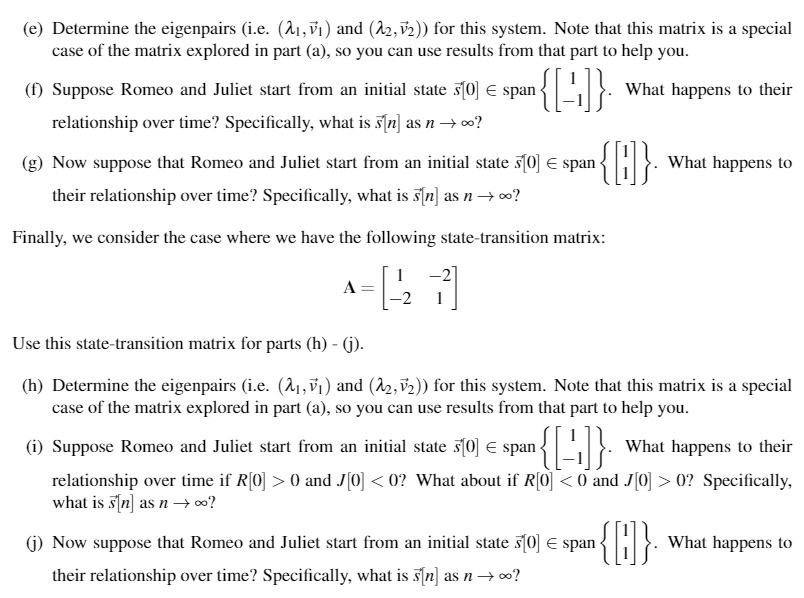
(e) Determine the eigenpairs (i.e. (21, VI ) and (12, v2)) for this system. Note that this matrix is a special case of the matrix explored in part (a), so you can use results from that part to help you. (f) Suppose Romeo and Juliet start from an initial state $10] e span { , ]} What happens to their relationship over time? Specifically, what is s(n] as n - co? (g) Now suppose that Romeo and Juliet start from an initial state $[0] C span What happens to their relationship over time? Specifically, what is s'(n] as n - co? Finally, we consider the case where we have the following state-transition matrix: A = Use this state-transition matrix for parts (h) - (j). (h) Determine the eigenpairs (i.e. (21, vi ) and (12, v2)) for this system. Note that this matrix is a special case of the matrix explored in part (a), so you can use results from that part to help you. (i) Suppose Romeo and Juliet start from an initial state s(0] e span _, What happens to their relationship over time if R[0] > 0 and /[0] 0? Specifically, what is s n as n -> co? (j) Now suppose that Romeo and Juliet start from an initial state s[0] C span What happens to their relationship over time? Specifically, what is s(n] as n -> co
Step by Step Solution
There are 3 Steps involved in it

Get step-by-step solutions from verified subject matter experts