Question: E E 2 TT AaBbCcDdEe AaBbCcDdEe AaBbCcDdEe AaBb CcD Heading 1 List Paragraph Normal No Spacing Headi BCOM 3306 Business Communication Individual Bad-News (Negative) Message
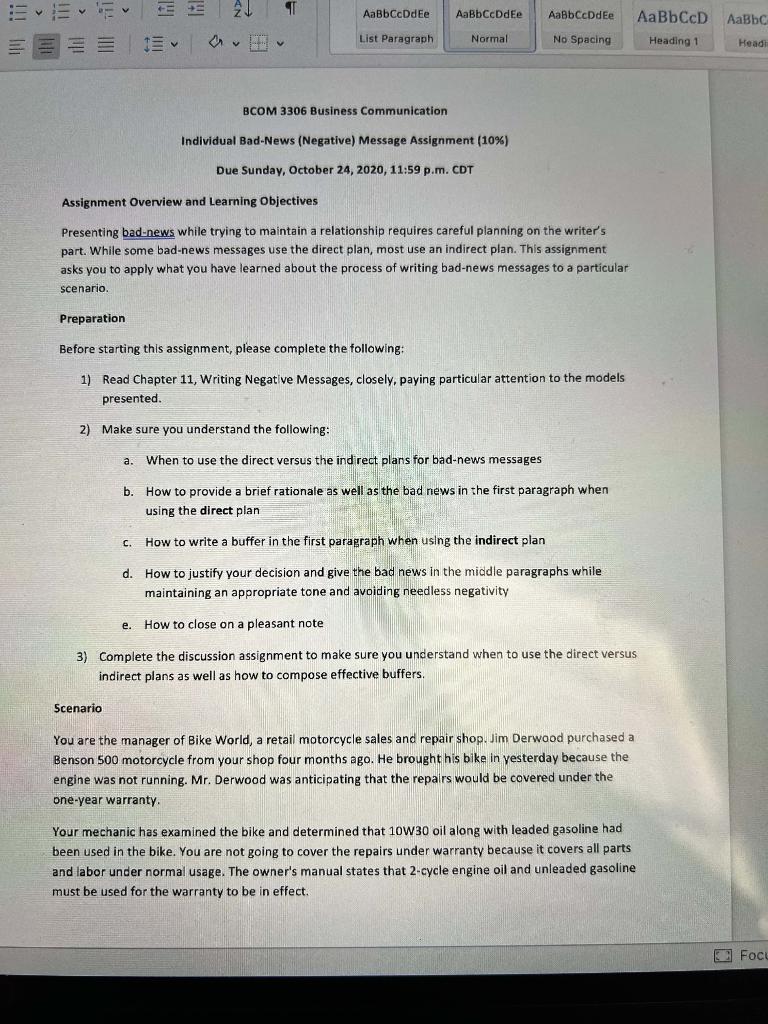
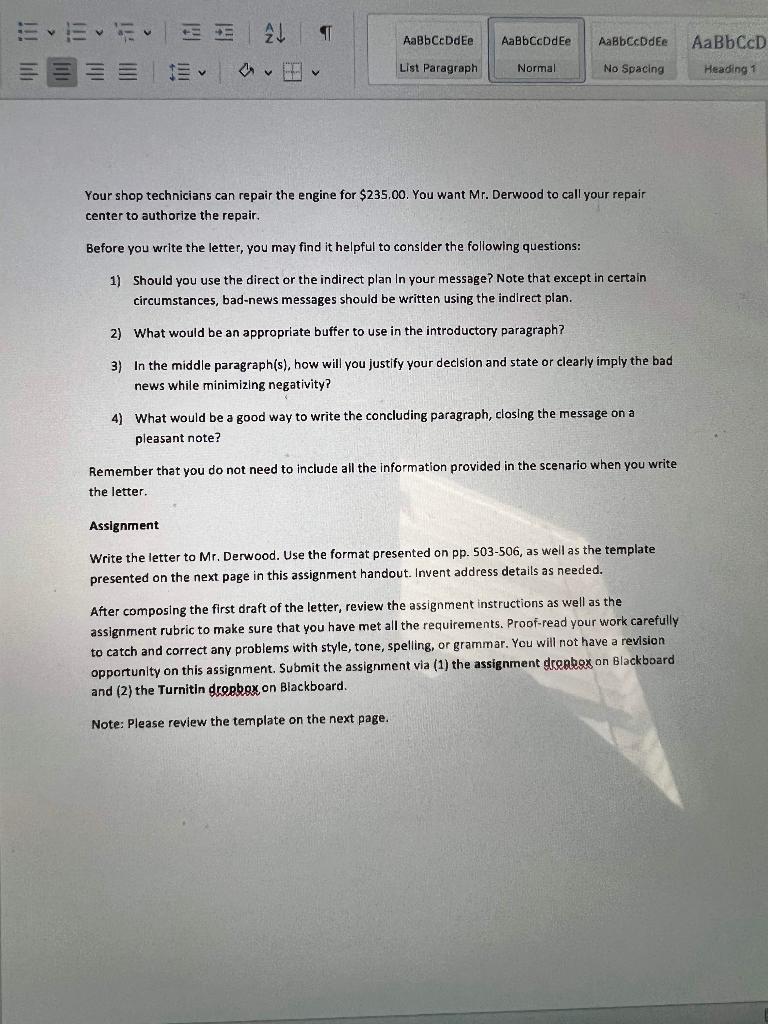
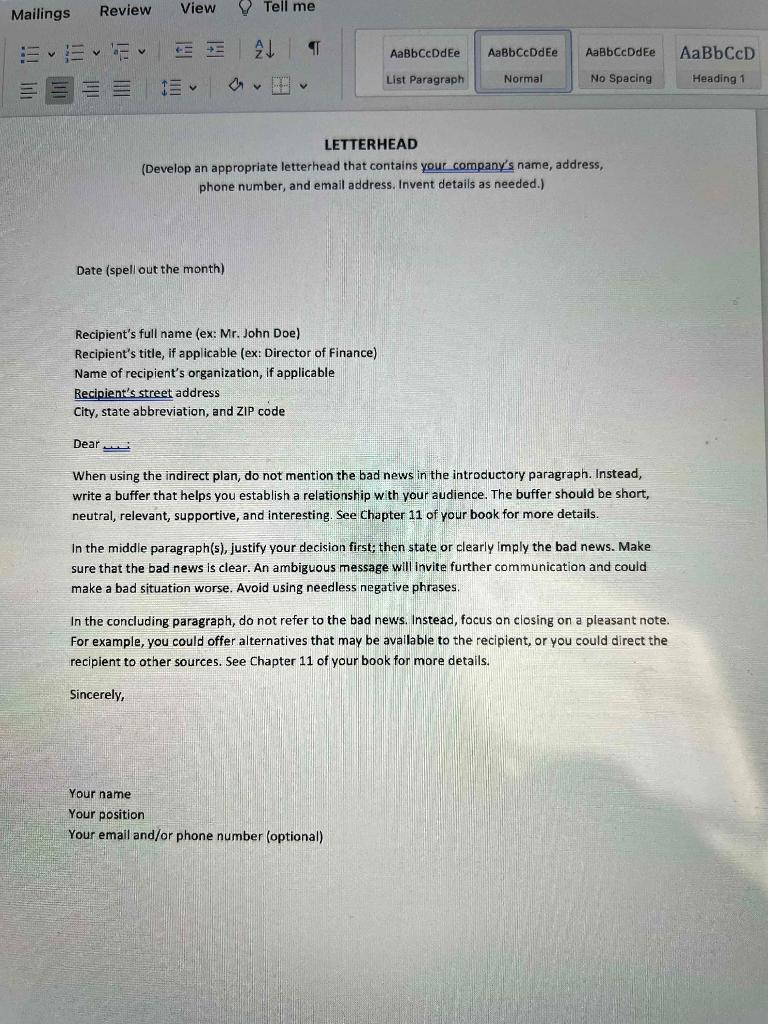
E E 2 TT AaBbCcDdEe AaBbCcDdEe AaBbCcDdEe AaBb CcD Heading 1 List Paragraph Normal No Spacing Headi BCOM 3306 Business Communication Individual Bad-News (Negative) Message Assignment (10%) Due Sunday, October 24, 2020, 11:59 p.m. CDT Assignment Overview and Learning Objectives Presenting bad news while trying to maintain a relationship requires careful planning on the writer's part. While some bad news messages use the direct plan, most use an indirect plan. This assignment asks you to apply what you have learned about the process of writing bad-news messages to a particular scenario. Preparation Before starting this assignment, please complete the following: 1) Read Chapter 11, Writing Negative Messages, closely, paying particular attention to the models presented. 2) Make sure you understand the following: a. When to use the direct versus the indirect plans for bad-news messages b. How to provide a brief rationale as well as the bad news in the first paragraph when using the direct plan C. How to write a buffer in the first paragraph when using the indirect plan d. How to justify your decision and give the bad news in the middle paragraphs while maintaining an appropriate tone and avoiding needless negativity e. How to close on a pleasant note 3) Complete the discussion assignment to make sure you understand when to use the direct versus indirect plans as well as how to compose effective buffers. Scenario You are the manager of Bike World, a retail motorcycle sales and repair shop. Jim Derwood purchased a Benson 500 motorcycle from your shop four months ago. He brought his bike in yesterday because the engine was not running. Mr. Derwood was anticipating that the repairs would be covered under the one-year warranty. Your mechanic has examined the bike and determined that 10W30 oil along with leaded gasoline had been used in the bike. You are not going to cover the repairs under warranty because it covers all parts and labor under normal usage. The owner's manual states that 2-cycle engine oil and unleaded gasoline must be used for the warranty to be in effect. Focu 21 AaBbCcDdEe AaBbCcDdEe AaBbCcDdEe AaBb CCD List Paragraph Normal No Spacing Heading 1 Your shop technicians can repair the engine for $235.00. You want Mr. Derwood to call your repair center to authorize the repair. Before you write the letter, you may find it helpful to consider the following questions: 1) Should you use the direct or the indirect plan in your message? Note that except in certain circumstances, bad-news messages should be written using the indirect plan. 2) What would be an appropriate buffer to use in the introductory paragraph? 3) In the middle paragraph(s), how will you justify your decision and state or clearly imply the bad news while minimizing negativity? 4) What would be a good way to write the concluding paragraph, closing the message on a pleasant note? Remember that you do not need to include all the information provided in the scenario when you write the letter. Assignment Write the letter to Mr. Derwood. Use the format presented on pp. 503-506, as well as the template presented on the next page in this assignment handout. Invent address details as needed. After composing the first draft of the letter, review the assignment instructions as well as the assignment rubric to make sure that you have met all the requirements. Proof-read your work carefully to catch and correct any problems with style, tone, spelling, or grammar. You will not have a revision opportunity on this assignment. Submit the assignment via (1) the assignment dropbox on Blackboard and (2) the Turnitin gropbox on Blackboard. Note: Please review the template on the next page. Mailings Review View Tell me 21 AaBbCcDdEe AaBbCcDdEe AaBbCcDdEe AaBbCcD List Paragraph Normal No Spacing Heading 1 LETTERHEAD (Develop an appropriate letterhead that contains your company's name, address, phone number, and email address. Invent details as needed.) Date (spell out the month) Recipient's full name (ex: Mr. John Doe) Recipient's title, if applicable (ex: Director of Finance) Name of recipient's organization, if applicable Recipient's street address City, state abbreviation, and ZIP code Dear ve When using the indirect plan, do not mention the bad news in the introductory paragraph. Instead, write a buffer that helps you establish a relationship with your audience. The buffer should be short, neutral, relevant, supportive, and interesting. See Chapter 11 of your book for more details. In the middle paragraph(s), justify your decision first, then state or clearly imply the bad news. Make sure that the bad news is clear. An ambiguous message will invite further communication and could make a bad situation worse. Avoid using needless negative phrases. In the concluding paragraph, do not refer to the bad news. Instead, focus on closing on a pleasant note. For example, you could offer alternatives that may be available to the recipient, or you could direct the recipient to other sources. See Chapter 11 of your book for more details. Sincerely, Your name Your position Your email and/or phone number (optional)









 Study Help