







Question: e please 13. Two interacting Einstein solids A and B have 6 and 4 oscillators respectively and a total of 12 units of energy ()
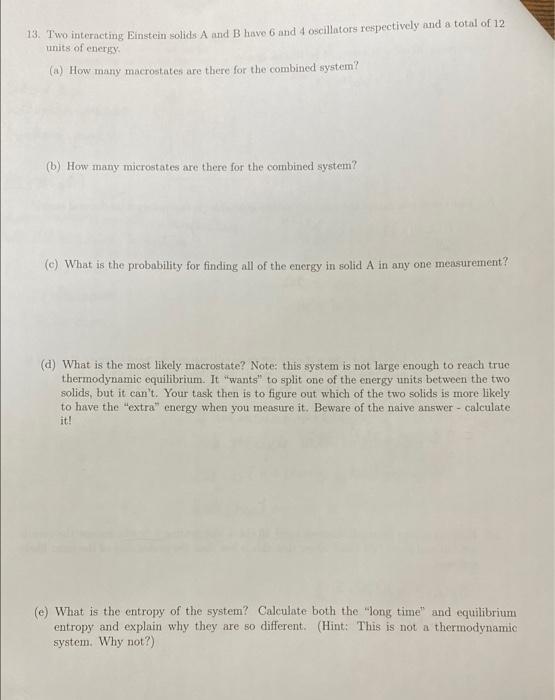
13. Two interacting Einstein solids A and B have 6 and 4 oscillators respectively and a total of 12 units of energy () How many macrostates are there for the combined system? (b) How many microstates are there for the combined system? () What is the probability for finding all of the energy in solid A in any one measurement? (d) What is the most likely macrostate? Note: this system is not large enough to reach true thermodynamic equilibrium. It "wants" to split one of the energy units between the two solids, but it can't. Your task then is to figure out which of the two solids is more likely to have the "extra" energy when you measure it. Beware of the naive answer - calculate it! (e) What is the entropy of the system? Calculate both the long time and equilibrium entropy and explain why they are so different. (Hint: This is not a thermodynamic system. Why not?) 13. Two interacting Einstein solids A and B have 6 and 4 oscillators respectively and a total of 12 units of energy () How many macrostates are there for the combined system? (b) How many microstates are there for the combined system? () What is the probability for finding all of the energy in solid A in any one measurement? (d) What is the most likely macrostate? Note: this system is not large enough to reach true thermodynamic equilibrium. It "wants" to split one of the energy units between the two solids, but it can't. Your task then is to figure out which of the two solids is more likely to have the "extra" energy when you measure it. Beware of the naive answer - calculate it! (e) What is the entropy of the system? Calculate both the long time and equilibrium entropy and explain why they are so different. (Hint: This is not a thermodynamic system. Why not?)
Step by Step Solution
There are 3 Steps involved in it

Get step-by-step solutions from verified subject matter experts
 Study Help