





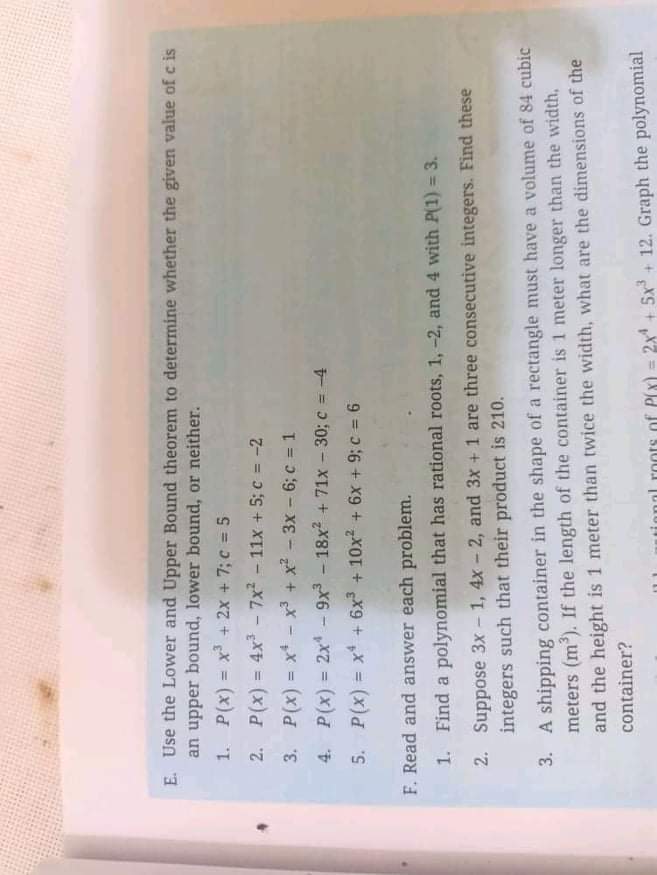
Question: E. Use the Lower and Upper Bound theorem to determine whether the given value of c is an upper bound, lower bound, or neither. 1.
E. Use the Lower and Upper Bound theorem toE. Use the Lower and Upper Bound theorem to
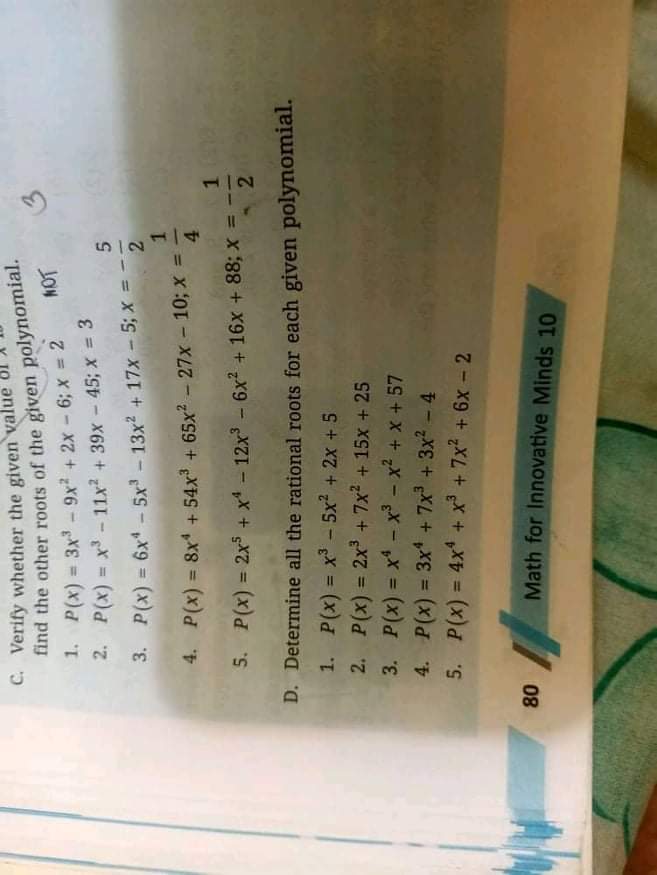
E. Use the Lower and Upper Bound theorem to determine whether the given value of c is an upper bound, lower bound, or neither. 1. P(x) = x3 + 2x + 7; 0 = 5 2. P(x) = 4x3 - 7x2 - 11x + 5; C = -2 3. P(x) = x4 - x3 + x - 3x - 6; 0 = 1 4. P(x) = 2x1 - 9x3 - 18x2 + 71x - 30; 0 = -4 5. P(x) = X4 + 6x3 + 10x2 + 6x + 9; 0 =6 F. Read and answer each problem. 1. Find a polynomial that has rational roots, 1, -2, and 4 with P(1) = 3. 2. Suppose 3x - 1, 4x - 2, and 3x + 1 are three consecutive integers. Find these integers such that their product is 210. 3. A shipping container in the shape of a rectangle must have a volume of 84 cubic meters (m3). If the length of the container is 1 meter longer than the width, and the height is 1 meter than twice the width, what are the dimensions of the container? 5x3 + 12. Graph the polynomialC. Verify whether the given value of A find the other roots of the given polynomial. 3 1. P(x) = 3x3 - 9x2 + 2x - 6; X = 2 NOT 2. P(x) = x3 - 11x2 + 39x - 45; X = 3 5 3. P(x) = 6x4 - 5x3 - 13x2 + 17x - 5; X = = 4. P(x) = 8x4 + 54x3 + 65x2 - 27x - 10; X = = 4 5. P(x) = 2x5 + x" - 12x3 - 6x2 + 16x + 88; X= 1 2 D. Determine all the rational roots for each given polynomial. 1. P(x) = x3 - 5x2 + 2x + 5 2. P(x) = 2x3 + 7x2 + 15x + 25 3. P(x) = X4 - x3 - x2 + x + 57 4. P(x) = 3x4 + 7x3 + 3x2 - 4 5. P(x) = 4x4 + x3 + 7x2 + 6x - 2 80 Math for Innovative Minds 10

Step by Step Solution

There are 3 Steps involved in it

1 Expert Approved Answer
Step: 1 Unlock blur-text-image
Question Has Been Solved by an Expert!

Get step-by-step solutions from verified subject matter experts

Step: 2 Unlock
Step: 3 Unlock

Students Have Also Explored These Related Mathematics Questions!