



Question: e. What is the third quartile 19. Suppose that the average waiting time for a patient at a physician's office is just over 29 minutes.
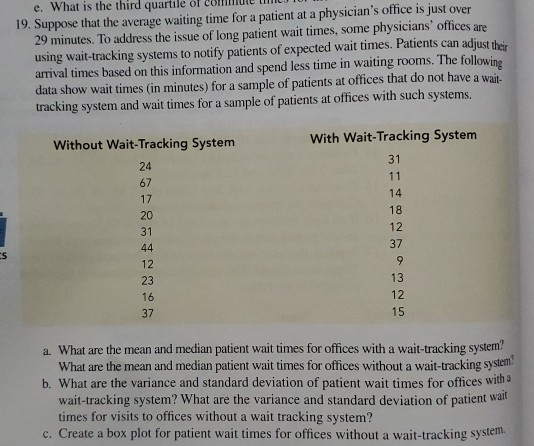

e. What is the third quartile 19. Suppose that the average waiting time for a patient at a physician's office is just over 29 minutes. To address the issue of long patient wait times, some physicians' offices are using wait-tracking systems to notify patients of expected wait times. Patients can adjust their arrival times based on this information and spend less time in waiting rooms. The following data show wait times (in minutes) for a sample of patients at offices that do not have a wait- tracking system and wait times for a sample of patients at offices with such systems. Without Wait-Tracking System 24 67 17 20 31 44 12 23 16 37 With Wait-Tracking System 31 11 14 18 12 37 9 13 12 15 a What are the mean and median patient wait times for offices with a wait-tracking system! What are the mean and median patient wait times for offices without a wait-tracking system b. What are the variance and standard deviation of patient wait times for offices with a wait-tracking system? What are the variance and standard deviation of patient wait times for visits to offices without a wait tracking system? c. Create a box plot for patient wait times for offices without a wait-tracking system. d. Create a box plot for patient wait times for offices with a wait-tracking system. e. Do offices with a wait-tracking system have shorter patient wait times than offices without a wait-tracking system? Explain
Step by Step Solution
There are 3 Steps involved in it
1 Expert Approved Answer
Step: 1 Unlock

Question Has Been Solved by an Expert!
Get step-by-step solutions from verified subject matter experts
Step: 2 Unlock
Step: 3 Unlock