







Question: E10-20 (Algo) Identifying Minimum, Maximum Transfer Prices, Determining Effect on Each Division's Profit (LO 10-6] Tulip Company is made up of two divisions: A and
![Division's Profit (LO 10-6] Tulip Company is made up of two divisions:](https://s3.amazonaws.com/si.experts.images/answers/2024/07/669512b91bffb_688669512b8961ec.jpg)
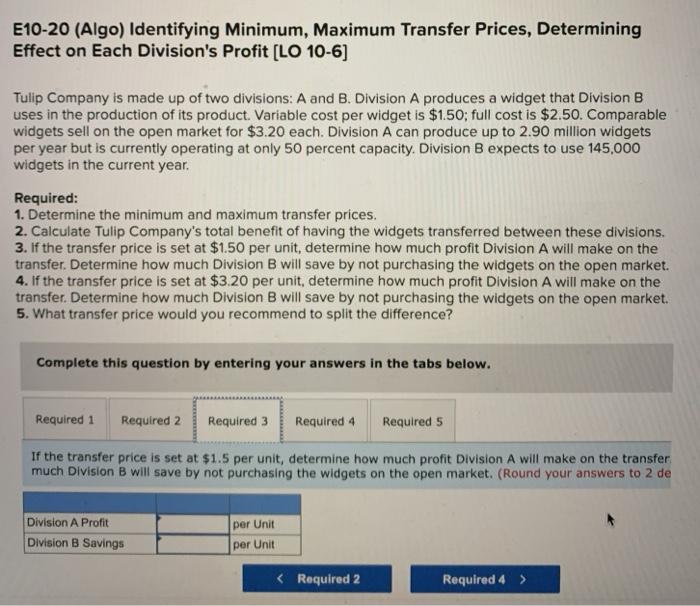
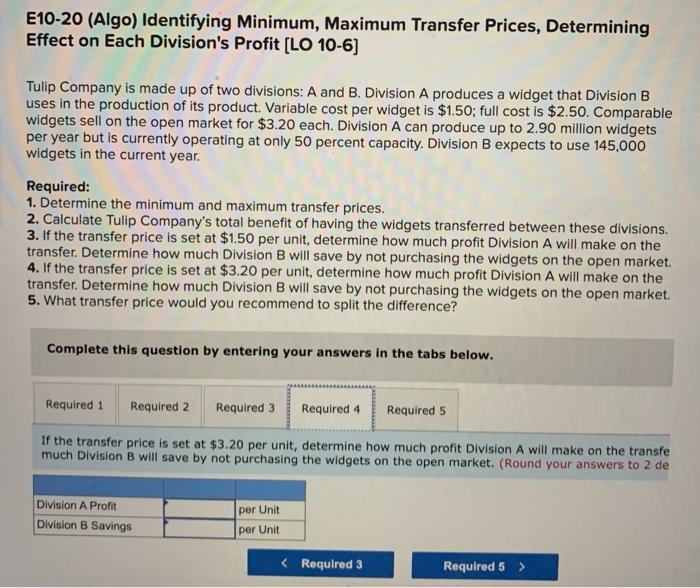
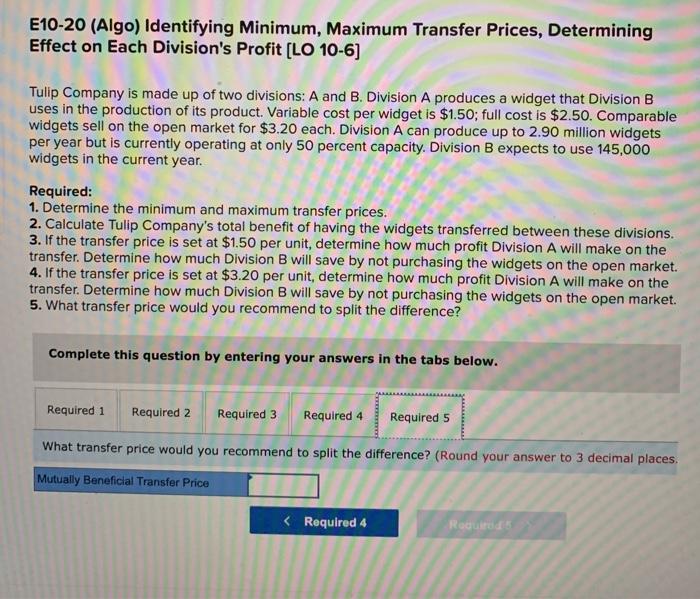
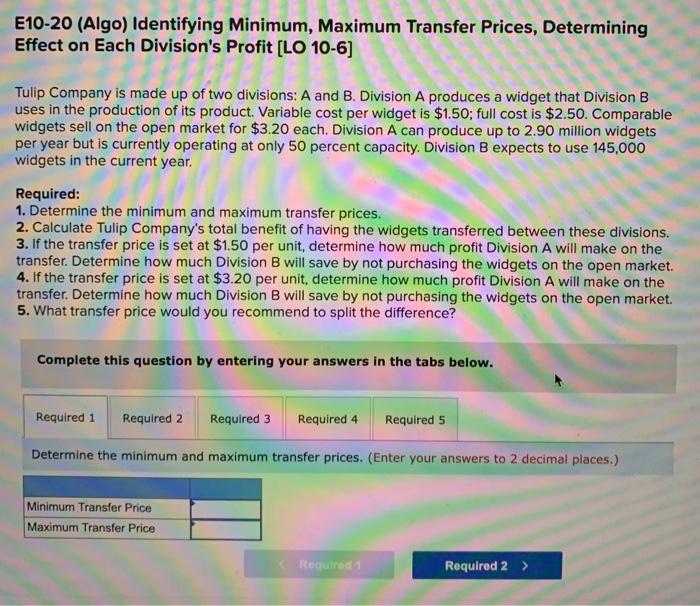
E10-20 (Algo) Identifying Minimum, Maximum Transfer Prices, Determining Effect on Each Division's Profit (LO 10-6] Tulip Company is made up of two divisions: A and B. Division A produces a widget that Division B uses in the production of its product Variable cost per widget is $1.50; full cost is $2.50. Comparable widgets sell on the open market for $3.20 each. Division A can produce up to 2.90 million widgets per year but is currently operating at only 50 percent capacity. Division B expects to use 145,000 widgets in the current year. Required: 1. Determine the minimum and maximum transfer prices. 2. Calculate Tulip Company's total benefit of having the widgets transferred between these divisions. 3. If the transfer price is set at $1.50 per unit, determine how much profit Division A will make on the transfer. Determine how much Division B will save by not purchasing the widgets on the open market. 4. If the transfer price is set at $3.20 per unit, determine how much profit Division A will make on the transfer. Determine how much Division B will save by not purchasing the widgets on the open market. 5. What transfer price would you recommend to split the difference? Complete this question by entering your answers in the tabs below. Required 1 Required 2 Required 3 Required 4 Required 5 Determine the minimum and maximum transfer prices. (Enter your answers to 2 decimal places.) Minimum Transfer Price Maximum Transfer Price Required Required 2 > E10-20 (Algo) Identifying Minimum, Maximum Transfer Prices, Determining Effect on Each Division's Profit [LO 10-6] Tulip Company is made up of two divisions: A and B. Division A produces a widget that Division B uses in the production of its product Variable cost per widget is $1.50; full cost is $2.50. Comparable widgets sell on the open market for $3.20 each. Division A can produce up to 2.90 million widgets per year but is currently operating at only 50 percent capacity. Division B expects to use 145,000 widgets in the current year. Required: 1. Determine the minimum and maximum transfer prices. 2. Calculate Tulip Company's total benefit of having the widgets transferred between these divisions. 3. If the transfer price is set at $1.50 per unit, determine how much profit Division A will make on the transfer. Determine how much Division B will save by not purchasing the widgets on the open market. 4. If the transfer price is set at $3.20 per unit, determine how much profit Division A will make on the transfer. Determine how much Division B will save by not purchasing the widgets on the open market. 5. What transfer price would you recommend to split the difference? Complete this question by entering your answers in the tabs below. Required 1 Required 2 Required 3 Required 4 Required 5 Calculate Tulip Company's total benefit of having the widgets transferred between these divisions. Total Benefit E10-20 (Algo) Identifying Minimum, Maximum Transfer Prices, Determining Effect on Each Division's Profit [LO 10-6) Tulip Company is made up of two divisions: A and B. Division A produces a widget that Division B uses in the production of its product. Variable cost per widget is $1.50; full cost is $2.50. Comparable widgets sell on the open market for $3.20 each. Division A can produce up to 2.90 million widgets per year but is currently operating at only 50 percent capacity. Division B expects to use 145,000 widgets in the current year. Required: 1. Determine the minimum and maximum transfer prices. 2. Calculate Tulip Company's total benefit of having the widgets transferred between these divisions. 3. If the transfer price is set at $1.50 per unit, determine how much profit Division A will make on the transfer. Determine how much Division B will save by not purchasing the widgets on the open market. 4. If the transfer price is set at $3.20 per unit, determine how much profit Division A will make on the transfer. Determine how much Division B will save by not purchasing the widgets on the open market. 5. What transfer price would you recommend to split the difference? Complete this question by entering your answers in the tabs below. Required 1 Required 2 Required 3 Required 4 Required 5 If the transfer price is set at $1.5 per unit, determine how much profit Division A will make on the transfer much Division B will save by not purchasing the widgets on the open market. (Round your answers to 2 de Division A Profit Division B Savings per Unit per Unit E10-20 (Algo) Identifying Minimum, Maximum Transfer Prices, Determining Effect on Each Division's Profit [LO 10-6] Tulip Company is made up of two divisions: A and B. Division A produces a widget that Division B uses in the production of its product. Variable cost per widget is $1.50; full cost is $2.50. Comparable widgets sell on the open market for $3.20 each. Division A can produce up to 2.90 million widgets per year but is currently operating at only 50 percent capacity. Division B expects to use 145,000 widgets in the current year. Required: 1. Determine the minimum and maximum transfer prices. 2. Calculate Tulip Company's total benefit of having the widgets transferred between these divisions. 3. If the transfer price is set at $1.50 per unit, determine how much profit Division A will make on the transfer. Determine how much Division B will save by not purchasing the widgets on the open market. 4. If the transfer price is set at $3.20 per unit, determine how much profit Division A will make on the transfer. Determine how much Division B will save by not purchasing the widgets on the open market. 5. What transfer price would you recommend to split the difference? Complete this question by entering your answers in the tabs below. Required 1 Required 2 Required 3 Required 4 Required 5 If the transfer price is set at $3.20 per unit, determine how much profit Division A will make on the transfe much Division B will save by not purchasing the widgets on the open market. (Round your answers to 2 de Division A Profit Division B Savings per Unit per Unit E10-20 (Algo) Identifying Minimum, Maximum Transfer Prices, Determining Effect on Each Division's Profit [LO 10-6] Tulip Company is made up of two divisions: A and B. Division A produces a widget that Division B uses in the production of its product Variable cost per widget is $1.50; full cost is $2.50. Comparable widgets sell on the open market for $3.20 each. Division A can produce up to 2.90 million widgets per year but is currently operating at only 50 percent capacity. Division B expects to use 145,000 widgets in the current year. Required: 1. Determine the minimum and maximum transfer prices. 2. Calculate Tulip Company's total benefit of having the widgets transferred between these divisions. 3. If the transfer price is set at $1.50 per unit, determine how much profit Division A will make on the transfer. Determine how much Division B will save by not purchasing the widgets on the open market. 4. If the transfer price is set at $3.20 per unit, determine how much profit Division A will make on the transfer. Determine how much Division B will save by not purchasing the widgets on the open market. 5. What transfer price would you recommend to split the difference? Complete this question by entering your answers in the tabs below. Required 1 Required 2 Required 3 Required 4 Required 5 What transfer price would you recommend to split the difference? (Round your answer to 3 decimal places Mutually Beneficial Transfer Price
Step by Step Solution
There are 3 Steps involved in it
To solve the questions lets go through each requirement stepbystep Required 1 Minimum and Maximum Tr... View full answer

Get step-by-step solutions from verified subject matter experts
 Study Help