







Question: each answer should have a complete solution and explanation. PHINMA EDUCATION FIN 012: CREDIT AND COLLECTION STUDENT ACTIVITY SHEET #21 Name: Class number. Section: Schedule:
each answer should have a complete solution and explanation.
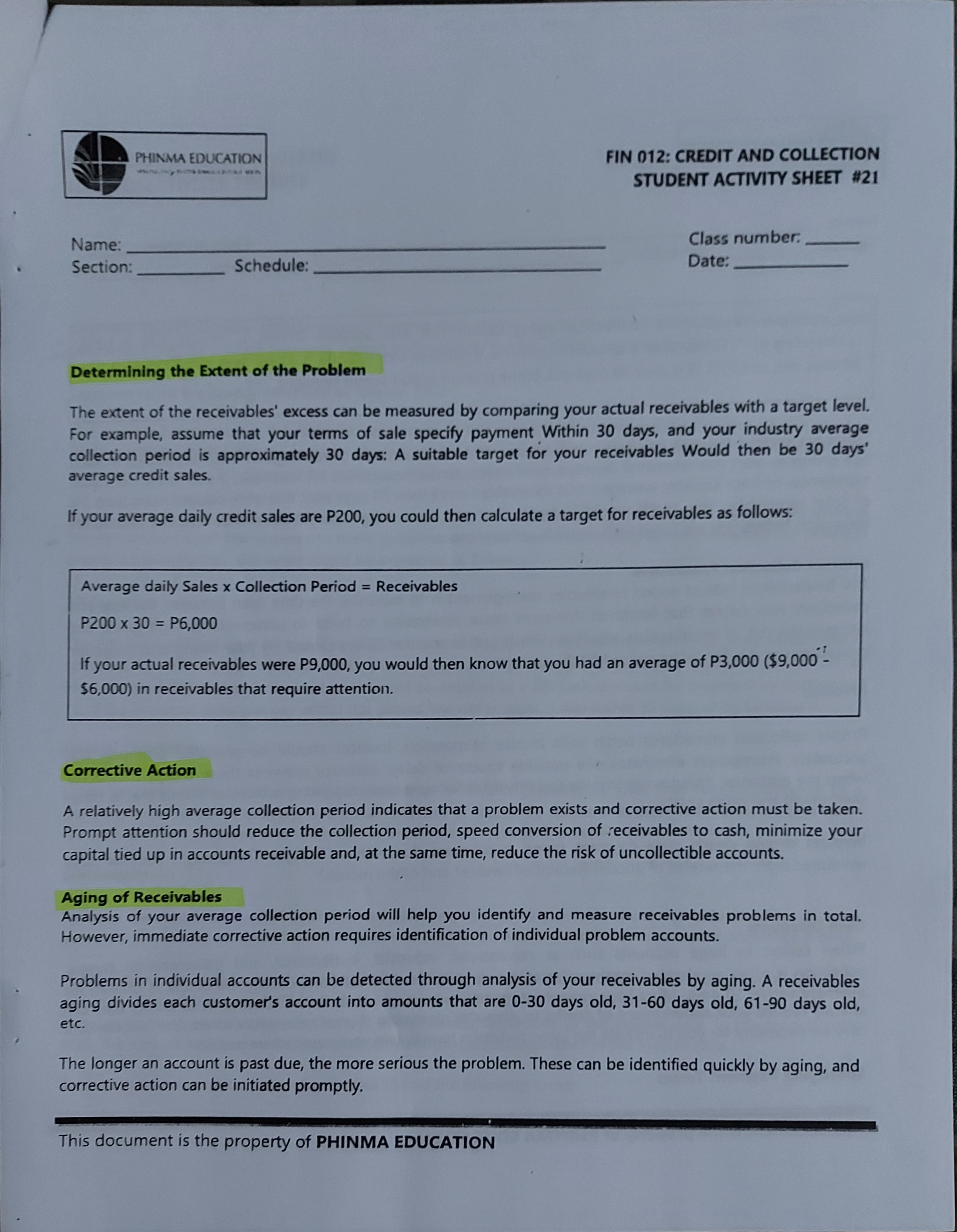
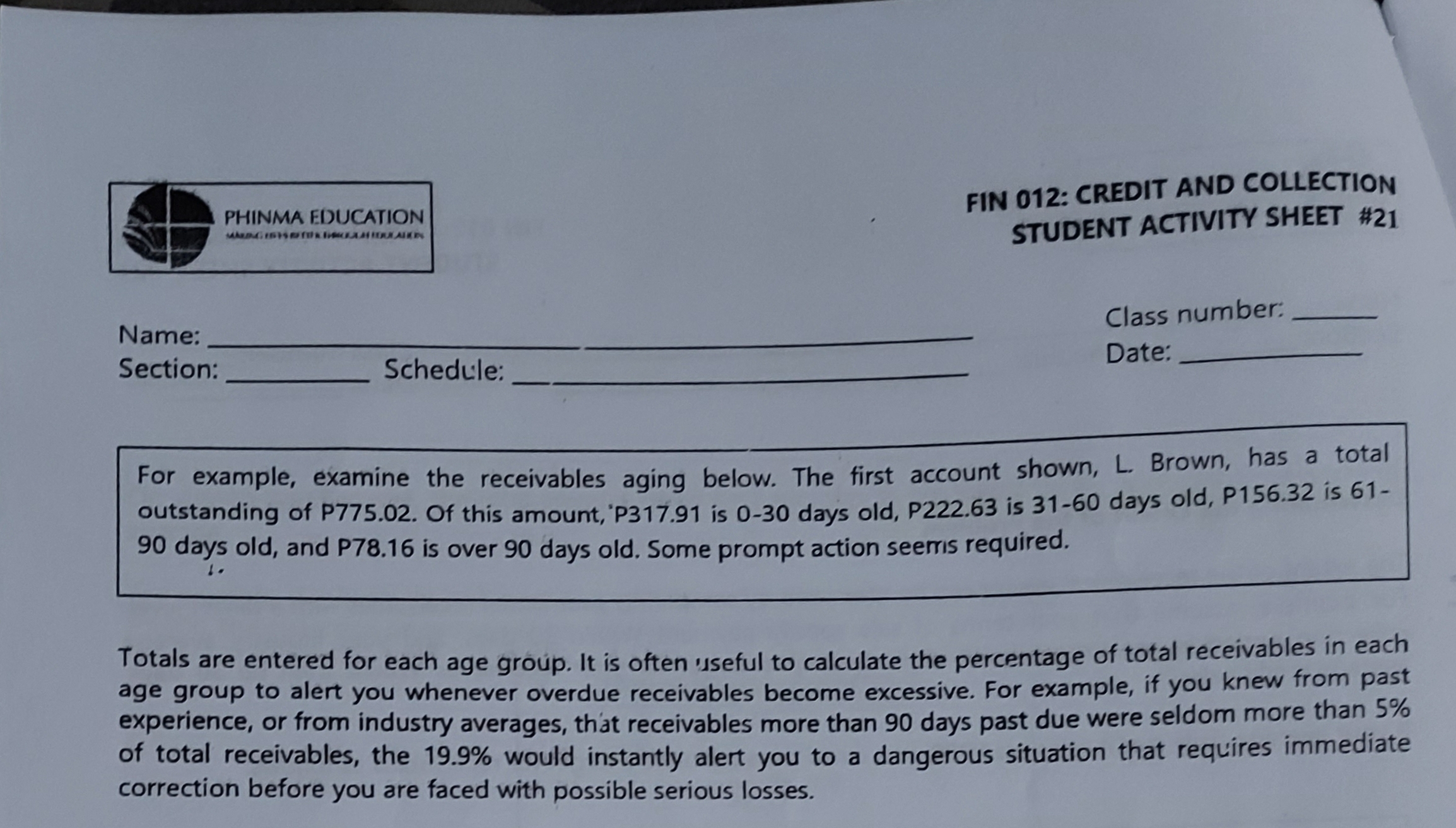
PHINMA EDUCATION FIN 012: CREDIT AND COLLECTION STUDENT ACTIVITY SHEET #21 Name: Class number. Section: Schedule: Date: Determining the Extent of the Problem The extent of the receivables' excess can be measured by comparing your actual receivables with a target level. For example, assume that your terms of sale specify payment Within 30 days, and your industry average collection period is approximately 30 days: A suitable target for your receivables Would then be 30 days' average credit sales. If your average daily credit sales are P200, you could then calculate a target for receivables as follows: Average daily Sales x Collection Period = Receivables P200 x 30 = P6,000 If your actual receivables were P9,000, you would then know that you had an average of P3,000 ($9,000 - $6,000) in receivables that require attention. Corrective Action A relatively high average collection period indicates that a problem exists and corrective action must be taken. Prompt attention should reduce the collection period, speed conversion of receivables to cash, minimize your capital tied up in accounts receivable and, at the same time, reduce the risk of uncollectible accounts. Aging of Receivables Analysis of your average collection period will help you identify and measure receivables problems in total. However, immediate corrective action requires identification of individual problem accounts. Problems in individual accounts can be detected through analysis of your receivables by aging. A receivables aging divides each customer's account into amounts that are 0-30 days old, 31-60 days old, 61-90 days old, etc. The longer an account is past due, the more serious the problem. These can be identified quickly by aging, and corrective action can be initiated promptly. This document is the property of PHINMA EDUCATIONFIN 012: CREDIT AND COLLECTION PHINMA EDUCATION STUDENT ACTIVITY SHEET #21 Name: Class number: Section: Schedule: Date: For example, examine the receivables aging below. The first account shown, L. Brown, has a total outstanding of P775.02. Of this amount, 'P317.91 is 0-30 days old, P222.63 is 31-60 days old, P156.32 is 61- 90 days old, and P78.16 is over 90 days old. Some prompt action seems required. Totals are entered for each age group. It is often useful to calculate the percentage of total receivables in each age group to alert you whenever overdue receivables become excessive. For example, if you knew from past experience, or from industry averages, that receivables more than 90 days past due were seldom more than 5% of total receivables, the 19.9% would instantly alert you to a dangerous situation that requires immediate correction before you are faced with possible serious losses
Step by Step Solution
There are 3 Steps involved in it

Get step-by-step solutions from verified subject matter experts
 Study Help