







Question: each blue question has 2 options to pick from thats why i provided 2 screenshots of the same set of questions so i didnt have
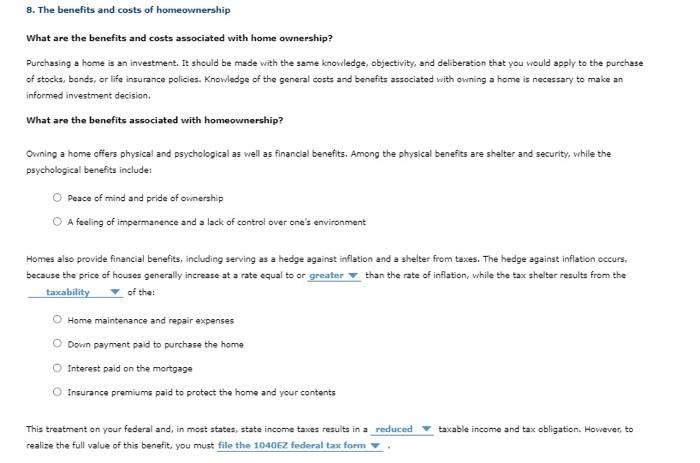
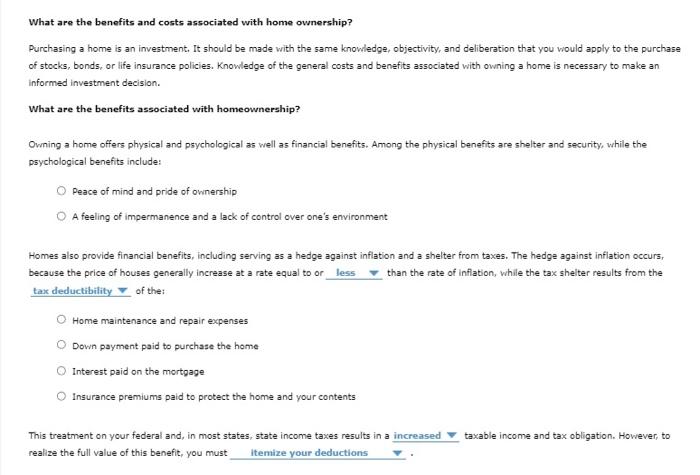
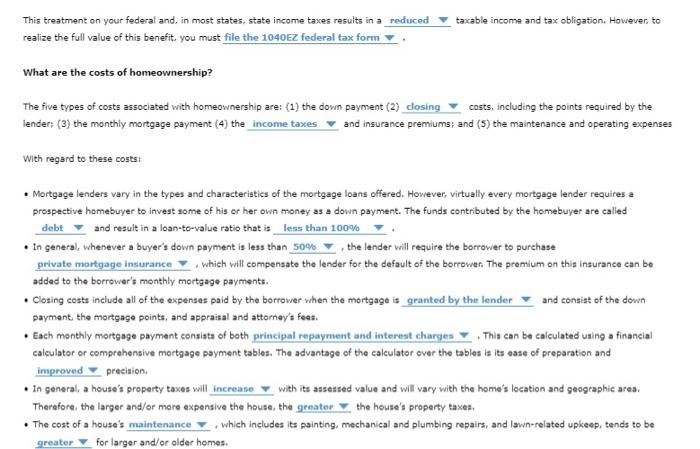
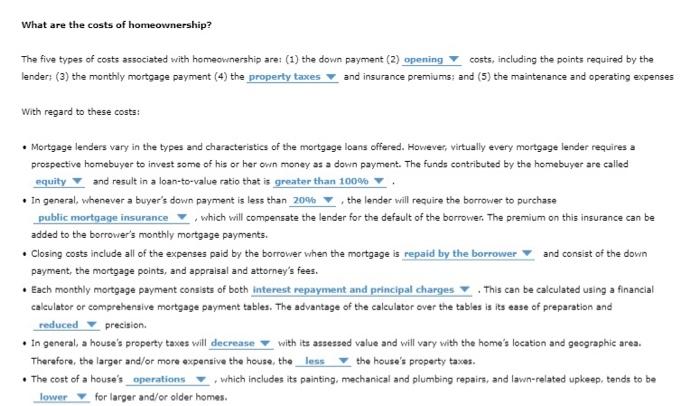
8. The benefits and costs of homeownership What are the benefits and costs associated with home ownership? Purchasing a home is an investment. It should be made with the same knowledge, objectivity, and deliberation that you would apply to the purchase of stocka, bonds, or life insurance policies. Knowledge of the general costs and benefits associated with owning a home is necessary to make an informed investment decision. What are the benefits associated with homeownership? Owning a home offers physical and psychological as well as financial benefits. Among the physical benefits are shelter and security, while the psychological benefits include: Peace of mind and pride of ownership O A feeling of impermanence and a lack of control over one's environment Homes also provide financial benefits, including serving as a hedge against inflation and a shelter from taxes. The hedge against inflation occurs. because the price of houses generally increase at a rate equal to or greater than the rate of inflation, while the tax shelter results from the taxability of the Home maintenance and repair expenses Down payment paid to purchase the home Interest paid on the mortgage Insurance premium paid to protect the home and your contents This treatment on your federal and, in most states, state income taxes results in a reduced realize the full value of this benefit, you must file the 1040EZ federal tax form taxable income and tax obligation. However, to What are the benefits and costs associated with home ownership? Purchasing a home is an investment. It should be made with the same knowledge, objectivity, and deliberation that you would apply to the purchase of stocks, bonds, or life insurance policies. Knowledge of the general costs and benefits associated with owning a home is necessary to make an informed investment decision. What are the benefits associated with homeownership? Owning a home offers physical and psychological as well as financial benefits. Among the physical benefits are shelter and security, while the Psychological benefits include: Peace of mind and pride of ownership A feeling of impermanence and a lack of control over one's environment Homes also provide financial benefits, including serving as a hedge against inflation and a shelter from taxes. The hedge against inflation occur because the price of houses generally increase at a rate equal to or less than the rate of inflation, while the tax shelter results from the tax deductibility of the Home maintenance and repair expenses Down payment paid to purchase the home Interest paid on the mortgage Insurance premiums paid to protect the home and your contents taxable income and tax obligation. However, to This treatment on your federal and, in most states, state income taxes results in a increased realize the full value of this benefit you must itemize your deductions taxable income and tax obligation. However to This treatment on your federal and, in most states, state income taxes results in a reduced realize the full value of this benefit, you must file the 1040EZ federal tax form What are the costs of homeownership? The five types of costs associated with homeownership are: (1) the down payment (2) dosing costs, including the points required by the lender; (3) the monthly mortgage payment (4) the income taxes and insurance premiums; and (5) the maintenance and operating expenses With regard to these costs: a . . Mortgage lenders vary in the types and characteristics of the mortgage loans offered. However, virtually every mortgage lender requires a prospective homebuyer to invest some of his or her own money as a down payment. The funds contributed by the homebuyer are called debt and result in a loan-to-value ratio that is less than 100% In general, whenever a buyer's down payment is less than 50% the lender will require the borrower to purchase private mortgage insurance which will compensate the lender for the default of the borrower. The premium on this insurance can be added to the borrower's monthly mortgage payments. Closing costs include all of the expenses paid by the borrower when the mortgage is granted by the lender and consist of the down payment, the mortgage points, and appraisal and attorney's fees. . Each monthly mortgage payment consists of both principal repayment and interest charges. This can be calculated using a financial calculator or comprehensive mortgage payment tables. The advantage of the calculator over the tables is its ease of preparation and improved precision In general, a house's property taxes will increase with its assessed value and will vary with the home's location and geographic area. Therefore, the larger and/or more expensive the house, the greater the house's property taxes. The cost of a house's maintenance, which includes its painting, mechanical and plumbing repairs, and lawn-related upkeep, tends to be greater for larger and/or older homes. What are the costs of homeownership? The five types of costs associated with homeownership are: (1) the down payment (2) opening costs, including the points required by the lender; (3) the monthly mortgage payment (4) the property taxes and insurance premiums; and (5) the maintenance and operating expenses With regard to these costs: Mortgage lenders vary in the types and characteristics of the mortgage loans offered. However, virtually every mortgage lender requires a prospective homebuyer to invest some of his or her own money as a down payment. The funds contributed by the homebuyer are called equity and result in a loan-to-value ratio that is greater than 100% In general, whenever a buyer's down payment is less than 20% the lender will require the borrower to purchase public mortgage insurance which will compensate the lender for the default of the borrower. The premium on this insurance can be added to the borrower's monthly mortgage payments. Closing costs include all of the expenses paid by the borrower when the mortgage is repaid by the borrower and consist of the down payment, the mortgage points, and appraisal and attorney's fees. Each monthly mortgage payment consists of both interest repayment and principal charges. This can be calculated using a financial calculator or comprehensive Mortgage payment tables. The advantage of the calculator over the tables is its ease of preparation and reduced precision In general, a house's property taxes will decrease with its assessed value and will vary with the home's location and geographic area. Therefore, the larger and/or more expensive the house, the less the house's property taxes. The cost of a house's operations which includes its painting, mechanical and plumbing repairs, and lawn-related upkeep, tends to be lower for larger and/or older homes. a
Step by Step Solution
There are 3 Steps involved in it

Get step-by-step solutions from verified subject matter experts
 Study Help