







Question: each part plz Consider the multiple linear regression model Y = XB + E where Y is the n x 1 column vector of responses,
each part plz
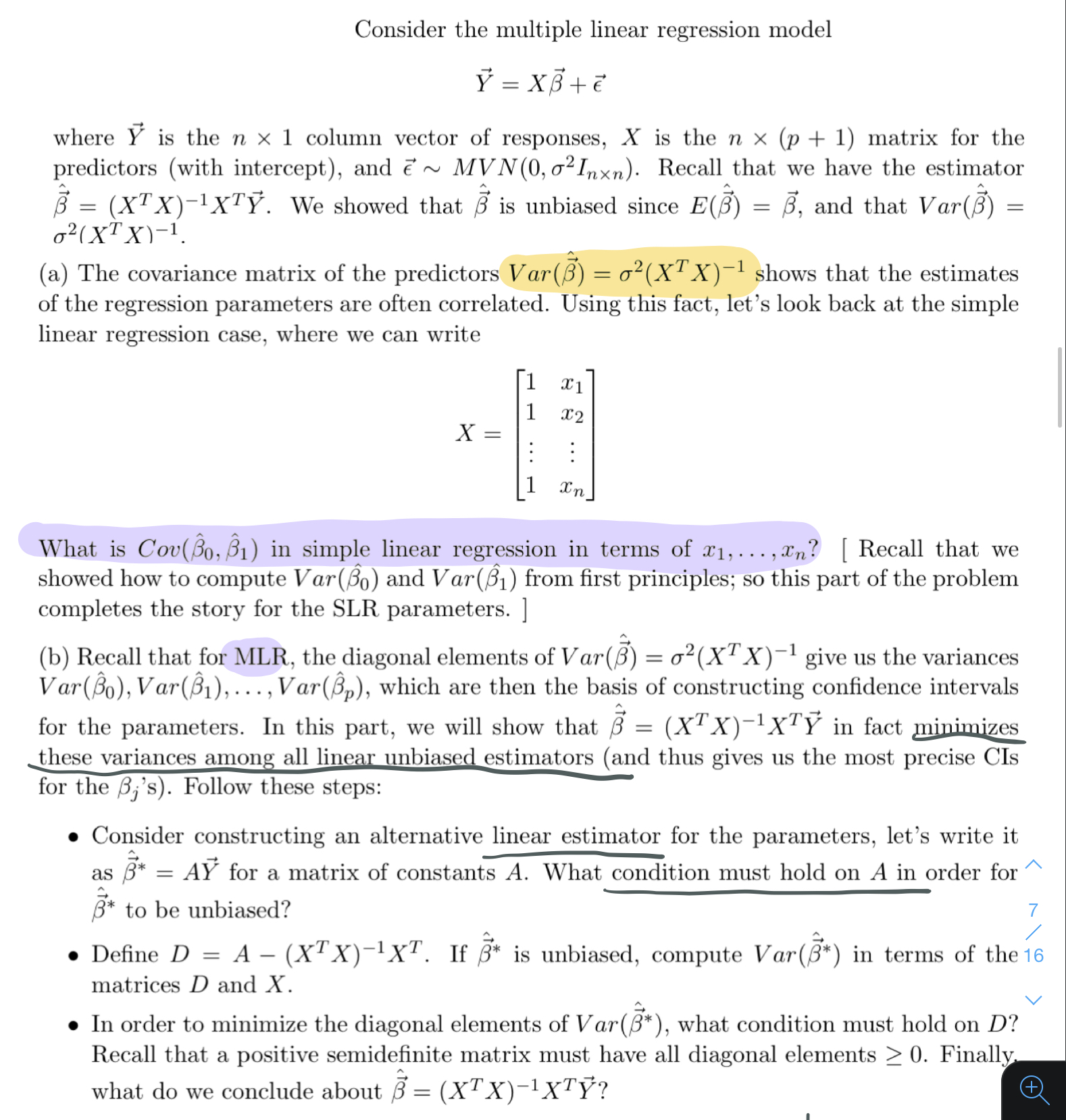
Consider the multiple linear regression model Y = XB + E where Y is the n x 1 column vector of responses, X is the n x (p + 1) matrix for the predictors (with intercept), and E ~ MVN(0, 2 Inxn). Recall that we have the estimator B = (XTX)-1XTY. We showed that 3 is unbiased since E(B) = 3, and that Var(B) = "" ( X X) -1. (a) The covariance matrix of the predictors Var(B) = 02(XX)-1 shows that the estimates of the regression parameters are often correlated. Using this fact, let's look back at the simple linear regression case, where we can write X = . . . . . . What is Cov( Bo, B1) in simple linear regression in terms of x1,..., In? [ Recall that we showed how to compute Var(Bo) and Var(B1) from first principles; so this part of the problem completes the story for the SLR parameters. ] (b) Recall that for MLR, the diagonal elements of Var(B) = 02(XTX)-1 give us the variances Var(Bo), Var(B1), ..., Var(Bp), which are then the basis of constructing confidence intervals for the parameters. In this part, we will show that B = (XTX)-1XTY in fact minimizes these variances among all linear unbiased estimators (and thus gives us the most precise CIs for the Bj's). Follow these steps: . Consider constructing an alternative linear estimator for the parameters, let's write it as * = AY for a matrix of constants A. What condition must hold on A in order for~ (* to be unbiased? . Define D = A - (XTX)-1XT. If * is unbiased, compute Var(B*) in terms of the 16 matrices D and X. . In order to minimize the diagonal elements of Var(*), what condition must hold on D? Recall that a positive semidefinite matrix must have all diagonal elements 2 0. Finally what do we conclude about 3 = (XTX)-1XTY
Step by Step Solution
There are 3 Steps involved in it

Get step-by-step solutions from verified subject matter experts
 Study Help