







Question: Each question below specifies a graph operation, a graph representation, and a desired bound. The possible answers are all O() or () complexity measures written
Each question below specifies a graph operation, a graph representation, and a desired bound. The possible answers are all O() or () complexity measures written in terms of V (the number of vertices in the graph) and/or E (the number of edges in the graph).
All graphs are directed, unweighted graphs.
You are to choose the complexity measure that correctly characterizes the desired bound on the provided operation, assuming that the specified representation is being used.
If more than one complexity measure is correct, choose the one that is tightest.
Keep these two things in mind:
- When determining best cases, do not assume that V = E = 0, or anything of the sort. Instead, imagine what graph with V vertices and E edges would lead to the lowest running time.
- Do not assume that the number of edges entering or leaving a vertex is stored explicitly.
- Assume that an adjacency list is an array of linked lists, and that the linked lists are not ordered in any particular way
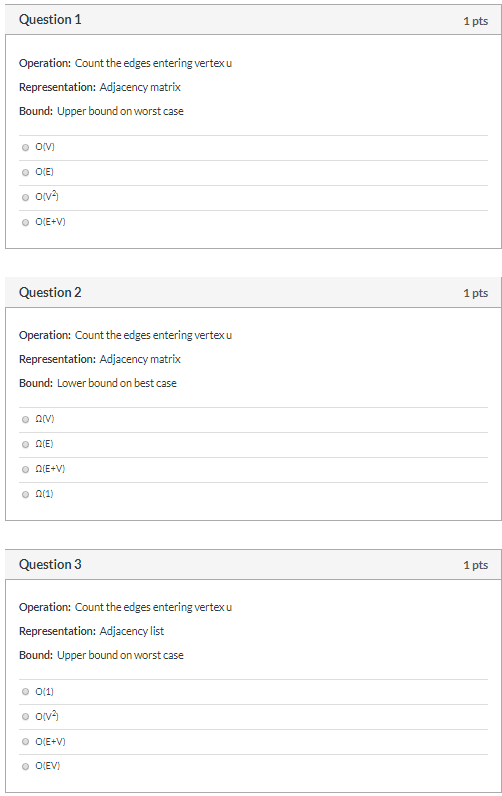
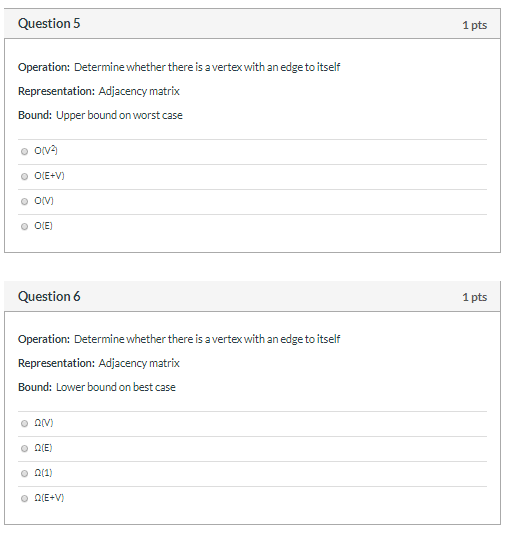
Question 1 1 pts Operation: Count the edges entering vertex u Representation: Adjacency matrix Bound: Upper bound on worst case o OMV) O(E) 012 O[E+V) Question 2 1 pts Operation: Count the edges entering vertex u Representation: Adjacency matrix Bound: Lower bound on best case O OV) DIE 0[E+V) 0(1) Question 3 1 pts Operation: Count the edges entering vertex u Representation: Adjacency list Bound: Upper bound on worst case 0(1) OV O[E+V) O(EV) Question 5 1 pts Operation: Determine whether there is a vertex with an edge to itself Representation: Adjacency matrix Bound: Upper bound on worst case 012 O[E+V) o ov O(E) Question 6 1 pts Operation: Determine whether there is a vertex with an edge to itself Representation: Adjacency matrix Bound: Lower bound on best case DV) Q(E) (EV)
Step by Step Solution
There are 3 Steps involved in it
Lets analyze each question step by step Question 1 Operation Count the edges entering vertex u Repre... View full answer

Get step-by-step solutions from verified subject matter experts
 Study Help