







Question: Each state corresponds with a binary number in a binary reduced state machine. The binary number represents the state number as a decimal translation. What
Each state corresponds with a binary number in a binary reduced state machine. The binary number represents the state number as a decimal translation. What does this mean? In a binary reduced state machine, we convert the binary number into a decimal number to find the state number. So 00 = state 0 and 11 = state 3. Each state contains a transition to the next state based on an input G. G represents G=1, while G represents G=0. A transition on G means you move from a specified state to the state the transition points to when the G input is set to 1. The outputs are dependent on the current state.
State 00 refers to the Main State
State 01 refers to the Play State
State 10 refers to the Meeting State
State 11 refers to the Game Over State
First, produce the K-maps for the state transition diagram above Use the K-maps to produce the reduced Boolean expressions for the state machine.
The inputs for each K-map are:
S0 = Current state least significant bit
S1 = Current state most significant bit
G = Input button
The outputs to make K-maps for are:
N0 = Next State least significant bit
N1 = Next State most significant bit
Game Music (GM), Tasks (T), Suspenseful Music (SM)
Please Note: This State Machine is a Moore State Machine, meaning that the output values are determined solely by the current state (you should not use the N1 and N0 outputs or the G input for determining the values for Game Music (GM), Tasks (T), Suspenseful Music (SM)).
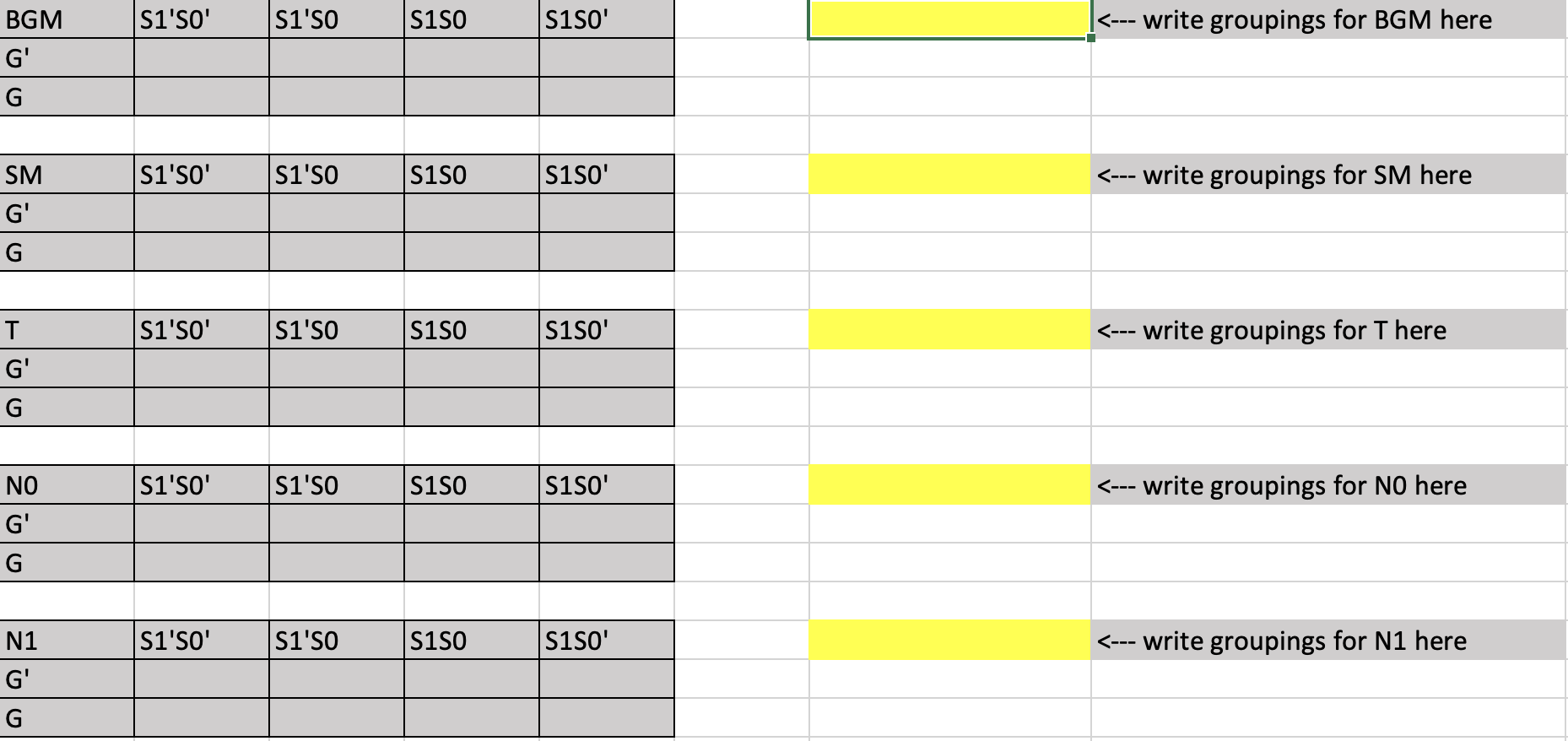
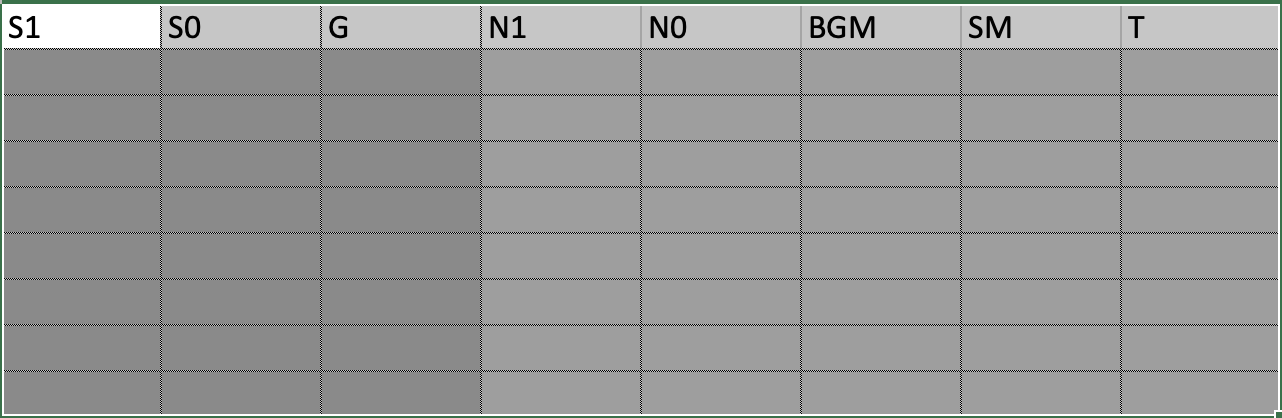
You will fill out one K-map per output and one per next state bit for a total of 5 K-maps (GM, T, SM, N0, N1). The respective K-maps are located in the kmap.xlsx file.
Your K-map must give the best solution of groupings possible to receive full credit. This means you must select the optimal values for any dont cares (if applicable) in your K-maps to do this.
It may be helpful to check with others on Ed Discussion to see if your circuit is optimal. In order to do this without giving away your answer you may share the number of AND and OR gates used. The final total number is enough. Try not to give away how many gates you used for each step, as it could give away how your K-maps are done.
IMPORTANT: The K-maps will be autograded. Because of this, there are a set of restrictions to how you must fill your K-maps to ensure you get full credit:
When you fill the row and column headers for your K-maps, you may only use the following variable names: S0, S1, and G.To negate a variable, you must use an apostrophe. Two adjacent variables with nothing in between are interpreted as an AND. Example label: S0G
When writing the Boolean expressions resulted from your K-map groupings, you must use the same rules as the previous bullet point, but also use + for OR. Example grouping: For the Boolean expression (NOT S0) OR (S1 AND G), write S0+S1G
When filling in the cells of your K-map table, you must use 0, 1, and X.
\begin{tabular}{|l|l|l|l|l|} \hline BGM & S1 SO & S1SO & S1SO & SSOSO \\ \hline G & & & & \\ \hline G & & & & \\ \hline \end{tabular} & & & & \\ \hline G & & & & \\ \hline \end{tabular} T & S1'S0' & S1'S0 & S1S0 & S1S0' \\ \hline G' & & & & \\ \hline G & & & & \\ \hline \end{tabular} & & & & \\ \hline G & & & & \\ \hline \end{tabular}
Step by Step Solution
There are 3 Steps involved in it

Get step-by-step solutions from verified subject matter experts
 Study Help