







Question: Each student is to complete and submit two (2) cases throughout this semester. The due dates for the cases are as follows: Case #1 Due
Each student is to complete and submit two (2) cases throughout this semester. The due dates for the cases are as follows:
Case #1 Due in class on Monday, February 10, 2019 Case #2 Due in class on Monday, March 23, 2019
Titles of the assigned cases will be given out at a later date. Cases must be 4 pages in length excluding the title page.
Format for Case Writing: Instructions ***READ INSTRUCTIONS AND FORMAT CAREFULLY. ALL CASES MUST BE PRESENTED IN THIS FORMAT***
All cases must be in twelve-point type, with 3 cm margins on all sides, double-spaced and NO LONGER than the designated number of pages specified in the course outline excepting the title page. Cases that are too long will be docked by 50% of the cases worth. For example, Case #1 will be marked out of 50% if its too long. However, two or three pages would not do justice to a case study of this nature.
1. Situation Analysis Bold Heading Two or three paragraphs describing the circumstances and background of the case.
2. SWOT Analysis Bold heading Use 2 columns to list SWOT elements
Strengths (Bold this subheading)
- Single space - Point form (at least 2 points) - Describe the INTERNAL STRENGTHS Weaknesses (Bold this subheading) Single space - Point form (at least 2 points) - the INTERNAL WEAKNESSES Opportunities (Bold this subheading)
- Single space - Point form (at least 2 points) - Describe the EXTERNAL OPPORTUNITIES Threats (Bold this subheading) - Single space - Point form (at least 2 points) - Describe the EXTERNAL THREATS
3. Problem Statement Bold heading Two or three paragraphs on the problem and/or the situation the organization is facing
4. Alternatives Bold heading Summarize the alternatives in one or two sentences List three or four alternatives List more than one pro and con: associated with each alternative Use point form in a vertical format (two columns) for the pros and cons under each alternative as follows:
Alternative #1: (State the alternative in bold). Describe the bold statement in 1 -2 sentences (not bold). Pros: - bold this subheading Cons: - bold this subheading - List pros in VERTICAL point form - List pros in VERTICAL point form - Single space - Single space
Recommendation: Bold heading State the ONE alternative you are recommending in paragraph form. Avoid I statements when writing the case. Use the third person singular form. In two or three paragraphs defend why you chose this alternative and how it will assist the company 1. Clearly outline specific steps of implementation 2. Explain how all cons will be overcome for the alternative you chose
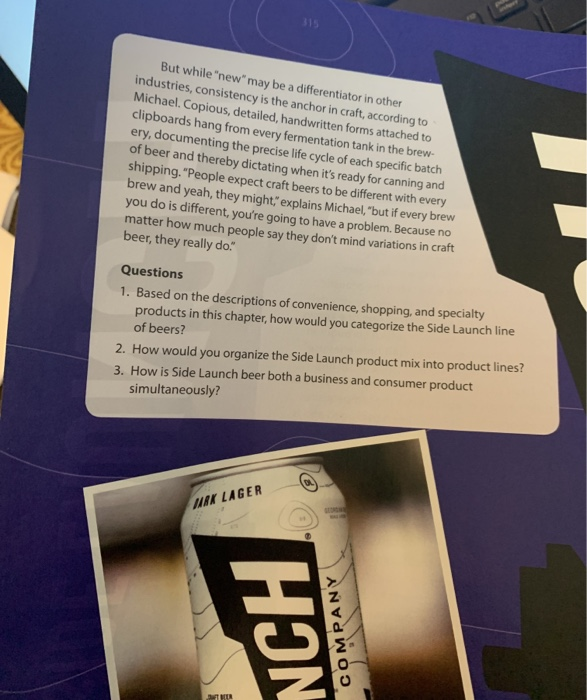
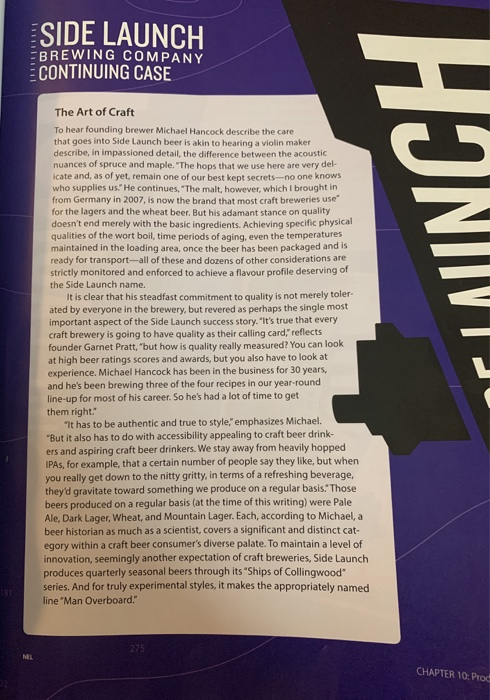
But while "new" may be a differentiator in other industries, consistency is the anchor in craft, according to Michael. Copious, detailed, handwritten forms attached to clipboards hang from every fermentation tank in the brew- ery, documenting the precise life cycle of each specific batch of beer and thereby dictating when it's ready for canning and shipping. "People expect craft beers to be different with every brew and yeah, they might," explains Michael,"but if every brew you do is different, you're going to have a problem. Because no matter how much people say they don't mind variations in craft beer, they really do." Questions 1. Based on the descriptions of convenience, shopping, and specialty products in this chapter, how would you categorize the Side Launch line of beers? 2. How would you organize the Side Launch product mix into product lines? 3. How is Side Launch beer both a business and consumer product simultaneously? MINX LAGER NCH COMPANY SIDE LAUNCH EBREWING COMPANY E CONTINUING CASE The Art of Craft To hear founding brewer Michael Hancock describe the care that goes into Side Launch beer is akin to hearing a violin maker describe, in impassioned detail, the difference between the acoustic nuances of spruce and maple. "The hops that we use here are very del- icate and, as of yet, remain one of our best kept secrets--no one knows who supplies us." He continues, "The malt, however, which I brought in from Germany in 2007, is now the brand that most craft breweries use" for the lagers and the wheat beer. But his adamant stance on quality doesn't end merely with the basic ingredients. Achieving specific physical qualities of the wort boil, time periods of aging, even the temperatures maintained in the loading area, once the beer has been packaged and is ready for transport-all of these and dozens of other considerations are strictly monitored and enforced to achieve a flavour profile deserving of the Side Launch name. It is clear that his steadfast commitment to quality is not merely toler- ated by everyone in the brewery, but revered as perhaps the single most important aspect of the Side Launch success story. "It's true that every craft brewery is going to have quality as their calling card,"reflects founder Garnet Pratt, "but how is quality really measured? You can look at high beer ratings scores and awards, but you also have to look at experience. Michael Hancock has been in the business for 30 years, and he's been brewing three of the four recipes in our year-round line-up for most of his career. So he's had a lot of time to get them right." "It has to be authentic and true to style," emphasizes Michael. "But it also has to do with accessibility appealing to craft beer drink- ers and aspiring craft beer drinkers. We stay away from heavily hopped IPAs, for example, that a certain number of people say they like, but when you really get down to the nitty gritty, in terms of a refreshing beverage, they'd gravitate toward something we produce on a regular basis." Those beers produced on a regular basis (at the time of this writing) were Pale Ale, Dark Lager, Wheat, and Mountain Lager. Each, according to Michael, a beer historian as much as a scientist, covers a significant and distinct cat- egory within a craft beer consumer's diverse palate. To maintain a level of innovation, seemingly another expectation of craft breweries, Side Launch produces quarterly seasonal beers through its "Ships of Collingwood" series. And for truly experimental styles, it makes the appropriately named line "Man Overboard." TUNITVI CHAPTER 10: Prod But while "new" may be a differentiator in other industries, consistency is the anchor in craft, according to Michael. Copious, detailed, handwritten forms attached to clipboards hang from every fermentation tank in the brew- ery, documenting the precise life cycle of each specific batch of beer and thereby dictating when it's ready for canning and shipping. "People expect craft beers to be different with every brew and yeah, they might," explains Michael,"but if every brew you do is different, you're going to have a problem. Because no matter how much people say they don't mind variations in craft beer, they really do." Questions 1. Based on the descriptions of convenience, shopping, and specialty products in this chapter, how would you categorize the Side Launch line of beers? 2. How would you organize the Side Launch product mix into product lines? 3. How is Side Launch beer both a business and consumer product simultaneously? MINX LAGER NCH COMPANY SIDE LAUNCH EBREWING COMPANY E CONTINUING CASE The Art of Craft To hear founding brewer Michael Hancock describe the care that goes into Side Launch beer is akin to hearing a violin maker describe, in impassioned detail, the difference between the acoustic nuances of spruce and maple. "The hops that we use here are very del- icate and, as of yet, remain one of our best kept secrets--no one knows who supplies us." He continues, "The malt, however, which I brought in from Germany in 2007, is now the brand that most craft breweries use" for the lagers and the wheat beer. But his adamant stance on quality doesn't end merely with the basic ingredients. Achieving specific physical qualities of the wort boil, time periods of aging, even the temperatures maintained in the loading area, once the beer has been packaged and is ready for transport-all of these and dozens of other considerations are strictly monitored and enforced to achieve a flavour profile deserving of the Side Launch name. It is clear that his steadfast commitment to quality is not merely toler- ated by everyone in the brewery, but revered as perhaps the single most important aspect of the Side Launch success story. "It's true that every craft brewery is going to have quality as their calling card,"reflects founder Garnet Pratt, "but how is quality really measured? You can look at high beer ratings scores and awards, but you also have to look at experience. Michael Hancock has been in the business for 30 years, and he's been brewing three of the four recipes in our year-round line-up for most of his career. So he's had a lot of time to get them right." "It has to be authentic and true to style," emphasizes Michael. "But it also has to do with accessibility appealing to craft beer drink- ers and aspiring craft beer drinkers. We stay away from heavily hopped IPAs, for example, that a certain number of people say they like, but when you really get down to the nitty gritty, in terms of a refreshing beverage, they'd gravitate toward something we produce on a regular basis." Those beers produced on a regular basis (at the time of this writing) were Pale Ale, Dark Lager, Wheat, and Mountain Lager. Each, according to Michael, a beer historian as much as a scientist, covers a significant and distinct cat- egory within a craft beer consumer's diverse palate. To maintain a level of innovation, seemingly another expectation of craft breweries, Side Launch produces quarterly seasonal beers through its "Ships of Collingwood" series. And for truly experimental styles, it makes the appropriately named line "Man Overboard." TUNITVI CHAPTER 10: ProdStep by Step Solution
There are 3 Steps involved in it

Get step-by-step solutions from verified subject matter experts
 Study Help