



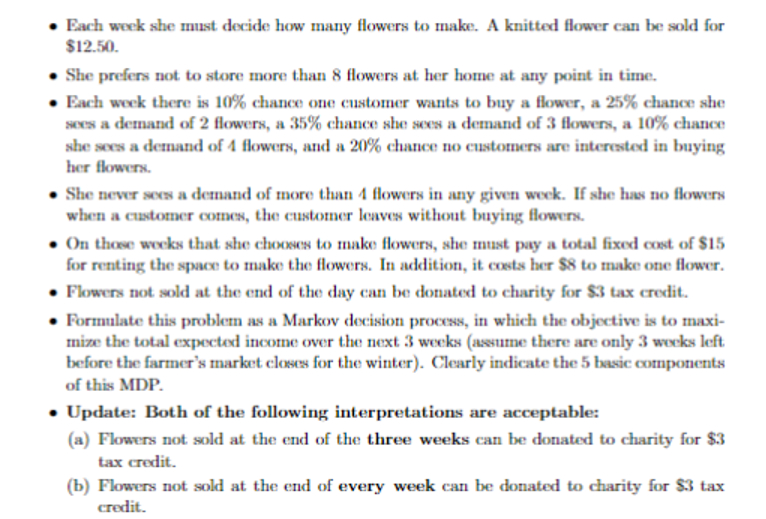
Question: - Each week she must decide how many flowers to make. A knitted flower can be sold for ( $ 1 2 .
Each week she must decide how many flowers to make. A knitted flower can be sold for $
She prefers not to store more than flowers at her home at any point in time.
Each week there is chance one customer wants to buy a flower, a chance she sees a demand of flowers, a chance she sees a demand of flowers, a chance she sees a demand of flowers, and a chance no customers are interested in buying her flowers.
She never sees a demand of more than flowers in any given week. If she has no flowers when a customer comes, the customer leaves without buying flowers.
On those woeks that she chooses to make flowers, she must pay a total fixed cost of $ for renting the space to make the flowers. In addition, it costs her $ to make one flower.
Flowers not sold at the end of the day can be donated to charity for $ tax credit.
Formulate this problem as a Markov decision process, in which the objective is to maximize the total expected income over the next weeks assume there are only woeks left before the farmer's market closes for the winter Clearly indicate the basic components of this MDP
Update: Both of the following interpretations are acceptable:
a Flowers not sold at the end of the three weeks can be donated to charity for $ tax credit.
b Flowers not sold at the end of every week can be donated to charity for $ tax credit.
Please write out complete answers with labels
Step by Step Solution
There are 3 Steps involved in it
1 Expert Approved Answer
Step: 1 Unlock

Question Has Been Solved by an Expert!
Get step-by-step solutions from verified subject matter experts
Step: 2 Unlock
Step: 3 Unlock