







Question: ead this entire specification carefully. Like a specification you will receive in industry, the information is spread out and not necessarily organized as you might
ead this entire specification carefully. Like a specification you will receive in industry, the
information is spread out and not necessarily organized as you might expect. An important item
might be buried in the middle of a paragraph where it is not expected. As you are responsible for
meeting all the requirements, read this document slowly and carefully!
A car company has asked you to design the logic in the car to work with a new key fob. This is
for a car they plan to introduce in the fall. The new fob works a bit differently than most.
If the key fob moves far from the car for two clocks, the car automatically locks.
If the car is unlocked, and the user presses the button on the fob, the car locks.
If the car is locked, and the user presses the button on the fob, the car unlocks.
Whenever the car unlocks, the lights flash for one clock.
Whenever the car locks, the horn beeps for one clock.
There are two inputs and three outputs:
Inputs:
S: means the fob is near the car; means the fob is far from the car.
B: means the fob button has not been pressed; means the fob button has been pressed.
Outputs:
H: means the horn does not honk; means the horn should honk
F: means the lights should not flash; means the lights should flash
L: means the car is unlocked, means the car is locked
You do NOT need to worry about the definition of far another engineering team is handling that.
Note that you design MUST have a minimum of states.
You will need to design two different state machines that satisfy the above requirements. Think about
different ways they might be implemented. Suggestions include how to handle the fact that the button
on the fob is pressed while the fob is far away. Does the car unlock? What happens if unlock and
lock directives conflict?
Come up with ideas on how youd like to design the system. Interview three different stake
holders to discuss your ideas. Stake holders may be other students, TAs, UGTAs, or family
members. Be sure to document the names of the people you interview and their role. That is
their role as student, TA UGTA, family member, etc.Task C: Document the Synchronous Sequential Machines
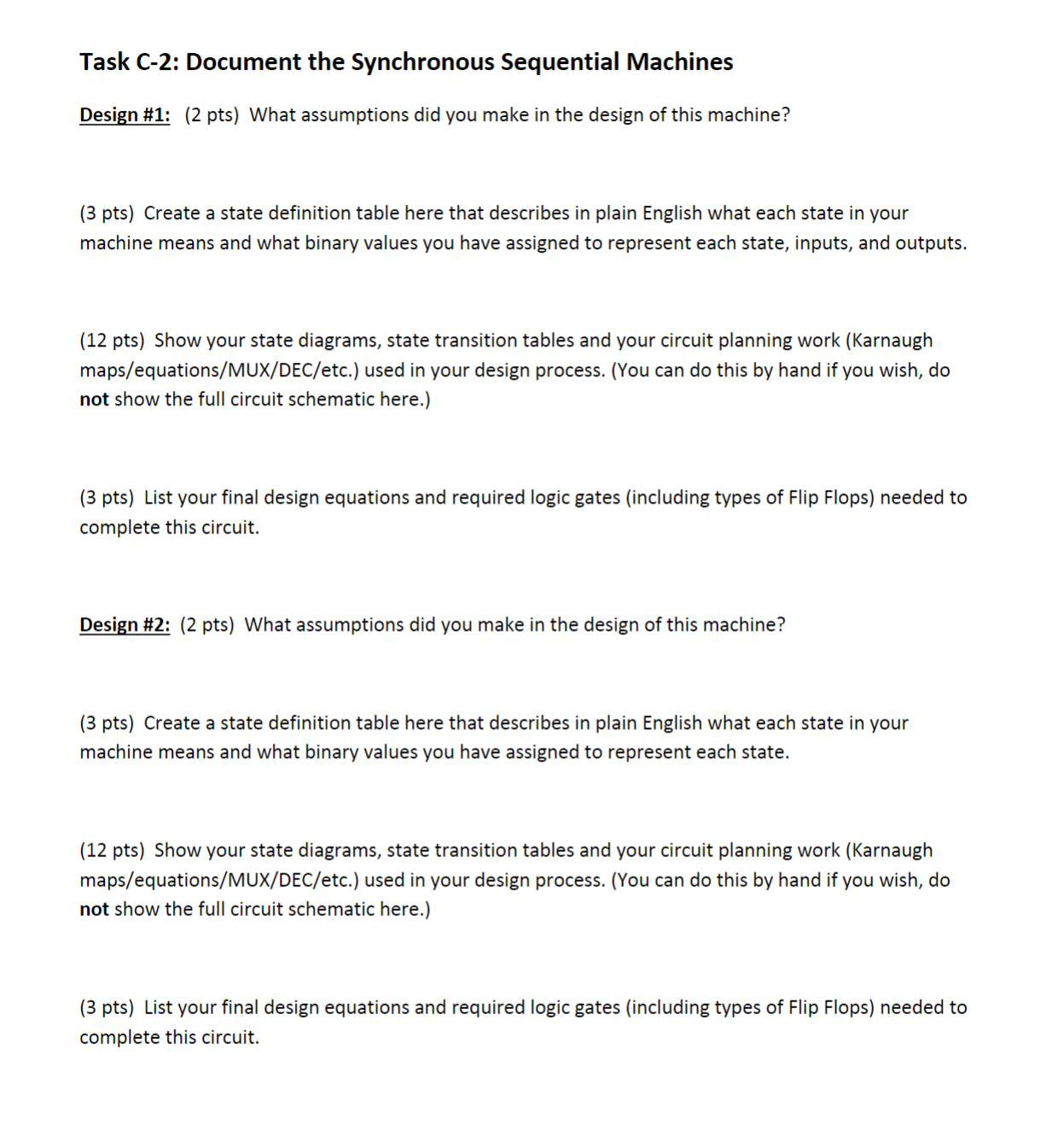
Design #: pts What assumptions did you make in the design of this machine?
pts Create a state definition table here that describes in plain English what each state in your
machine means and what binary values you have assigned to represent each state, inputs, and outputs.
pts Show your state diagrams, state transition tables and your circuit planning work Karnaugh
mapsequationsMUXDECetc used in your design process. You can do this by hand if you wish, do
not show the full circuit schematic here.
pts List your final design equations and required logic gates including types of Flip Flops needed to
complete this circuit.
Design #: pts What assumptions did you make in the design of this machine?
pts Create a state definition table here that describes in plain English what each state in your
machine means and what binary values you have assigned to represent each state.
pts Show your state diagrams, state transition tables and your circuit planning work Karnaugh
mapsequationsMUXDECetc used in your design process. You can do this by hand if you wish, do
not show the full circuit schematic here.
pts List your final design equations and required logic gates including types of Flip Flops needed to
complete this circuit.
Step by Step Solution
There are 3 Steps involved in it
1 Expert Approved Answer
Step: 1 Unlock

Question Has Been Solved by an Expert!
Get step-by-step solutions from verified subject matter experts
Step: 2 Unlock
Step: 3 Unlock
 Study Help