







Question: Earlier you were given a function which served as a way to quantify distance between two functions. Why is this function an apt choice of
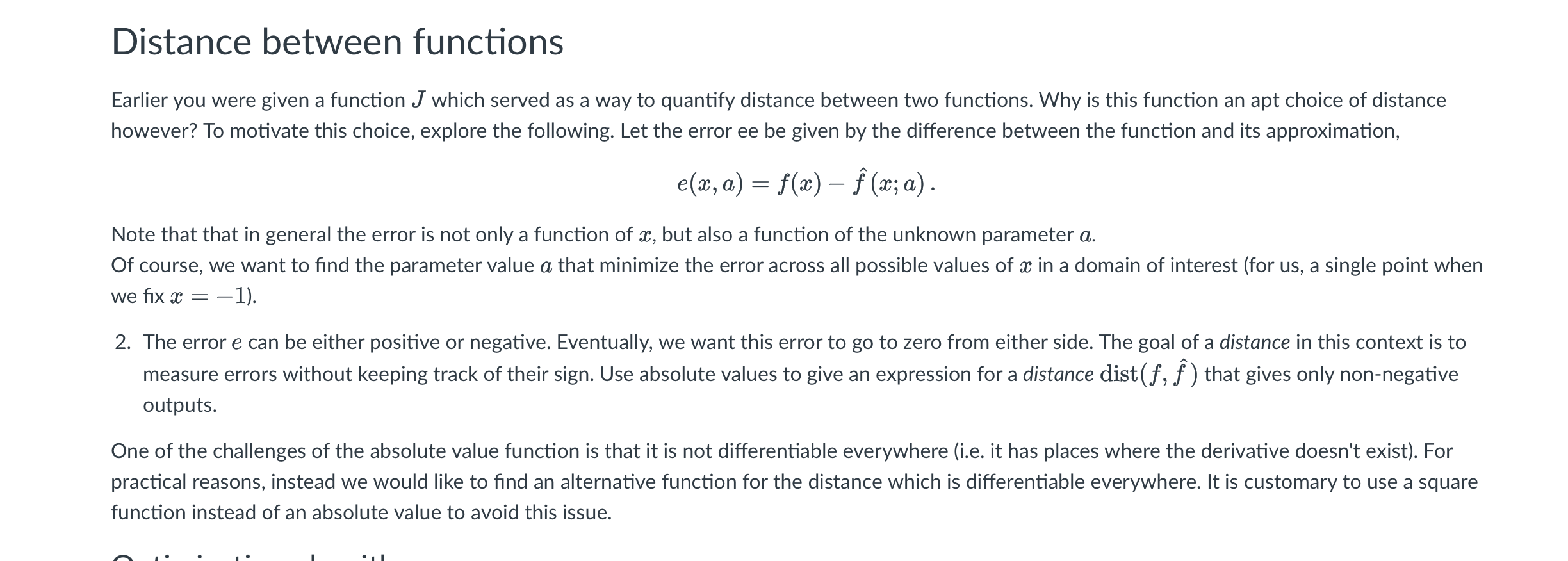
Earlier you were given a function which served as a way to quantify distance between two functions. Why is this function an apt choice of distance however? To motivate this choice, explore the following. Let the error ee be given by the difference between the function and its approximation,
exafxfx;a
Note that that in general the error is not only a function of but also a function of the unknown parameter
Of course, we want to find the parameter value that minimize the error across all possible values of x in a domain of interest for us a single point when we fix x
The error e can be either positive or negative. Eventually, we want this error to go to zero from either side. The goal of a distance in this context is to measure errors without keeping track of their sign. Use absolute values to give an expression for a distance ff that gives only nonnegative outputs.
One of the challenges of the absolute value function is that it is not differentiable everywhere ie it has places where the derivative doesn't exist For practical reasons, instead we would like to find an alternative function for the distance which is differentiable everywhere. It is customary to use a square function instead of an absolute value to avoid this issue. Distance between functions
Earlier you were given a function J which served as a way to quantify distance between two functions. Why is this function an apt choice of distance however? To motivate this choice, explore the following. Let the error ee be given by the difference between the function and its approximation,
ex afxhatfx ; a
Note that that in general the error is not only a function of x but also a function of the unknown parameter a
Of course, we want to find the parameter value a that minimize the error across all possible values of x in a domain of interest for us a single point when we fix x
The error e can be either positive or negative. Eventually, we want this error to go to zero from either side. The goal of a distance in this context is to measure errors without keeping track of their sign. Use absolute values to give an expression for a distance operatornamedistfhatf that gives only nonnegative outputs.
One of the challenges of the absolute value function is that it is not differentiable everywhere ie it has places where the derivative doesn't exist For practical reasons, instead we would like to find an alternative function for the distance which is differentiable everywhere. It is customary to use a square function instead of an absolute value to avoid this issue.
Step by Step Solution
There are 3 Steps involved in it
1 Expert Approved Answer
Step: 1 Unlock

Question Has Been Solved by an Expert!
Get step-by-step solutions from verified subject matter experts
Step: 2 Unlock
Step: 3 Unlock
 Study Help