







Question: earning Goal: o understand how to quantitatively determine whether a particle in a state of mechanical equilibrium. 1 statics, we make extensive use of Newton's
earning Goal: o understand how to quantitatively determine whether a particle in a state of mechanical equilibrium.
statics, we make extensive use of Newton's first law, which tates that a particle, initially at rest, or moving in a straight line ith constant velocity, will remain in its current state unless the article is subjected to an unbalanced force system. If the sum of ne forces acting on a particle is zero, then it is in mechanical quilibrium. Although a particle is most likely at rest when in quilibrium, it could alternatively be in a state of constant motion. gure
of Graphically, we can determine whether the sum of the iorces is so the sum of the forces acting on the particle is zero, Although graphing force vectors in two dimensions is simple, graphing them in three dimensions is more difficult. Mathematically, we can express the forces as Cartesian vectors; for equilibrium, the sum of the forces' components in each direction is zero. Mathematically, this means that and
Part B
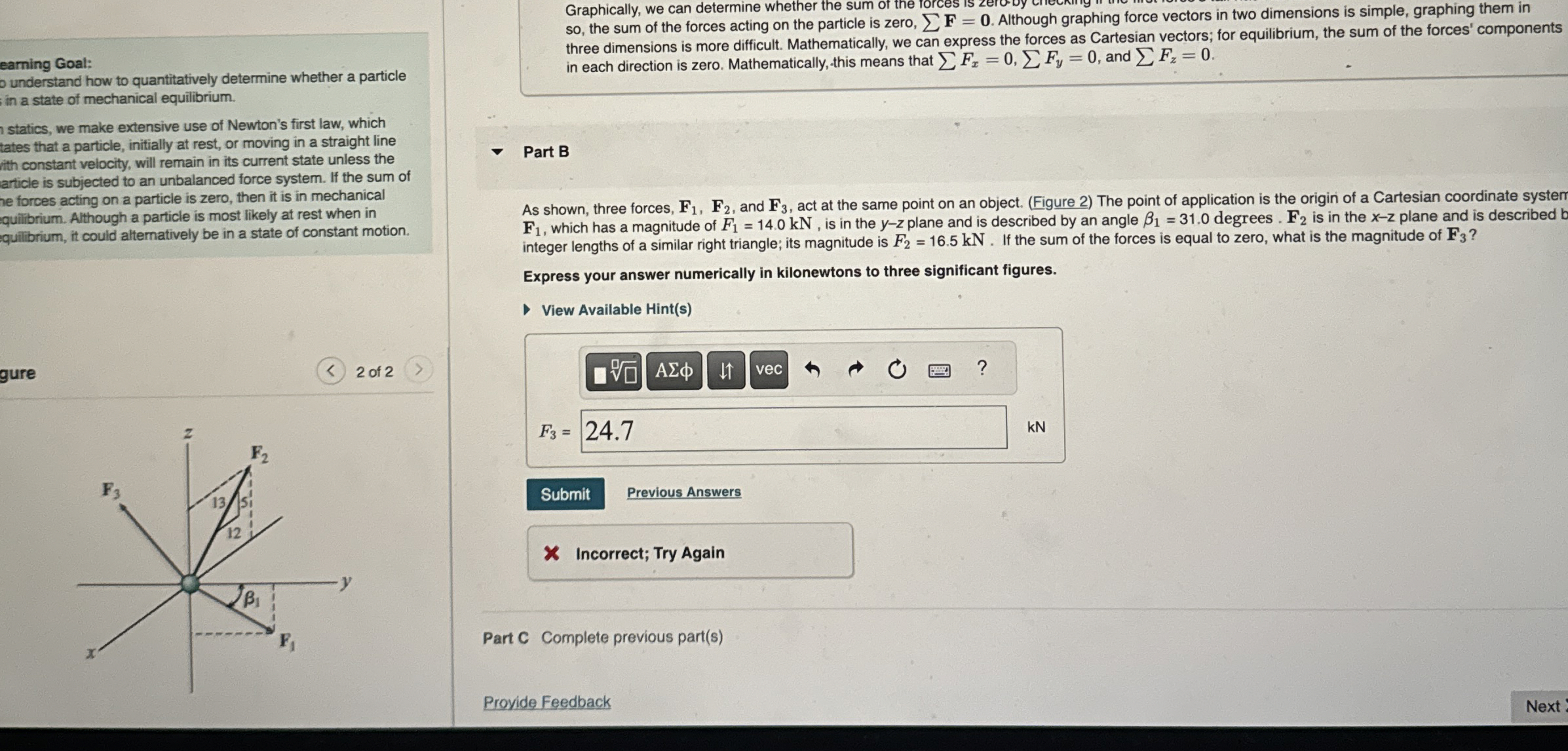
As shown, three forces, and act at the same point on an object. Figure The point of application is the origin of a Cartesian coordinate syster which has a magnitude of is in the plane and is described by an angle degrees. is in the plane and is described b integer lengths of a similar right triangle; its magnitude is If the sum of the forces is equal to zero, what is the magnitude of
Express your answer numerically in kilonewtons to three significant figures.
View Available Hints
Previous Answers
Incorrect; Try Again
Part C Complete previous parts
Provide Feedback
Step by Step Solution
There are 3 Steps involved in it
1 Expert Approved Answer
Step: 1 Unlock

Question Has Been Solved by an Expert!
Get step-by-step solutions from verified subject matter experts
Step: 2 Unlock
Step: 3 Unlock
 Study Help