







Question: eBook # Problem Walk-Through Last year Carson Industries issued a 10-year, 14% semiannual coupon bond at its par value of $1,000. Currently, the bond can
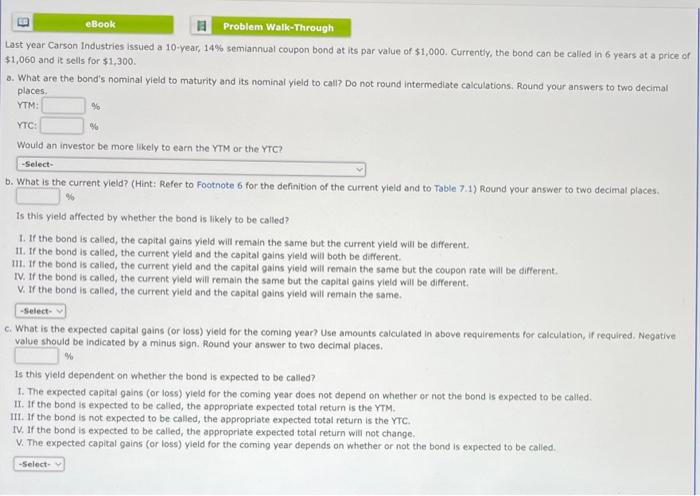
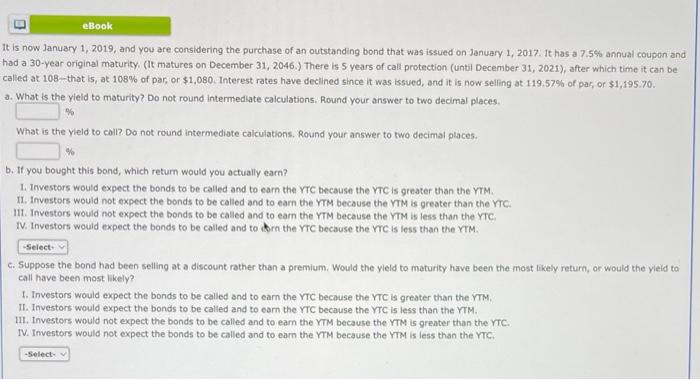
eBook # Problem Walk-Through Last year Carson Industries issued a 10-year, 14% semiannual coupon bond at its par value of $1,000. Currently, the bond can be called in 6 years at a price of $1,060 and it sells for $1,300. 2. What are the bond's nominal yield to maturity and its nominal yield to call? Do not round intermediate calculations. Round your answers to two decimal places YTM % YTC: 90 Would an investor be more likely to earn the YTM or the YTC? -Select- b. What is the current yield? (Hint: Refer to Footnote 6 for the definition of the current yield and to Table 7.1) Round your answer to two decimal places. Is this yield affected by whether the bond is likely to be called? 1. If the bond is called, the capital gains yield will remain the same but the current yield will be different. 11. If the bond is called, the current yield and the capital gains yield will both be different. m. If the bond is called the current yield and the capital gains yield will remain the same but the coupon rate will be different IV. If the bond is called the current yield will remain the same but the capital gains yield will be different. V. If the bond is called, the current yield and the capital gains yield will remain the same. -Select- c. What is the expected capital gains (or loss) yield for the coming year? Use amounts calculated in above requirements for calculation, If required. Negative value should be indicated by a minus sign. Round your answer to two decimal places. % Is this yield dependent on whether the bond is expected to be called? 1. The expected capital gains (or loss) yield for the coming year does not depend on whether or not the bond is expected to be called 11. If the bond is expected to be called, the appropriate expected total return is the YTM III. If the bond is not expected to be called, the appropriate expected total return is the YTC. IV. If the bond is expected to be called, the appropriate expected total return will not change, V. The expected capital gains (or loss) Vield for the coming year depends on whether or not the bond is expected to be called -Select- eBook It is now January 1, 2019, and you are considering the purchase of an outstanding bond that was issued on January 1, 2017. It has a 7.5% annual coupon and had a 30-year original maturity. (It matures on December 31, 2046.) There is 5 years of call protection (until December 31, 2021), after which time it can be called at 108-that is, at 108% of par, or $1,080. Interest rates have declined since it was issued, and it is now selling at 119.57% of par, or $1,195.70. 3. What is the yield to maturity? Do not round Intermediate calculations. Round your answer to two decimal places. What is the yield to coll? Do not round intermediate calculations. Round your answer to two decimal places b. If you bought this bond, which return would you actually earn? 1. Investors would expect the bonds to be called and to earn the YTC because the YTC is greater than the YTM II. Investors would not expect the bonds to be called and to earn the YTM because the YTM is greater than the YTC. 111. Investors would not expect the bonds to be called and to earn the YTM because the YTM is less than the YTC. IV. Investors would expect the bonds to be called and to do the YTC because the YTC is less than the YTM -Select c. Suppose the bond had been selling at a discount rather than a premium. Would the yield to maturity have been the most likely return, or would the yield to call have been most likely? 1. Investors would expect the bonds to be called and to earn the YTC because the YTC is greater than the YTM II. Investors would expect the bonds to be called and to earn the YTC because the YTC is less than the YTM III. Investors would not expect the bonds to be called and to eam the YTM because the YTM is greater than the YTC. IV. Investors would not expect the bonds to be called and to earn the YTM because the YTM is less than the YTC. -Select
Step by Step Solution
There are 3 Steps involved in it

Get step-by-step solutions from verified subject matter experts
 Study Help