



Question: eBook Show Me How Perpetual Inventory Using LIFO Beginning inventory, purchases, and sales data for prepaid cell phones for May are as follows: Inventory Purchases
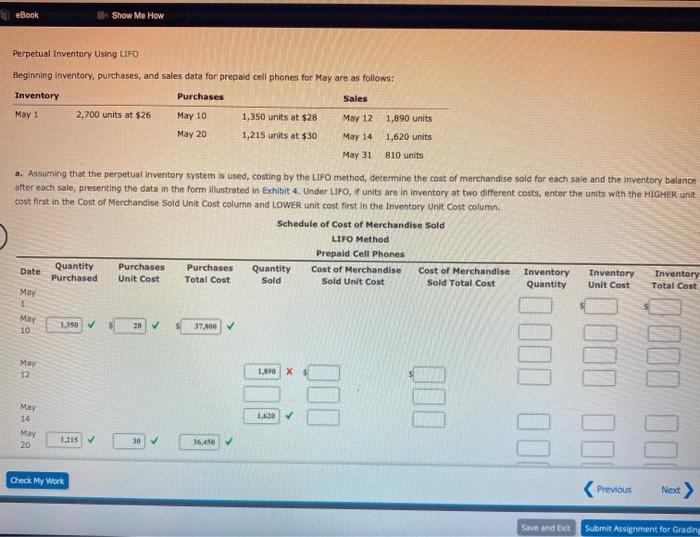
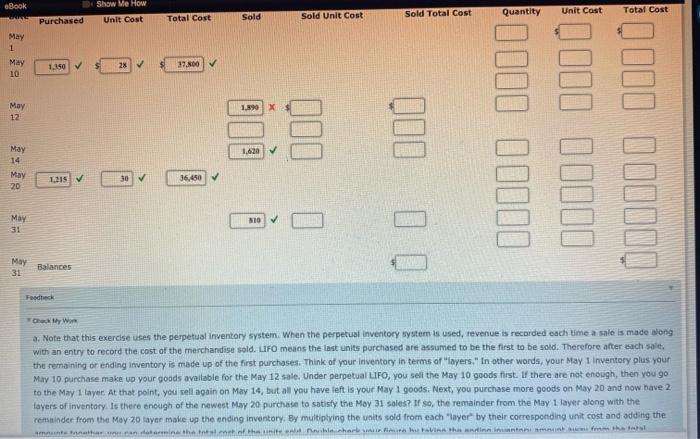
eBook Show Me How Perpetual Inventory Using LIFO Beginning inventory, purchases, and sales data for prepaid cell phones for May are as follows: Inventory Purchases Sales May 1 2,700 units at $26 May 10 1,350 units at $28 May 12 1,890 units May 20 1,215 units at $30 May 14 1,620 units May 31 810 units a. Assuming that the perpetual Inventory system is used, costing by the LIFO method, determine the cost of merchandise sold for each sale and the inventory balance after each sale, presenting the data in the form Illustrated in Exhibit 4. Under LIFO, units are in inventory at two different costs, enter the units with the HIGHER unit cost first in the Cost of Merchandise Sold Unit Cost column and LOWER unit cost first in the Inventory Unit Cost column Schedule of Cost of Merchandise Sold LIFO Method Prepaid Cell Phones Quantity Purchases Purchases Quantity Cost of Merchandise Cost of Merchandise Date Inventory Inventory Inventory Purchased Unit Cost Total Cost Sold Sold Unit Cost Sold Total Cost Quantity Unit Cost Total Cost May 1 May 10 1.350 20 37,00 May 12 1.890 X 0101 00 Wood OO May 1,420 MY 1.215 20 30 36,450 Check My Work Save and Submit Assignment for Grading eBook Show Me How Unit Cost Sold Quantity Sold Total Cost Unit Cost Total Cost Total Cost Purchased Sold Unit Cost May 1 May 10 1.150 28 37.00 May 12 1.890 X 0011 11110 10000 10000 1.630 May 14 May 20 1215 30 36,450 May 31 310 I MAY Balances 31 Fedteck why w 3. Note that this exercise uses the perpetual inventory system. When the perpetual inventory system is used, revenue is recorded each time a sale is made wong with an entry to record the cost of the merchandise sold. LIFO means the last units purchased are assumed to be the first to be sold. Therefore after each sale, the remaining or ending inventory is made up of the first purchases. Think of your inventory in terms of "layers." In other words, your May 1 inventory plus your May 10 purchase make up your goods available for the May 12 sale. Under perpetual LIFO, you sell the May 10 goods first. If there are not enough, then you go to the May 1 layer. At that point, you sell again on May 14, but all you have left is your May 1 goods. Next, you purchase more goods on May 20 and now have 2 layers of inventory. Is there enough of the newest May 20 purchase to satisfy the May 31 sales? If so, the remainder from the May 1 layer along with the remainder from the May 20 layer make up the ending inventory. By multiplying the units sold from each layer" by their corresponding unit cost and adding the te that there that time in the
Step by Step Solution
There are 3 Steps involved in it

Get step-by-step solutions from verified subject matter experts