







Question: ECollogriboard AP PHYSICS 1 Test Booklet Unit 4 Progress Check: FRQ 4 Show all your work for each part of the question. The parts within
ECollogriboard
AP PHYSICS
Test Booklet
Unit Progress Check: FRQ
Show all your work for each part of the question. The parts within the question may not have equal weight.
Note: Figure not uravil tw aven.
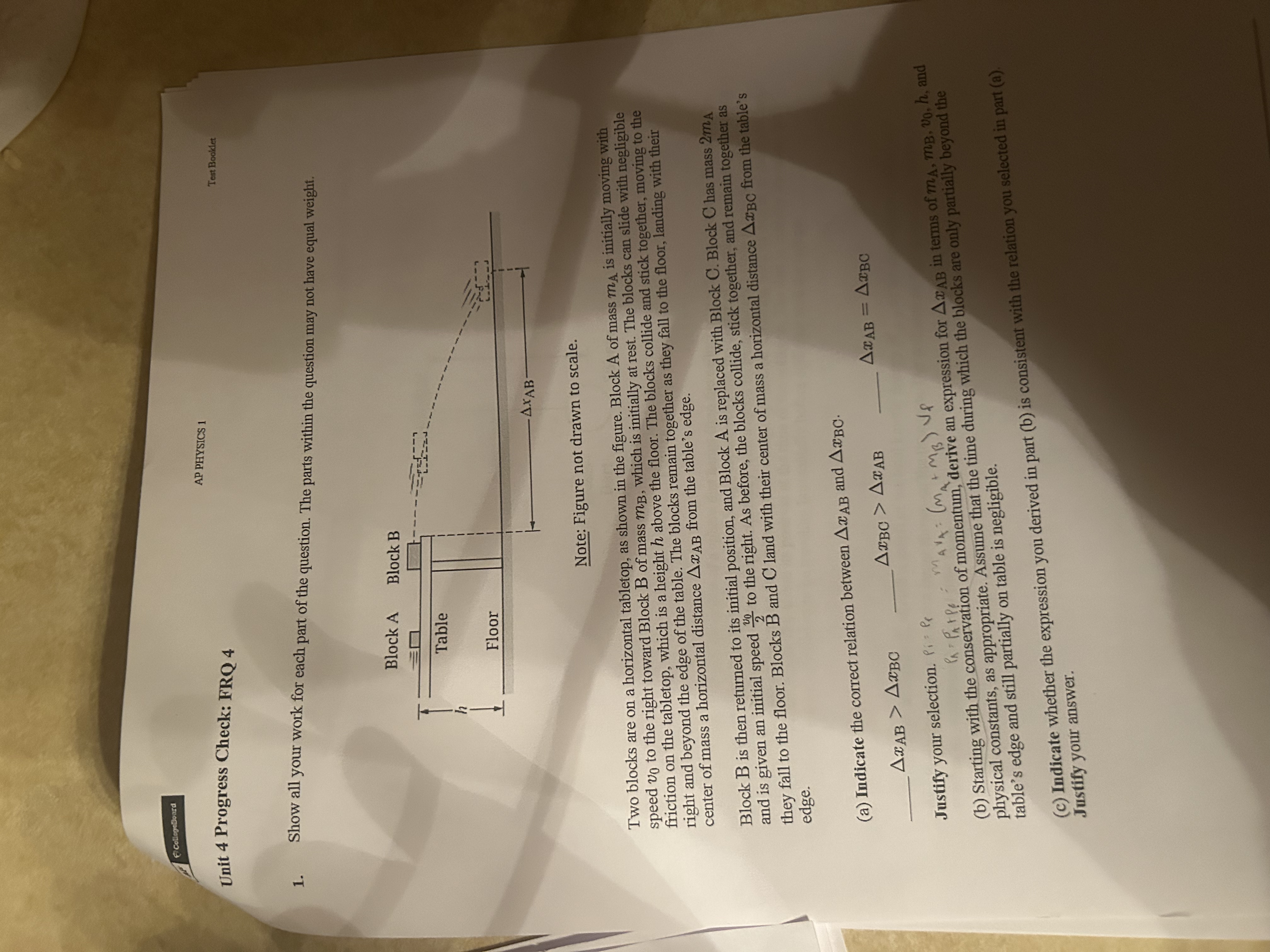
Two blocks are on a horizontal tabletop, as shown in the figure. Block A of mass is initially moving with speed to the right toward Block of mass which is initially at rest. The blocks can slide with negligible friction on the tabletop, which is a height above the floor. The blocks collide and stick together, moving to the right and beyond the edge of the table. The blocks remain together as they fall to the floor, landing with their center of mass a horizontal distance from the table's edge.
Block B is then returned to its initial position, and Block A is replaced with Block C Block C has mass and is given an initial speed to the right. As before, the blocks collide, stick together, and remain together as they fall to the floor. Blocks and land with their center of mass a horizontal distance from the table's edge.
a Indicate the correct relation between and
Indicate the correct relation between
Justify your selection.
::
conservation momentum, derive expression for terms and
b Starting with the conservation of momentum, derive an exps which the blocks are only partially beyond the physical constants, as appropriate. Assume that is negligible. table's edge and still partially on table is ngigite.
c Indicate whether the expression you derived in part b is consistent with the relation you selected in part a Justify your answer.
Step by Step Solution
There are 3 Steps involved in it
1 Expert Approved Answer
Step: 1 Unlock

Question Has Been Solved by an Expert!
Get step-by-step solutions from verified subject matter experts
Step: 2 Unlock
Step: 3 Unlock
 Study Help