







Question: Econ 200, please show me how to work through problems and explain. HOMEWORK #4: ELASTICITY & UTILITY 1. Suppose that 500 units of a good
Econ 200, please show me how to work through problems and explain.
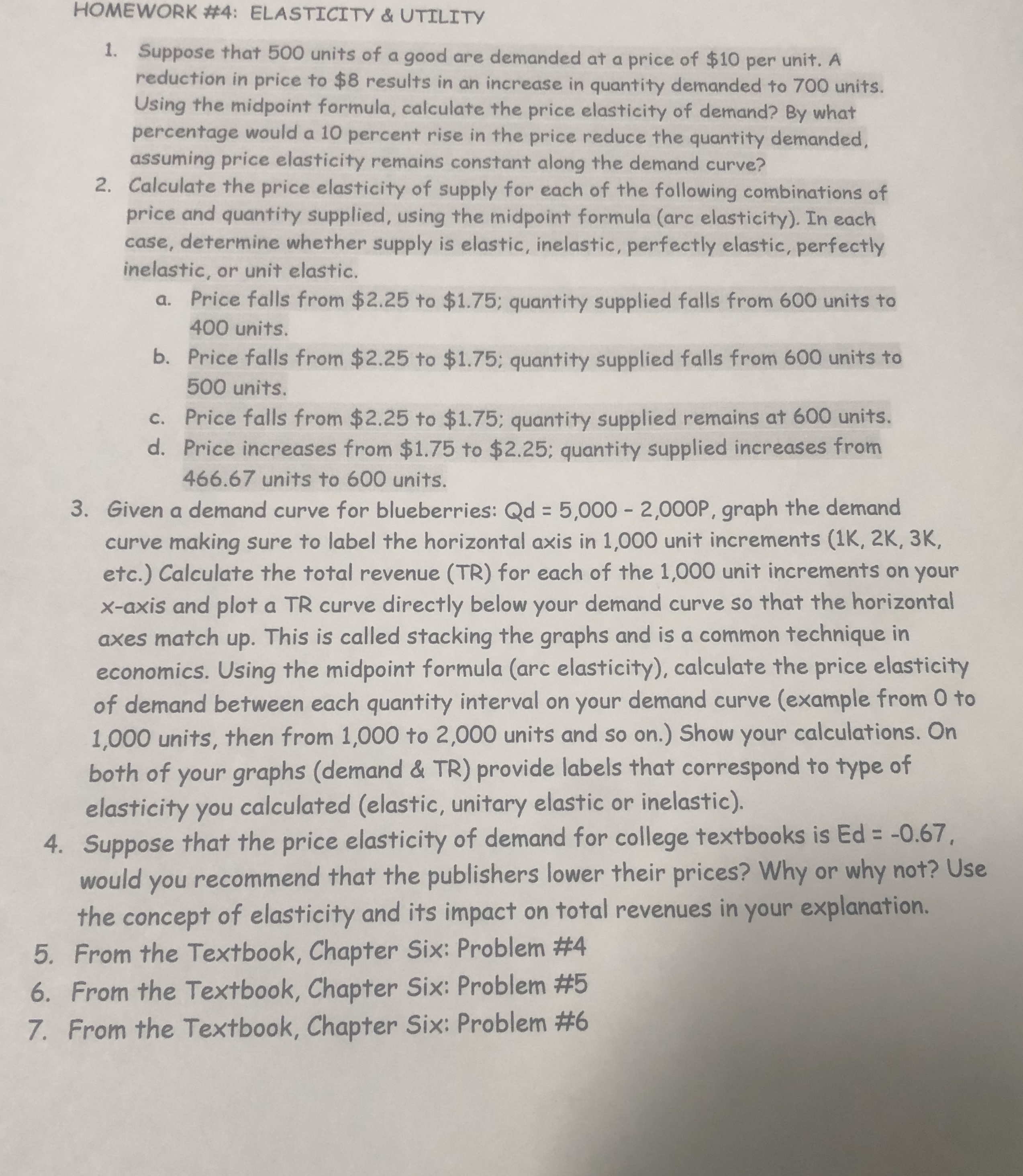
HOMEWORK #4: ELASTICITY & UTILITY 1. Suppose that 500 units of a good are demanded at a price of $10 per unit. A reduction in price to $8 results in an increase in quantity demanded to 700 units. Using the midpoint formula, calculate the price elasticity of demand? By what percentage would a 10 percent rise in the price reduce the quantity demanded, assuming price elasticity remains constant along the demand curve? 2. Calculate the price elasticity of supply for each of the following combinations of price and quantity supplied, using the midpoint formula (arc elasticity). In each case, determine whether supply is elastic, inelastic, perfectly elastic, perfectly inelastic, or unit elastic. a. Price falls from $2.25 to $1.75; quantity supplied falls from 600 units to 400 units. b. Price falls from $2.25 to $1.75; quantity supplied falls from 600 units to 500 units. c. Price falls from $2.25 to $1.75; quantity supplied remains at 600 units. d. Price increases from $1.75 to $2.25: quantity supplied increases from 466.67 units to 600 units. 3. Given a demand curve for blueberries: Qd = 5,000 - 2,000P, graph the demand curve making sure to label the horizontal axis in 1,000 unit increments (1K, 2K, 3K, etc.) Calculate the total revenue (TR) for each of the 1,000 unit increments on your x-axis and plot a TR curve directly below your demand curve so that the horizontal axes match up. This is called stacking the graphs and is a common technique in economics. Using the midpoint formula (arc elasticity), calculate the price elasticity of demand between each quantity interval on your demand curve (example from 0 to 1,000 units, then from 1,000 to 2,000 units and so on.) Show your calculations. On both of your graphs (demand & TR) provide labels that correspond to type of elasticity you calculated (elastic, unitary elastic or inelastic). 4. Suppose that the price elasticity of demand for college textbooks is Ed = -0.67, would you recommend that the publishers lower their prices? Why or why not? Use the concept of elasticity and its impact on total revenues in your explanation. 5. From the Textbook, Chapter Six: Problem #4 6. From the Textbook, Chapter Six: Problem #5 7. From the Textbook, Chapter Six: Problem #6
Step by Step Solution
There are 3 Steps involved in it

Get step-by-step solutions from verified subject matter experts
 Study Help